
P035
Custom Silk Product Development From Brief to Sample Discussion
We organise custom silk concept work as a practical product-development exchange for procurement teams. Begin with the article being developed, then outline its material direction, components, construction, visual choices, information layers, packout, and the particular product question for review. This resource does not confirm sample availability, capacity, MOQ, price, timing, production release, testing outcomes, certification, or final approval.
Published by China EverBen Silks Reviewed by Mark Liu
Turn a specification into an ordered buyer decision path
Identify the article, open construction or artwork question, sample stage, approval owner, and next review.
Start With the Finished Silk Article Your Customer Will Receive
We begin custom silk development with the defined item, not a broad request for silk. A pillowcase pair, a bed-linen item, a personal accessory, or a presentation-led set has its own customer use, surfaces, components, and packout questions. Naming the article early makes every later material, artwork, construction, and presentation conversation more useful.
Describe the Product in Customer-Unit Language
The buyer should say what one customer or recipient receives
A single item, pair, set, and gift arrangement are different products
Tell us which customer unit the business wants to develop: for example, a single pillowcase, a paired sleep product, a sheet or duvet-cover piece, a personal accessory, or a coordinated presentation. The sale unit frames the discussion. It tells product, brand, packaging, and procurement colleagues which finished offer they are examining instead of leaving each person to imagine a different result from the same category name.
Add the intended B2B setting in ordinary words. You may be building a beauty-led retail range, a bedding collection, a hotel or spa programme, a corporate recognition gift, or an accessory assortment. This context helps us understand why a particular detail matters. A sleep mask for a travel gift moment may raise a different packout question from a sleep mask sold as an individual beauty item, even when both begin with a similar shape.
Keep the first description specific but not overburdened. You do not need a complete technical document before opening a development conversation. State the article, the customer or business use, the visible feature your team is considering, and what you need to decide next. We can then discuss the named product instead of treating a broad category image as an instruction for an unknown assortment.
Separate the Main Silk Item From Supporting Presentation Pieces
Cards, pouches, sleeves, and cartons should not disappear inside a product name
Each supporting piece needs a stated relationship to the textile article
A custom silk article may be accompanied by a card, care insert, pouch, sleeve, tissue, carton, or other presentation layer. These pieces can be commercially important, but they are not automatically part of the textile specification. Identify what your customer will touch, see, open, or keep. This allows the buyer team to decide whether a question belongs to the silk product itself or to the way the business intends to present it.
For example, a pillowcase may be the main product, while an outer sleeve carries product information. A sleep mask may be the main product, while a pouch creates a gift moment. A scrunchie may sit on a backing card, and a bedding set may have an outer package that communicates the collection. Naming these relationships early stops a visual reference from being treated as though every printed or branded feature belongs directly on the silk surface.
When you send an inquiry, state which pieces are essential to the first discussion and which remain exploratory. We keep the exchange centred on the article your business wants to develop; your company continues to decide its brand language, customer information, and presentation choices. That is clearer than attaching several images without explaining whether they show the product, the package, or a general retail mood.
Name the Customer Experience the Article Is Meant to Support
Use occasion and channel to make the product brief more practical
The intended moment helps the team prioritize product details
A custom silk product should be described in the setting where the customer will encounter it. A pillowcase may be part of a beauty ritual, premium bedding offer, or gift programme. A sleep mask may be a travel, wellness, or event item. A bonnet or scrunchie may sit within a hair-care range. By stating the customer experience, the buyer team can identify which visible features, packout decisions, or information questions deserve attention first.
Avoid assuming that a market reference settles the product choice. A competitor listing may show a color mood, a package style, or a customer use, but your business still needs to name the article it wants to discuss. Tell us what you want the reference to explain. Perhaps it shows a folded presentation, a restrained color family, a gift relationship, or a particular customer moment. That focused explanation gives the development discussion a useful starting point.
The customer experience also helps your team decide who should contribute. Product colleagues may focus on construction, brand colleagues on visual direction, and procurement on the business brief. We do not infer final requirements from the occasion alone. We use the context you provide to keep the conversation tied to the custom silk product your organization is considering.
Build a Custom Silk Brief Around the Buyer Question That Matters Most
A good development brief does not pretend every choice is complete. It identifies what your team has chosen, what still needs consideration, and which question is holding up the next decision. We would rather receive a direct buying question than a lengthy description built from assumptions about materials, construction, price, availability, or timing.
State the First Decision Your Team Needs to Make
A focused question makes the next discussion easier to organize
Name the issue that is stopping product progress
Begin with the decision that matters now. You may need to decide whether a pillowcase is a single unit or a pair, whether a silk face and reverse should be discussed separately, whether a sleep mask has a fixed or adjustable relationship, whether a scrunchie belongs in a set, or whether a package layer should carry customer information. A specific question gives the conversation direction and prevents a custom product brief from becoming a list of unrelated wishes.
Explain why the decision matters to your business. It may affect assortment placement, customer presentation, a brand story, an internal product review, or the way a retailer will receive the item. This does not require confidential strategy. A concise commercial reason helps us understand the buyer's perspective while keeping the discussion based on the finished silk article rather than a generic feature list.
If two alternatives remain open, name both without forcing a premature choice. Explain the two directions and the information needed to distinguish them before your buyer group chooses one. This is more useful than presenting one option as settled and later discovering that another colleague had been planning a different article or sale unit.
Distinguish Selected Details From Questions Still Under Review
Clear open points reduce avoidable development loops
Let the supplier see where the buyer needs discussion rather than guesswork
A brief becomes easier to use when it separates selected details from questions still under review. You may know the product family, intended market, basic color direction, and selling unit, while still considering material wording, a visible edge, a print placement, a packout relationship, or a customer-information layer. State that difference plainly. It gives your team a common understanding of where work remains.
Open points are not a weakness in an early custom silk conversation. They are the reason a buyer needs a product discussion. What creates confusion is leaving them hidden inside an image, a category label, or an unlabeled attachment. A direct note such as the team has selected a pillowcase pair concept and needs to discuss the opening and outer presentation is more actionable than several incomplete pictures sent without a question.
Keep the list of open points proportionate to the stage of your work. A first inquiry may focus on one or two questions. Later written communication can address more detail as the project develops. We do not fill gaps with invented specifications or commercial terms. We respond to the silk product question your buyer team presents and identify where further information would help the next discussion.
Use References to Clarify a Feature Rather Than Replace the Brief
A swatch, photograph, drawing, and sample image each have a limited purpose
Tell us what you want a reference to show
References can help a custom silk discussion when their purpose is clear. A swatch may explain a color family, a drawing may show dimensions or a component relationship, a photograph may show a visual direction, and a pack image may show an opening or presentation moment. Attach only the material needed for the question your team is asking. This makes it easier to understand what the reference supports and what it does not.
Do not assume a reference establishes material composition, construction, performance, certification, rights ownership, market approval, or commercial conditions. A competitor image may be useful for discussing a customer-facing mood, yet it is not your finished product definition. A product photograph may suggest an edge treatment, yet it may not show the opening, reverse, dimensions, or package information your team needs to discuss.
When you send a file, add one sentence explaining its role. For example, say that a photograph is being used to discuss a calm folded presentation, a drawing is being used to clarify the visible panel, or a swatch is being used to identify a color direction. That discipline helps your development conversation remain tied to the article and the decision your business needs to make.
Define Silk Material and Surface Questions for the Finished Product
Silk should be discussed as part of a finished product, not as a stand-alone label. We ask buyers to identify the surface the customer will see or use, the supporting components that belong with it, and the product question that needs attention. This creates a more useful development brief without making an unsupported statement about availability, performance, or a final specification.
Identify the Customer-Facing Silk Surface
A visible face, reverse, border, and support layer may need different questions
Describe the area of the article the buyer means
Start by naming the exact portion of the item under discussion. A pillowcase may involve its sleeping face, reverse, edge, opening, or label placement; a bedding article may require attention to a particular panel or sham. For a hair or sleep accessory, identify the visible silk body and any supporting part. This direct description stops a generic textile label from obscuring the feature the customer will see or touch.
The product surface matters because it connects material direction to the intended customer experience. A buyer can explain whether the question concerns the visible side, an interior relationship, a trim, a closure area, or a component included with the selling unit. Product and brand colleagues can then review the same part of the article rather than apply one reference image to several unrelated surfaces.
Use buyer language your team understands. You do not need to guess technical terminology to begin. A clear starting statement might identify the pillowcase’s sleeping panel and the edge that frames it. We can discuss that named article while unknown performance, availability, commercial, and technical terms stay for project-specific written conversation.
Keep Supporting Components Visible in the Development Brief
A finished article can include non-silk elements with their own purpose
Separate the textile question from the component relationship
A custom silk product can include more than a silk surface. A sleep mask may have a strap or support component, a bonnet may have a tie or gathered opening, a scrunchie may contain an elastic relationship, and a gift unit may include a pouch or card. Do not let those elements disappear inside a broad product name. Identify them so the team knows which question applies to the textile and which applies to another part of the finished article.
This is especially important when a product image shows only the most visible side. A buyer may like the mood of a photograph while still needing to discuss how the article opens, gathers, closes, is identified, or is presented. The development brief should say which component is known, which component needs discussion, and how it relates to the customer unit. That creates a more useful B2B conversation than assuming an image resolves every physical detail.
We do not infer component materials, construction, or performance from an accessory category. Bring the specific product point that requires discussion, together with any reference that helps explain it. We can keep the exchange grounded in the named silk article while your organization decides which product and business requirements should move forward.
Use Material Vocabulary Without Making Unsupported Product Claims
A buyer can ask a clear question without turning a term into a promise
Keep product language connected to the actual article
Material vocabulary can help a team frame a product conversation, but it should not become a shortcut for unverified claims. Begin with the actual article—perhaps a pillowcase, a bed-linen component, an eye mask, or a hair accessory—and explain how the textile question applies to it. The discussion may concern a visible surface, a hand-feel direction, a colour relationship, or the connection between the main article and a supporting component.
Avoid writing broad outcomes into an early brief. A material term does not settle product performance, customer benefits, care results, testing, certification, market acceptance, or legal wording. Those issues require the appropriate project information and buyer review. We focus on the product direction that your team can describe today, then keep the remaining questions visible rather than fill them with a claim that the chosen article may not support.
Clear language benefits purchasing as well as product development. It allows a buyer to say which silk feature is central to the range and what the team needs to compare or discuss next. That makes an RFQ more meaningful and helps colleagues avoid treating a material label, a marketplace phrase, or an image as a substitute for the actual product requirements they intend to consider.
Plan Construction, Fit, and Measurement Questions Before Product Review
Construction details shape the product a customer receives. We encourage buyers to identify the opening, edge, closure, strap, tie, elastic, seam, dimension, or bedding relationship that needs a focused discussion. A specific question does not establish a final tolerance, sample result, performance outcome, or production arrangement; it makes the development conversation more accurate.
Describe the Functional Feature Your Customer Will Notice
Openings, edges, and closures should be tied to a named article
Explain how the feature relates to customer use
A pillowcase opening, a visible flange, a duvet closure, a sleep-mask strap, a bonnet tie, or a scrunchie profile can all affect how a customer understands the item. Name the feature and describe what your team wants to consider about it. You may be deciding how an article looks in a retail presentation, how a component sits within a customer unit, or what visual relationship makes sense for the product direction.
Avoid asking for a generic premium construction without explaining the article. That phrase can mean different things to a pillowcase buyer, bedding buyer, accessory buyer, or gift-programme buyer. A clear brief names the finished product, the feature, and the customer moment. It gives product colleagues a shared basis for discussion and helps purchasing keep the inquiry focused on a physical question rather than a vague expectation.
If the feature is still open, state the alternatives your team is considering. You might be comparing two opening directions or deciding whether a visible edge is part of the product story. We can discuss the product question as you describe it. We do not treat a general visual preference as a complete construction specification, a test result, or a commitment about a final outcome.
Use Measurement Questions to Define the Buyer Conversation
Dimensions need a product and a point of reference
Explain whether fit, presentation, or customer compatibility is the issue
When dimensions matter, identify the article and the reason your team is asking. A pillowcase may relate to an insert context, a fitted sheet to a mattress context, a duvet cover to an intended bedding component, a sleep mask to a facial coverage question, and a bonnet to a head or tie relationship. This gives measurement language a business and product purpose without asking a supplier to guess at the unit your customer will use.
Do not assume that a product name carries one universal measurement basis. Buyers may use different markets, selling units, or customer expectations. State the information you have and the question you need to consider. A clear note can distinguish a desired finished size, a reference item, an internal range decision, or a customer presentation issue. That is more useful than attaching a number without explaining what it relates to.
We do not publish universal tolerances or product-fit guarantees through a general development resource. Those matters need the actual article and written project discussion. We can help you organize a measurement question around the product, customer use, and next decision so your team is better prepared to continue the conversation.
Place Sewing and Assembly Details Within the Product Story
A seam or gathered feature should be discussed where the customer encounters it
Keep visible assembly choices separate from unknown performance claims
Sewing and assembly details can influence how a silk product looks and is presented. A buyer might want to review a pillowcase perimeter, a mask edge, a bonnet-panel relationship, a scrunchie gathering, or the framing of a bedding piece. Name the location and its visible purpose. This allows the team to consider the feature in the context of the article instead of treating every seam as a generic manufacturing request.
A visual reference can help explain a desired relationship, but it should be paired with a written question. Say whether the reference is being used to discuss line placement, apparent proportion, a gathered look, a closing area, or another customer-facing detail. This keeps the product brief clear when several colleagues contribute images, drawings, and notes to the same custom silk range.
We do not imply durability, comfort, suitability, or other outcomes from a general assembly conversation. The buyer should describe the physical question that matters to the product. We can then maintain a focused discussion around the named silk article while the organization decides how it will assess technical, commercial, and customer requirements for its own programme.
Bring Artwork, Colour, and Visual Direction Into the Silk Product Brief
Visual direction should make a custom silk article easier to discuss, not turn an early image into an implied final instruction. We invite buyers to identify the surface seen by the customer, the purpose of the visual direction, the way colour or print relates to the article, and the next point for review. Product and brand colleagues can then use the same vocabulary while unknown outcomes remain for written project discussion.
Explain the Role of Each Artwork or Colour Reference
A file should answer one defined visual question
Tell us whether it shows mood, placement, palette, or product hierarchy
An artwork file, print image, swatch, mood board, product photograph, or package layout can be useful when the buyer explains its role. A swatch may indicate a colour family. An image may show how a silk pillowcase appears within a range. A drawing may show the area proposed for a motif. Add one sentence identifying the exact feature the reference should illuminate, so the team does not assume it answers unrelated construction or commercial questions.
Color and print can operate differently across a collection. A duvet cover may carry a stronger visual statement than a pillowcase, while a sleep mask or scrunchie may support the same color family in a smaller form. Identify the article and visible surface before asking for a discussion. This gives your team a way to preserve collection coherence without treating every product as a copy of one visual reference.
We do not treat a general color or artwork reference as proof of exact shade, material composition, colorfastness, market acceptance, or a finished production result. Your brief should describe the creative direction your business wants to explore. We can then keep the B2B conversation tied to the product and the buyer question rather than extend a reference beyond its purpose.
Connect Print Placement to the Finished Silk Article
A motif needs a named product area and a customer-facing reason
Placement changes when the item folds, gathers, opens, or pairs
Print placement is meaningful only when it is connected to a product surface. A pillowcase face, bedding panel, mask front, bonnet crown, scrunchie shell, pouch, or outer card may each present a motif differently. Tell us where the buyer is considering the visual and how the customer is expected to encounter it. This makes the discussion more specific than saying that a product should use a certain print.
Think about the product as the customer will see it. A folded pillowcase may show one area; a sleep mask may show another; a scrunchie may gather and change the appearance of a motif. An image can help explain the intended look, but the buyer should identify the feature that remains open. That allows brand and product colleagues to discuss the same question without assuming that a flat reference defines every finished orientation.
We do not promise reproduction, print method, color result, or production outcome from an early visual conversation. We focus on the placement and article your team wants to consider. A clear visual brief helps you prepare the right next question, while project-specific written discussion is used for any further technical or commercial matters.
Keep Brand Elements Distinct From Product Details
A logo, product name, and package message may belong on different pieces
Do not let a broad branding request obscure the silk article
A custom programme may use a logo, monogram, collection name, product name, care text, card message, or package visual. These elements can be important to customer experience, yet each belongs to a specific part of the selling unit. State whether the buyer is discussing the silk surface, attached information, pouch, sleeve, card, or carton. This prevents a broad request for branding from becoming unclear product instruction.
Your own brand team should control its artwork and customer-facing language. We can discuss where buyer-provided visual direction relates to the article and presentation you describe. We do not clear rights, authorize brand use, approve marketing claims, or determine legal sufficiency through a product-development resource. That boundary helps the supplier conversation remain practical and protects your organization from treating early discussion as a final brand decision.
When a brand element matters to the next step, say why. It may help a buyer compare package hierarchy, identify a gift moment, separate product families, or understand a color relationship. A concise purpose makes the development brief more useful than a folder of unlabelled assets and helps your team keep the silk product at the center of the conversation.
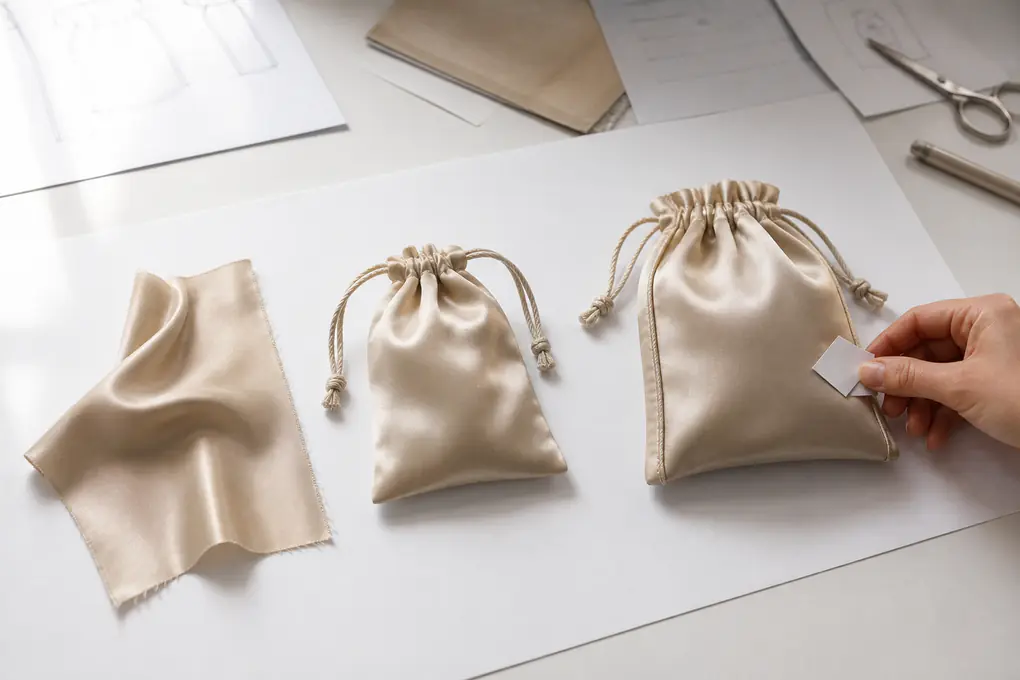
Design Labels, Care Information, and Packout Around the Customer Unit
The product a customer receives may include more than textile. Labels, care information, cards, sleeves, pouches, and cartons create an information and presentation layer around the silk item. We ask buyers to distinguish these pieces early so that a product discussion does not confuse customer messaging, package decisions, and the physical silk article.
Place Product Information With the Right Part of the Selling Unit
A sewn label, card, and outer package should have different stated purposes
Explain what the buyer wants each element to communicate
Identify where your team expects product information to appear. A sewn label may relate to the textile article; a card may support a retail or gift presentation; a care insert may be placed with a set; an outer sleeve may carry customer-facing product identity. Naming the location keeps a product-information question from being treated as though all wording belongs on the silk surface.
Explain the audience and purpose for each item. A customer may see a package before opening it, read an insert after purchase, or encounter a label during use. These are distinct moments. When a buyer describes the intended customer experience, brand and product colleagues can decide which information layer they need to review before adding more detail to a development discussion.
A general inquiry does not provide legal advice, regulatory clearance, retailer clearance, or a final market claim. Your organization should review customer language through its own qualified process. We can consider the silk article and its packout context as you describe them, helping the buyer keep the product, supporting information, and next product point distinct.
Plan Packout From the Product Outward
The textile article should remain visible inside a package discussion
Choose package layers that make sense for the intended customer moment
Start with the finished silk article, then describe the supporting presentation pieces your team is considering. One pillowcase pair might sit in a sleeve; a travel eye mask might be presented with a drawstring bag; a scrunchie grouping might use a backing card; and a corporate-gift set may include several layers. This order helps the buyer avoid designing a package before the sale unit and product relationship are clear.
A package reference can be useful if it explains one idea, such as a folded presentation, a gift opening sequence, a color hierarchy, or a product-information location. State that purpose in the brief. Do not treat a marketplace package image as a complete instruction for your programme. Your brand, customer, channel, and finished article may be different, and the supplier conversation needs to reflect the product you intend to buy.
Keep packout questions connected to buyer decisions. You may need to ask how to frame a silk article for a retail range, how a presentation layer relates to a gift concept, or what product information must be considered before internal review. We can discuss the defined question without assuming shipping, logistics, cost, production, or delivery terms that the buyer has not supplied.
Separate Customer Presentation From Outer Handling Decisions
A gift experience and an operational instruction are not the same subject
Keep each conversation with the people who need to consider it
Customer presentation concerns what a buyer, recipient, or shopper sees and experiences: the silk article, its fold, a card, pouch, sleeve, or gift arrangement. Outer handling may concern activities your own operations team manages after the commercial product brief is defined. These topics can be related, but they should not be collapsed into one vague package request that nobody can evaluate clearly.
When you describe a packout concept, say whether the question is about the customer unit, an information layer, a gift relationship, or an internal handling need. This helps product and packaging colleagues bring the right input to the development discussion. It also lets us stay focused on the silk article and presentation choice rather than infer an operational service or logistics arrangement from an early product reference.
A clear division protects the buyer calendar as well. Brand teams can review customer presentation, operations teams can manage their own activities, and procurement can prepare a focused commercial conversation. We do not promise carton performance, warehouse handling, shipping, or delivery. We help you frame the product and packout question your team needs to discuss next.
Set a Focused Purpose for Every Custom Silk Sample Discussion
A sample discussion is most useful when the buyer defines what the team wants to consider about one silk article. We help you turn a broad request into a focused product question involving appearance, dimensions, construction, artwork, or presentation. We do not state sample availability, timing, cost, production release, test results, or final approval through this buyer guidance.
Choose One Primary Product Question for the Sample Conversation
A defined purpose makes buyer feedback more useful
Avoid asking one visual reference to settle every issue
Before asking about a sample, decide which product question the sample should help your team explore. It might concern a sleep mask silhouette, a pillowcase surface, a relationship between bed-linen pieces, a bonnet tie, a scrunchie profile, print placement, or a packout idea. A stated purpose keeps the exchange linked to one finished article and prevents an early observation from becoming a blanket decision for the whole programme.
Describe the customer context behind the question. A retail buyer may need to compare a product appearance in a range, while a hospitality team may need to consider the relationship of one article to a room programme. A gift buyer may be exploring an opening moment. This does not create an outcome claim. It helps the team understand why a particular product feature deserves attention before it advances to the next conversation.
If several questions matter, list them in order rather than attempting to resolve everything at once. You may begin with the article and visible construction, then follow with artwork or packout once the buyer has clearer direction. We can keep the B2B conversation coherent by responding to the product question you identify, while your organization decides how it will review the information.
Connect Buyer Feedback to the Feature Under Consideration
Feedback should name the product area and customer effect
A useful note explains what the team needs to revisit
When your team gives feedback, connect it to a specific feature. You may be considering an edge, opening, strap, gathered section, print location, product-information piece, or presentation relationship. Explain what the buyer noticed and why it matters to the intended customer experience. This makes feedback easier for product, brand, and purchasing colleagues to interpret than a general instruction to make the item more premium or more attractive.
Use an image or sketch only if it helps show the feature. Add a written note that identifies the relevant area. A picture of a pillowcase can show a fold or color mood, but it may not explain which side, edge, or package component the team wants to discuss. A short comment keeps the reference connected to the actual decision instead of allowing different colleagues to read different intentions into the same visual.
We do not treat buyer feedback as a complete production, test, commercial, or delivery instruction. The purpose is to help your team make the next product decision. A precise product comment can be brought into written project discussion, while your business keeps control over its technical evaluation, market requirements, and commercial terms.
Use the Result to Frame the Next Development Question
One conversation can clarify what needs attention next
Move forward with a question rather than an implied release
After a sample-related discussion, ask what your team needs to consider next. It may be a new question about a visible component, a color direction, a customer unit, a package relationship, or the information needed to continue commercial planning. Name that question clearly. This helps the buyer avoid treating an early visual response as though it confirms every physical or business detail connected to a custom silk product.
A useful internal note can be short: identify the article, the feature discussed, the buyer observation, and the next person or team that needs to consider it. Keep that note in the system your organization uses for its own product work. It gives your team continuity when several colleagues are involved and reduces the chance that an image, message, or meeting summary is remembered as a complete decision.
Bring the next question to us in direct language. We can discuss the defined article and the product point your team has identified. We do not promise that any exploration creates an available sample, production slot, delivery date, test outcome, or commercial arrangement. Clear questions keep the development dialogue valuable without overstating what it establishes.
Compare Silk Product References With a Buyer Question in Mind
Custom product development often uses swatches, samples, photographs, drawings, competitor references, and internal concept material. We encourage buyers to compare these items with a stated question rather than treat them as interchangeable proof. A defined comparison helps the team discuss a silk article, while each reference remains limited to the feature it actually shows.
Choose a Comparable Reference for One Product Feature
A reference should explain a visible or physical point
Do not ask a broad image to function as a complete specification
Choose the reference that most directly relates to the feature you want to discuss. A swatch may help explain a color family; a sketch may help identify a dimension or panel; a photograph may help show a visual mood; a package image may help describe a customer opening moment. State the feature in writing so the receiving team knows why the item was included in the custom silk brief.
A comparable reference is not automatically an instruction to reproduce another product. A competitor listing may help your team describe market context, but your customer, brand, channel, and article may be different. Use it to identify the one feature you want to consider, such as a product grouping, a color relationship, a fold, or a package mood. Then state the buyer question in the language of your own programme.
This approach makes comparisons productive without pretending that an image proves material, construction, rights, performance, price, availability, or a final outcome. We use the information you supply to understand the custom silk direction. Your business decides which references are appropriate to share and how the final product requirements will be reviewed.
Compare Like With Like Across Articles and Selling Units
A pillowcase, bedding component, and accessory should not be merged casually
Keep the customer unit visible when you evaluate visual ideas
A product comparison should match the article and sale unit your team is considering. One pillowcase, a paired offer, a bed-linen piece, a sleep item, a bonnet, and a scrunchie can share a colour family yet still require separate questions. Do not compare them as though one set of dimensions, construction, packout, or customer expectations applies to all. Name the article before asking what a reference should help the team determine.
The same discipline applies to collection work. A mood image can guide a range, while each item needs its own product brief. A duvet-cover panel may carry a visual statement differently from a pillowcase; an accessory may support the color direction through a smaller customer-facing surface. By keeping comparisons connected to the article, the buyer can protect collection coherence without flattening meaningful differences between finished products.
We can discuss a defined comparison in a B2B product conversation, but we do not infer the rest of the range from one reference. Tell us which silk article is involved, what the customer receives, and what your team is considering. That keeps the discussion useful and helps the buyer avoid a development path built on mismatched visual or product assumptions.
Turn Comparison Feedback Into a Clear Development Brief
A conclusion should identify the article and the next feature to discuss
Use plain language rather than a vague preference
After comparing references, write the conclusion as a product question. You may say that your team prefers the calmer color relationship of one image but needs to discuss the pillowcase edge separately, or that a gift presentation helps explain the intended customer moment while the pouch remains an open question. This turns a visual reaction into a useful development brief that other colleagues can read.
Do not use a comparison as a shortcut for claims about the finished item. A reference does not establish that the article will have a particular performance, certification, customer response, or commercial result. Keep the comparison focused on the appearance, component, presentation, or customer-use question your team actually wants to consider. This protects the quality of the product discussion and reduces avoidable assumptions.
We welcome comparisons that are explained clearly. Include the relevant image or description, identify the finished silk article, and name the decision that follows. That gives us a practical basis for continuing the conversation and lets your organization keep control of the final product, brand, quality, and commercial choices it needs to make.
Keep Open Product Choices Visible Before They Become Assumptions
Custom silk development becomes difficult when an unfinished choice quietly starts to sound final. We encourage buying teams to name what has been selected for the article and what still needs discussion. That distinction lets us address the right product question without turning an early image, message, or preference into an unsupported instruction for the finished item.
Separate Selected Features From Questions Still Under Discussion
A clear brief shows what the team is considering and what remains open
Do not let one familiar reference fill gaps in a custom silk article
Start by listing the features your team can describe with confidence: the finished article, the intended customer unit, the material direction under consideration, visible components, artwork concept, and presentation idea. Then make a second list of the points that are not yet settled. That simple separation helps everyone read the same brief. It prevents a colleague from assuming that a colour photograph, a folded sample, or a competing product image settles questions it was never meant to answer.
An open choice is not a weakness in a B2B inquiry. It is useful information when it is named plainly. Your team may still be considering a closure style, a printed area, an edge treatment, a label location, a set relationship, or a customer presentation detail. Say which question remains and why it matters to the finished silk article. We can respond to the issue you identify instead of guessing whether an unfinished visual direction should control construction, packaging, or customer information.
Keep the language tied to the article rather than to a broad product category. A pillowcase colour question is not automatically a bedding-set instruction; a sleep-mask presentation idea is not automatically a bonnet specification. When an unfinished point belongs only to one item, write that connection into the brief. This protects the custom product conversation from accidental carryover and gives purchasing colleagues a clearer basis for the next commercial question.
Give Each Missing Detail a Practical Question
One well-framed question is easier to discuss than a vague request for options
Explain what customer, brand, or product concern sits behind the question
Turn every important gap into a direct question. Rather than writing that a silk pillowcase should feel more premium, say which part of the customer experience your team wants to explore: the surface appearance, the closure impression, the presentation layer, or the relationship to a bedding collection. Rather than asking for a sleep mask to look better, identify whether the question concerns shape, visible stitching, strap treatment, print placement, or a gift-unit relationship. Precise questions create more useful product dialogue.
Give the receiving team enough context to understand why the answer matters. A brand colleague may be protecting a visual language, a product manager may be comparing customer units, and a purchaser may be preparing an inquiry that needs clear article boundaries. A brief sentence about the business purpose helps us understand the direction without requiring your organization to share confidential plans. It also reduces the chance that a feature is evaluated separately from the role it plays in the finished customer offering.
Keep separate questions separate. A material-surface discussion, a care-information discussion, and an outer-presentation discussion may influence one another, yet they deserve their own wording. Combining them into a single sentence can hide the point your team needs to resolve. We can work through the defined question for the named silk article while your colleagues decide how each answer fits their wider range, customer relationship, and commercial review.
Prevent One Article From Silently Directing Another
Collection consistency should not erase product-specific choices
Carry a colour story carefully across bedding and accessory articles
A collection may share a visual family, but each silk article remains a separate customer product. A printed pillowcase, a flat sheet, a sleep mask, and a scrunchie can support the same brand direction while having different surfaces, dimensions, components, and presentation needs. State when an idea belongs across a range and when it belongs only to one item. This gives your product and brand colleagues a way to preserve coherence without assuming that every selected feature repeats unchanged.
Be especially careful with references that show several items together. A styled bedding image can explain an atmosphere, yet it may not identify the precise construction or colour treatment your business wants for every component. A gift image can suggest a presentation moment, yet it may not establish what belongs inside each customer unit. Use the image to describe the intended impression, then write the article-specific question your team still needs to discuss with us.
If a decision changes, update the short brief for the affected silk article rather than relying on remembered conversation. Say what changed, what remains relevant, and what needs review next. This keeps a custom programme intelligible when product, brand, purchasing, and quality colleagues contribute at different moments. We do not treat an open point as a promise, approval, or commercial term. We help you keep the product question clear enough for a disciplined B2B discussion.
Bring Product, Brand, Quality, and Purchasing Colleagues Into the Right Silk Decisions
A well-prepared custom silk brief does not ask one person to answer every question. We help B2B teams structure a product conversation so the colleagues closest to the article, customer presentation, procurement question, and quality expectations can contribute in plain language. Each person can focus on the point they are best placed to consider.
Ask Product Colleagues to Describe the Finished Article
The product discussion starts with what the customer receives and uses
Construction, dimensions, components, and customer unit belong in the article brief
Product colleagues can give the development conversation its physical focus. Invite them to describe the silk article your organization wants to discuss: the customer unit, visible components, intended use, construction features under consideration, and any measurements or relationships the team wants to review. This does not require a complete technical package on day one. It does require a shared understanding that a pillowcase, an eye mask, a hair bonnet, a gathered hair accessory, and a bedding component are separate finished articles with their own questions.
Ask for a distinction between what the team has selected and what it wishes to explore. A product manager may know the customer unit and overall visual direction but still need a conversation about an opening, seam, gathered element, print area, or package relationship. Naming that boundary lets us discuss the real custom silk question. It is more useful than sending a category name with several unlabelled images and expecting each reader to reach the same conclusion.
Product input should remain close to the customer article. If an image is supplied, identify the feature it illustrates. If a dimension is mentioned, say which point on the article it refers to. If a set is involved, say what is included in the customer unit. These small clarifications allow purchasing and brand colleagues to work from the same foundation while preventing a development conversation from becoming a collection of disconnected assumptions.
Ask Brand Colleagues to Explain the Customer-Facing Direction
Visual language becomes useful when it is connected to a specific product surface
A mood, mark, colour family, and packout idea should each have a stated role
Brand colleagues can explain what the customer should notice about the finished offering. They may describe a colour family, a print concept, a level of visual restraint, a gift relationship, or the way several articles sit together in a range. Encourage them to connect that direction to the named silk product. A broad mood can guide a collection, but the product brief should say where the visual idea appears and what customer moment it is meant to support.
A logo, artwork file, sketch, colour reference, or retail image is most helpful when it comes with a short note. Tell us whether it illustrates print placement, a tonal relationship, a graphic scale, a folded presentation, or an outer sleeve concept. That explanation protects the buyer from treating a reference as a complete physical specification. It also gives us a focused question to discuss with the team rather than an instruction implied from another brand's product image.
Brand input should not be asked to settle every material or construction question. It can state the customer-facing direction while product and purchasing colleagues identify the information needed for the article and the commercial inquiry. This division keeps the custom silk conversation practical. We can discuss how the described visual direction relates to the article without claiming a final market result, customer response, or outcome that has not been independently established.
Ask Purchasing and Quality Colleagues to Frame the Business Questions
Commercial and quality questions should be stated directly rather than hidden in a visual brief
A clear inquiry lets the right colleague review the right issue
Purchasing colleagues can turn the agreed product description into a concise B2B inquiry. They can identify the article, intended customer unit, information already available, destination or market context if relevant, and the commercial questions the business needs to discuss. This is not an invitation to assume quantities, price, minimums, availability, production timing, shipping, or delivery. It is a way to make sure the request is about a clearly identified custom silk product rather than an undefined category.
Quality colleagues can contribute the questions their organization needs considered for the finished article. Ask them to name the feature, material statement, construction point, care-information question, or customer-use concern that needs review. We do not provide a testing result, certification, legal determination, retailer approval, or product approval through this guide. Clear quality input simply helps the buyer make sure the product discussion includes the topics the organization regards as important.
Bring these contributions together in one readable brief, then identify the next question for us. Product, brand, quality, and purchasing perspectives do not need to sound identical; they need to refer to the same article. When each colleague uses plain, article-specific language, the custom silk development conversation becomes easier to follow and less likely to create a mismatch between the product idea, customer story, and commercial request.
Prepare a Commercial RFQ From a Clear Custom Silk Product Brief
A commercial RFQ works best when it follows a clear product conversation instead of trying to replace one. We invite buyers to describe the finished silk article, customer unit, material and construction direction, visual inputs, and open questions in a readable request. This gives the commercial discussion a defined subject without suggesting terms that have not been discussed and confirmed in writing.
Summarize the Product Before Asking Commercial Questions
The RFQ should identify the exact silk article and selling unit
A concise article summary keeps commercial discussion connected to the product
Open the RFQ by naming the finished product your business is considering and explain what the buyer receives: one item, a pair, a coordinated assortment, an accessory grouping, or a gift presentation. Identify the article in its own terms, such as a silk pillowcase, a bed-linen piece, a sleep product, a hair accessory, or another defined item. This straightforward opening keeps every later question attached to a real sale unit rather than to a broad category word that different readers may interpret differently.
Follow with the material and product information your team can provide. You may describe the silk direction, surface impression, visible components, construction points, colour or artwork direction, labels, and presentation pieces under consideration. Attach a drawing, image, swatch, or product reference only when it supports a stated point. A commercial request becomes easier to review when each attachment has a purpose, such as showing a print area, customer-unit relationship, edge treatment, or presentation mood.
Do not fill unknown commercial fields with assumptions simply to make an RFQ look complete. If your team needs to discuss pricing, quantities, availability, minimums, production, freight, delivery, payment, or other terms, list each question as a question. We do not publish or imply those project-specific terms through general product-development guidance. A direct, article-specific inquiry lets the conversation move forward on accurate information rather than on copied values from an unrelated product or marketplace listing.
State Market and Destination Context Only When It Helps the Discussion
Destination information can clarify the buyer question without becoming a promise
Tell us what your team is planning to consider, not an assumed shipping outcome
If market or destination context matters to your product conversation, state it in practical terms. You may be preparing a programme for a particular retail market, hospitality setting, gift channel, or customer group. You may also wish to identify the destination your organization expects to consider when it is ready for commercial discussion. This context can help the buyer keep product, packaging, and customer-information questions connected to the business setting without asking us to infer logistics or delivery commitments from an incomplete brief.
Use market context to explain a decision, not to make a public claim. For example, a buyer may be reviewing the presentation of a silk pillowcase for a beauty audience, the role of a bedding article in a home-textile assortment, or the position of an eye mask in a travel or wellness concept. Explain the customer setting and the question it raises. We can discuss the described product direction while your organization manages its market, legal, commercial, and operational review.
Keep destination-related questions distinct from the article description. The finished product, customer unit, materials, construction, artwork, labels, and packout should remain understandable on their own. Then add any destination or route question your purchasing colleagues want to raise. This gives the RFQ a sensible structure and prevents a single location reference from being misunderstood as confirmation of transport timing, shipping method, customs treatment, delivery, or any other commercial result.
Write the RFQ So the Next Reply Can Address a Defined Question
A useful RFQ ends with the information the team needs to discuss next
Keep product questions, commercial questions, and customer decisions visible
Close the RFQ with a short list of the questions your organization needs addressed. Put the most important product question first, then the commercial questions your purchaser needs to consider. You may ask how to discuss a named material direction, a construction feature, artwork application, a label relationship, a packout concept, or the information needed before your business can continue its review. A prioritized list is more useful than a general request for every available option.
Make clear which points belong to your organization. Your team remains responsible for its brand choices, customer statements, market approach, technical evaluation, and commercial decisions. We can respond to the custom silk article and the questions you state, but we do not turn an exploratory RFQ into a final product release, test result, certification, legal conclusion, approved customer claim, production commitment, or delivery promise. This boundary keeps the discussion credible for both sides.
Before you send the request, ask a colleague who was not involved in drafting it to read the article summary and the first question. If that reader cannot tell what the customer receives and what the buyer needs to discuss, revise the opening. A short, clear RFQ helps us engage with the right subject and gives your purchasing team a more useful written basis for its next commercial conversation.
Choose a Disciplined Next Step for the Custom Silk Product Programme
A productive custom silk product discussion should finish with one clear next step, not a collection of implied conclusions. We help buying teams identify the article, the point already discussed, the information still needed, and the colleague who should consider it next. This keeps the programme moving through deliberate questions while the business retains control of its own product, brand, quality, and commercial decisions.
Read the Finished Brief as a Customer Product, Not as a File of References
The article, customer unit, and intended experience should be understandable in one read
A colleague should be able to identify the next question without decoding attachments
Before advancing the conversation, read the brief from the customer-product perspective. Can a colleague tell what the customer receives, how the silk article is intended to be used, which visible features matter, and what presentation relationship the team is considering? If the answer depends on interpreting several pictures or remembering a discussion, add a direct sentence. The goal is not a long document for its own sake; it is a description clear enough for product, brand, purchasing, and quality colleagues to discuss the same article.
Check every reference against the question it is meant to answer. A swatch may explain a colour direction, a drawing may show a construction point, a photograph may show a visual mood, and a package image may explain a customer opening moment. Remove or relabel anything that does not have a purpose. This makes the next conversation easier because no one has to guess whether a reference depicts the finished article, a supporting presentation piece, or a general market idea.
Then restate the one issue that comes next. It may concern a product feature, material direction, artwork, label location, packout relationship, customer unit, or commercial inquiry. A defined next question keeps the custom silk programme disciplined. We do not treat a well-organized brief as proof of availability, approval, production, performance, certification, timing, delivery, or any other outcome that requires its own written confirmation.
Keep Article-Specific Information Together as the Programme Develops
A silk pillowcase, bedding component, and accessory each need their own readable brief
Collection ideas can be shared while product questions remain distinct
Keep the information for each finished article together. A custom silk pillowcase may have a material, construction, colour, and presentation conversation that differs from a coordinating sleep mask or scrunchie. A bedding component may share a visual family with another item yet require its own customer-unit and construction discussion. Separate article briefs help the buyer avoid applying a useful decision from one product to another product that has different customer use, components, or presentation needs.
Where several articles belong to one collection, include a short collection note that names the shared direction: perhaps a colour family, artwork concept, customer moment, or gift relationship. Then let each product brief state the details that belong only to that item. This approach supports a coherent range without forcing every article into the same specification. It is particularly helpful when product and brand colleagues are reviewing a broad concept while purchasing needs a focused B2B inquiry for one piece.
Use ordinary product language in these materials. Say pillowcase, mask, sheet component, bonnet, scrunchie, pouch, sleeve, card, or gift set when that is what the team means. Avoid labels that only make sense to the people who created the document. We can respond more effectively when the article and the next question are visible in the words your organization actually uses to discuss its customer products.
Send the Next Question With the Context Needed to Answer It
One concise message can carry a custom silk discussion forward
Include the article, the relevant reference, and the point your team needs to explore
When you are ready to continue the discussion, send a concise message that names the silk article and the product point you want to explore. Include an image, sketch, swatch, artwork, or description only when it helps explain that point. Say whether the topic is material, surface, construction, measurement, print, colour, labels, presentation, sale unit, or a commercial subject. This gives us an understandable starting point without overstating what the conversation establishes.
Tell us what your colleagues have already considered and what still needs input. For example, you may have selected the customer unit but need to discuss a construction feature, or you may have a colour direction but need to clarify how it relates to a specific product surface. This level of context helps us avoid repeating questions your team has already answered. It also makes it easier for you to keep the reply connected to the correct article when several custom silk products are moving through the programme.
Use the next reply to build clarity, not to convert a discussion into an assumption. We do not promise actual sample availability, capacity, quantities, pricing, production, testing, certification, shipment, delivery, or a final approval in this guide. We will engage with the custom silk product question you present. Your organization can then decide the appropriate product, brand, quality, legal, and commercial steps for its own programme.
Custom silk product-development questions
What should we include in a custom silk product brief?
Name the finished article and selling unit, customer use, material and construction questions, visual direction, packout concept, quantity context, and the next decision your team needs to consider.
Does a development discussion confirm a sample or production outcome?
Not by itself. We review the development question first. Any arrangements for samples, production, testing, timing, prices, or commercial matters must be confirmed for the named project in a written reply.
Can we start while some product choices remain open?
Yes. State which choices are selected and which require discussion. A clear open question is more useful than an invented product detail.