
P006
Wholesale Silk Scrunchies: Size, Elastic, and Print Development
A silk scrunchie range should be defined by the finished silhouette, relaxed opening, intended hair or wrist use, tube and gather relationship, elastic route, seam placement, color or print variants, and selling-unit count. We help B2B buyers make those choices visible before a private-label bulk discussion, rather than treating every scrunchie as one generic accessory.
Published by China EverBen Silks Reviewed by Mark Liu
Avoid an ambiguous scrunchie size request
Name the outer measure, relaxed or open condition, elastic circuit, seam, and multipack question.
Build the Silk Scrunchie Assortment around a Clear Customer Job
A scrunchie range can serve everyday tying, statement styling, sleep or low-profile use, gifting, brand color stories or another defined purpose. It should not become a wall of nearly identical shades and widths with no reason for customers to choose. We begin with hairstyle, visual volume, hold expectation, channel and selling unit. Those decisions determine which widths and constructions deserve development and which variations only dilute quantity.
Name the Hairstyle and Styling Role
Low-profile hold and statement volume need different bodies
The customer action precedes the color palette
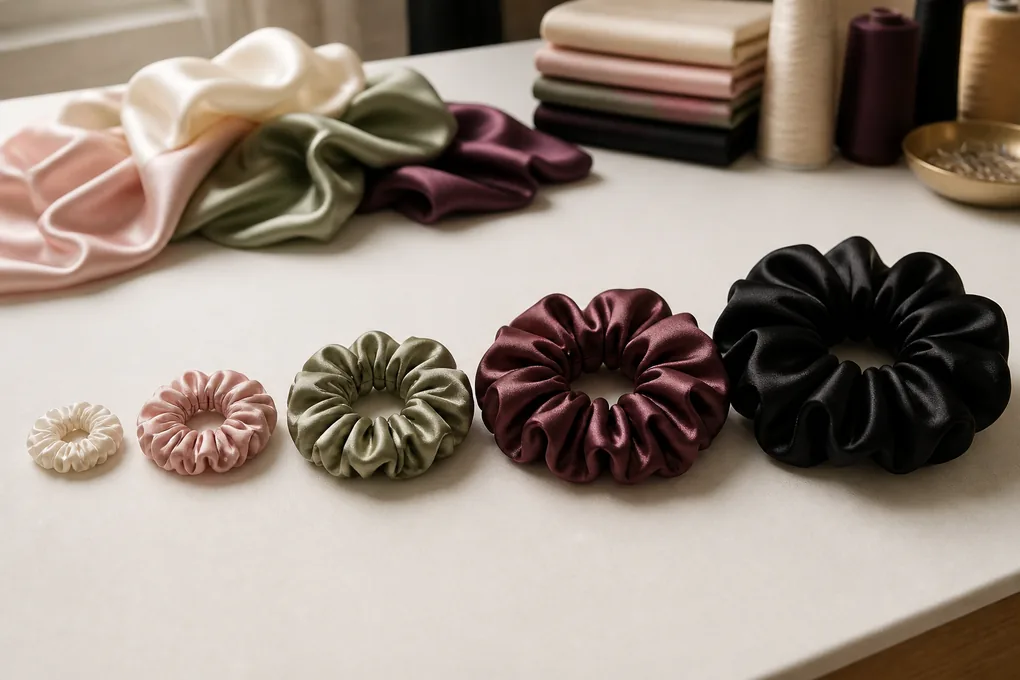
A narrow scrunchie can support subtle ties and multipacks, while a 5, 6 or 8 centimeter body creates progressively stronger visual volume when gathered. The intended use may include ponytails, buns, braids or loose styling, but hold also depends on elastic loop, hair volume and number of wraps. We ask the buyer which styles matter and whether the product should disappear into the hair or remain visibly decorative.
The range can include more than one width when each serves a real job. We document the role, customer and expected styling for every family. This gives merchandising useful language and gives sample reviewers a reason to compare gather, loop and hold. Width is not presented as a universal ranking in which larger always means better. The right body is the one that supports the selected use and selling position.
The assortment objective is tested against the way customers will compare variants. If the listing shows three widths, photography uses the same hairstyle, angle and scale where practical so visual volume is understandable. If multipacks serve distinct needs, their contents are explained rather than ranked through vague value language. Wholesale line sheets provide numeric width, piece count and material scope beside the imagery. We also decide whether a core color repeats across widths or each width carries a separate palette. Those choices affect sample coverage and inventory. A focused launch can still feel rich when every option serves a recognizable styling job and carries enough quantity for consistent project and replenishment.
Match Assortment Breadth to the Sales Channel
Core replenishment and seasonal stories need different depth
Allocation follows expected repeatability
A wholesale basic program may favor stable core colors and one or two widths that can be reordered. A beauty collection can coordinate scrunchies with a launch palette or licensed artwork, requiring tighter revision and color control. Gift channels may prefer planned sets whose pieces have distinct but compatible roles. Identify the number of orderable variants and the shelf or listing space available before committing sample work.
Online marketplaces can hide multiple physical styles under one variant family, making reviews difficult to interpret. We recommend preserving width, loop, print and pack identity so an elastic complaint from one style does not describe every scrunchie. Clear variant data also prevents customers from selecting a color thumbnail and unknowingly receiving another width or count. Product architecture becomes part of return prevention.
Assortment planning includes replacement and complaint handling. If a multipack contains one failing piece, the brand may replace the complete pack or hold service stock by color and width. That policy affects SKU identity and inventory. We ask about it before finalizing the range. Customer service categories retain elastic, seam, size, shade and pack issues separately, enabling product teams to revise the responsible construction instead of treating all negative feedback as a single “scrunchie quality” problem.
The final assortment brief lists measurable success indicators the buyer can track: variant sell-through, return reason by width or pack, elastic complaints, seam complaints, shade or print concerns and wrong-count incidents. These signals remain tied to the shipped SKU. A buyer can use them in the next reorder review to adjust construction or allocation. A broad satisfaction score may support the brand, but it cannot reveal whether a particular 5 cm loop or three-color recipe needs correction. Product-level data keeps development focused on causes.
Use Complaint Themes to Set the Development Priority
Elastic failure, exposed seams and wrong count point to different controls
Feedback becomes product-specific action
Common review themes include elastic snapping or stretching out, fabric separating at the join, rough seams catching hair, body width appearing smaller than expected, colors differing from images and multipacks arriving with the wrong count. We separate each problem by likely cause. Elastic behavior needs component and cycling work; seam exposure needs construction review; width needs a finished measuring method; shade and pack count need their own approvals.
The buyer ranks which failures would damage the program most and supplies existing return data where possible. Do not copy review language into marketing. Turn it into prototypes, sample-card fields and bulk checkpoints. After launch, feedback retains SKU and lot identity, allowing correction of the affected style rather than a cosmetic rewrite of the entire range.
The buyer’s commercial goal is expressed without retail commercial comparison. Positioning may be core, premium, gift or promotional, but construction facts still define the product. This lets us review material and setup against the intended range while keeping current bulk terms inside the RFQ.
Choose a 5 cm Silk Scrunchie or a Printed Style by Product Intent
A 5 centimeter scrunchie and a printed scrunchie answer different questions. The 5 cm reference defines visible body scale and gather behavior; print defines artwork, repeat and placement on a narrow, highly folded object. They can be combined, but one does not substitute for the other. Select width, loop and hold first, then decide whether solid color or print creates the customer value.
Use the 5 cm Reference for Controlled Statement Volume
Finished body width needs a repeatable method
Gather and loop determine the worn silhouette
The catalog 5 cm direction can start a medium-to-statement scrunchie brief. We define whether 5 cm is the flattened finished tube width or another named measurement, then control it at agreed points. Fabric length, gather ratio, elastic loop and join affect how that width appears when relaxed and worn. A broad flat body can collapse into a smaller-looking ring if the gather or elastic relationship is wrong.
Samples are photographed next to scale and worn on representative hair volumes. We count practical wraps and observe hold, bunching and seam orientation without promising the same result for every customer. If the buyer wants a more dramatic shape, changes to width, fabric length and elastic are tested deliberately. The accepted 5 cm style receives its own SKU rather than inheriting dimensions from an unspecified “regular” scrunchie.
A print reference should not use competitor artwork as project art. Inspiration is translated into original, rights-cleared files. This protects both parties and allows repeat, scale and color to be controlled rather than copied from a low-resolution listing image.
Use Printed Styles When Artwork Earns the Variant
Motif scale must survive gathering and twisting
A flat strike-off is only the first approval
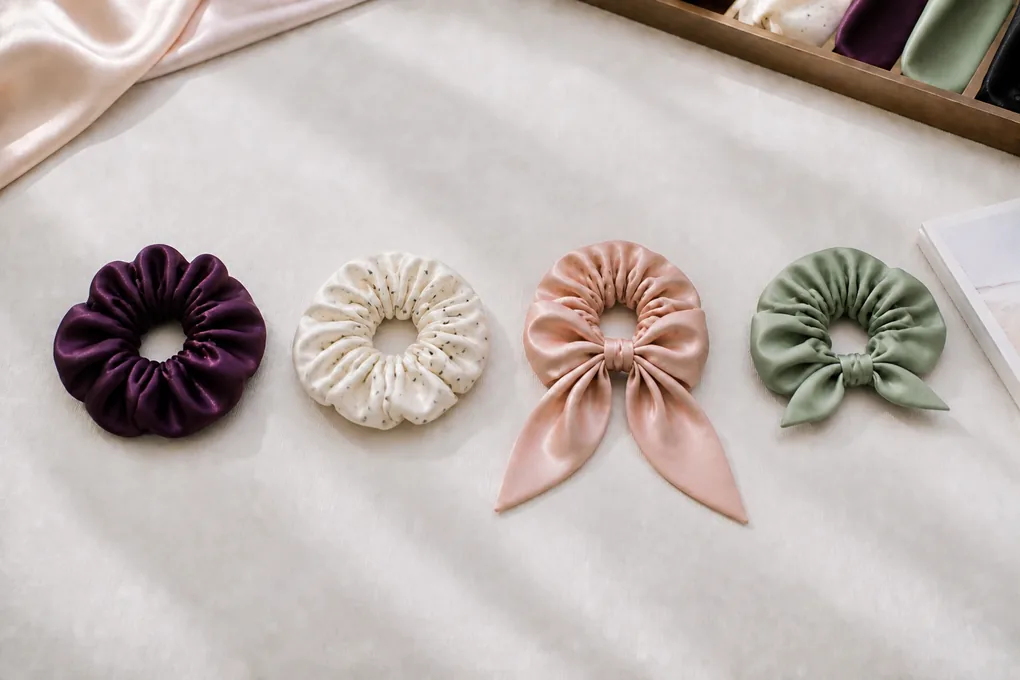
Printed scrunchies suit collections where pattern, collaboration or brand artwork is the reason to buy. The buyer provides rights-cleared files, color targets, scale and repeat. Small motifs, stripes, logos and directional elements behave differently after fabric is cut into a tube and heavily gathered. We preview the likely distribution but approve the printed fabric and finished ring because no flat rectangle can show every worn fold.
Important logos or faces should not be expected to appear identically on every randomly cut unit unless engineered placement is specified. Engineered placement can affect yield and seam alignment. We define acceptable motif cropping, orientation and join visibility. Bulk inspection verifies artwork version, colorway and gross placement rules without rejecting natural variation that the approved repeat necessarily creates.
A 5 cm printed style receives two linked approvals: the physical ring and the artwork behavior. The fabric strike-off may establish color and repeat, while the finished sample establishes gather, seam and motif visibility. If the buyer later places the same artwork on an 8 cm body, the increased visible area and different fabric length can change composition, so coverage is reviewed again. Conversely, changing from print to solid removes artwork controls but does not authorize another loop or gather. This separation keeps revisions proportional and prevents a successful print trial from being cited as evidence for an untested size.
Combine Width and Print without Losing Product Clarity
One matrix controls physical and graphic variants
The customer sees the actual combination selected
If the same print appears in 2.5 cm and 5 cm styles, each width has a separate pattern and sample. Motif scale may remain constant or change by body width; the buyer chooses. Colorway thumbnails and pack labels identify both artwork and size. A 5 cm solid cannot share the same order row as a 5 cm print because material processing, approval and allocation differ.
Quotation follows the exact combinations and quantities. Printed development may add strike-off, artwork control and print-lot inspection; wider bodies change fabric consumption and pack volume. Show those dependencies instead of commercial comparison a generic scrunchie with optional adjectives. Buyers can then decide whether print breadth, width breadth or a focused combination creates the strongest program.
The 5 cm style also needs a clear measurement relationship to product photography. A flattened width can look much larger in a macro image than it appears around hair. We capture flat and worn views with consistent scale and avoid calling the body oversized unless the buyer defines that term. For printed versions, the same images show motif behavior in gathers. Accurate presentation reduces returns driven by visual expectation rather than product-development failure.
Printed and solid products also receive distinct care communication when their approved methods differ. If one instruction can safely cover both, the artwork remains consistent. If print or decoration introduces a limitation, the affected SKU and pack carry it visibly. Do not hide a more restrictive route inside a shared assortment statement. The buyer can decide whether operational simplicity justifies using one validated care process across the range or whether the visual value of print warrants a separate instruction and inventory path.
Specify Finished Width, Gather Ratio and Loop Diameter Separately
Scrunchie size is not one number. Finished fabric body width controls visible scale; fabric length and gather ratio control fullness; elastic loop or relaxed opening controls how the ring sits and wraps. Marketplace complaints about “too small” can refer to any of these relationships. We define each measurement with a stated product condition and connect it to wearing trials, so project does not stretch or flatten the scrunchie arbitrarily to pass.
Measure the Flattened Fabric Body without Stretching Elastic
Width follows named points on the finished tube
Gather folds should not hide the actual result
The approved method arranges a section of the fabric tube without pulling the elastic, smooths only enough to locate edges and measures the flattened width at named representative points. The catalog includes 1, 2.5, 3.5, 5, 6 and 8 centimeter directions; each selected value must use the same definition. Seam allowance and internal elastic are excluded from visible width unless the drawing states otherwise.
Several readings reveal whether cutting or sewing has tapered the tube. Averages do not excuse one visibly narrow section. Tolerance considers the feature scale and silk handling, with pilot data confirming manufacturability. Product photography includes scale or a worn view so customers can distinguish a slim style from a statement body without relying on enlarged close-ups.
Loop measurement and body width are linked to packaging data feeds. The buyer’s ecommerce attributes, package size wording and wholesale line sheet should refer to the same numeric basis. If a marketing size name changes, the released geometry does not. This parity prevents one system from calling the product 5 cm based on cut width while another uses a finished measurement, a discrepancy that customers can easily notice.
Sample dimension records include the relationship between fabric tube and elastic. A wider body may need different cut length to achieve comparable gather, while a changed loop can alter the relaxed silhouette even if fabric remains constant. Show these values together on the approved card. Project can then diagnose whether a flatter bulk appearance comes from insufficient fabric, a longer loop, uneven feeding or pressing rather than guessing from the finished outside alone.
Define Fabric Length and Gather Distribution
Fullness depends on material around the loop
Uniform gathers protect the intended silhouette
Cut fabric length and finished seam path determine how much silk gathers around the elastic. The ratio is discussed against the elastic loop and desired visual volume, not copied from another width. Too little fabric can expose an overly plain ring; excessive length can create dense bulk, uneven folds and difficult packaging. Inspect gather distribution around the circumference and check whether the join creates one heavy lump.
Printed motifs interact with gathers. A large motif may vanish into folds, while stripes can reveal twisting. Solid light colors expose uneven density and internal shadow. Samples combine selected material, width, fabric length and elastic because those variables cannot be approved independently through swatches. The released construction records them together.
Measurements are sampled after the scrunchie has rested from project handling for an agreed period where recovery matters. This avoids comparing a newly stretched unit with a relaxed retained standard. The report states the condition and timing.
Control Relaxed Loop, Extension and Practical Wraps
Opening diameter alone does not describe hold
Hair volume and elastic behavior complete the fit
The finished inner opening or loop length is measured in a relaxed stated condition. Extension under a defined load, recovery and practical wrap count are assessed separately. A larger relaxed ring can still hold firmly with suitable elastic, while a small ring can feel difficult to use if extension is limited. We trial representative hair volumes and styling actions defined by the buyer.
Customer guidance remains limited. A buyer can describe the physical dimensions and observed styling range, but not guarantee a specific number of wraps for every hair type. The sample card records wearer or bundle reference, wraps, hold, removal and visible shape. This connects numeric control to use without turning subjective experience into an unsupported universal claim.
Dimensional inspection considers soft-product variation without accepting an undefined silhouette. A buyer can use templates or visual references alongside tape measurements for gather distribution and ring shape. The accepted sample shows how the product relaxes naturally; inspectors do not comb every fold into an artificial display. At the same time, severe twisting, flat zones, tapered body or a bulky closing area remain visible failures. Pattern, cutting and sewing data allow project to correct those conditions. The customer sees a naturally gathered accessory whose size is consistent enough to compare and reorder, not a rigid molded circle.
Engineer Elastic for Hold, Recovery and Hair-Friendly Removal
Elastic is the functional core of a scrunchie. It must extend enough for the intended wraps, recover after use, remain secure at its join and work with the fabric body without becoming a hard cord. Complaints about snapping, stretching out or slipping cannot be corrected by silk claims. We specify the elastic reference and finished behavior, then validate it through cycling, wear and care in the actual construction.
Select Elastic Width and Force for the Target Use
Hold and pressure require a balanced component
Stronger is not automatically better
The buyer identifies expected hair volume, styling action and hold priority. We nominate elastic width, material reference and force direction that can extend without excessive effort. A very strong narrow elastic may concentrate pressure or make removal unpleasant; a soft component may lose hold. The fabric cover also matters because seam, gather and friction affect how force reaches the hair. Finished samples provide the useful comparison.
Component lots are identified, and substitutions need functional review. Two elastics of similar width can have different extension curves, recovery, heat response and surface. Color is controlled where pale silk can reveal shadow. The specification focuses on attributes that support the approved product rather than calling the elastic “premium” without measurable meaning.
Elastic life is evaluated in relation to realistic extension. Cycling every ring to an extreme beyond intended use can create irrelevant failures, while review only one gentle pull misses weak joins. We agree a load or extension tied to the selected loop and wearer direction, number of cycles for development or sampling, recovery time and acceptance observation. The check can be supported by wear trials and retained samples. If the buyer needs a quantified durability claim, a stronger method and evidence review may be required. Normal QC instead protects approved construction and catches drift without turning a sample check into an unlimited lifetime guarantee.
Secure the Elastic Join without Creating a Hard Lump
Overlap, stitching and location affect use
The fabric join should not stack over the elastic join
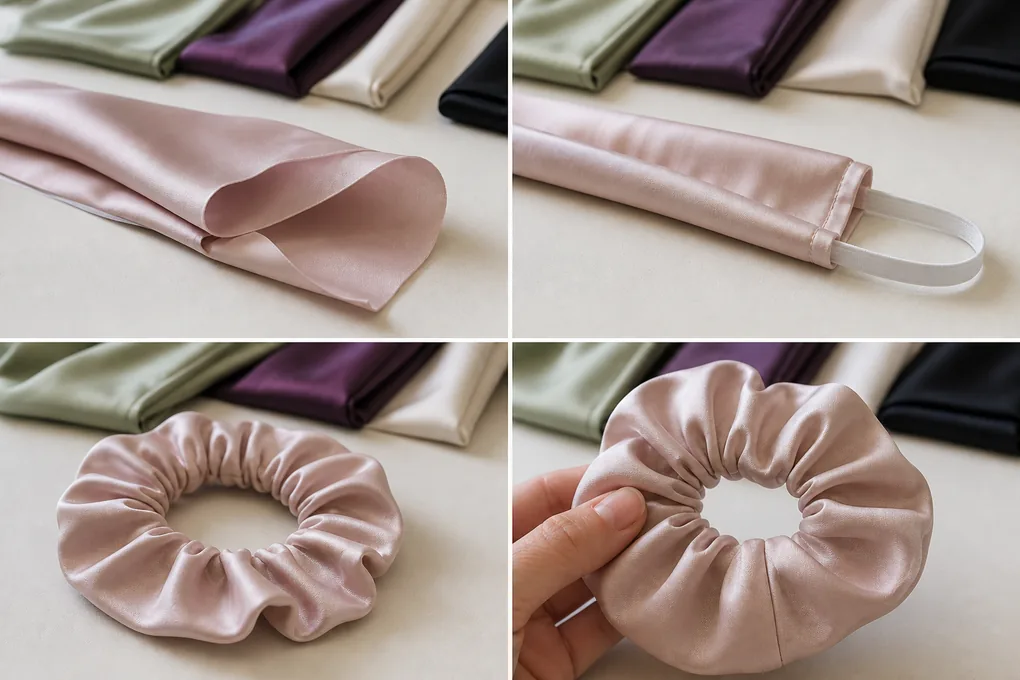
The elastic ends may be overlapped, sewn or joined by another approved method with defined overlap and stitch pattern. The joint must resist separation through cycling without forming a bulky hard point. We control its position relative to the fabric closing seam where possible so two joins do not create one prominent lump. Selected samples are flexed and felt around the full circumference.
If adhesive, metal crimps or heat joining are proposed, their contact, odor, corrosion and care risks require separate assessment. Simple sewn construction is not replaced casually for faster assembly. A failure investigation identifies whether the elastic material broke, the join opened or stitching cut the elastic. Corrective action follows the actual mode rather than merely increasing stitches.
Incoming elastic control can screen width, appearance and a nominated extension or recovery property before cutting fabric. This protects silk from being assembled around an unsuitable component. In-process checks confirm join and loop, while final checks assess the completed ring. These stages serve different purposes and create traceability. A supplier supporting document or component pass does not replace wear validation of the finished scrunchie.
Elastic approval includes storage considerations. Components held under heat, sunlight, chemicals or long tension can age before sewing, and finished goods tightly restrained on display cards can remain stretched. Storage and pack design should not impose a condition outside the tested use. Incoming lots are rotated and identified. If a delayed program relies on old components, representative rereview may be appropriate before full project. These controls reduce the chance that a correct development sample becomes a weak launch months later.
Check Extension, Recovery and Removal in the Finished Ring
Bench cycling and hair trials answer different questions
Care effects are included when relevant
A component or finished-ring check can cycle to a defined extension and record retained length after a stated recovery time. Wear trials examine practical wrapping, hold during movement and removal without abrupt catching. Results state the sample, elastic lot, body width, gather and hair reference. Do not claim no creasing, no damage or suitability for every hair type from one trial.
The agreed care route is applied to finished samples. Heat, water and detergent can affect elastic differently from silk, causing loss of recovery or uneven gathering. Covers are checked for twisting and exposed elastic. Bulk inspection can include sampled extension or loop checks and join security, supported by incoming component control. This addresses the failure customers experience rather than confirming only that an elastic is present.
Care instructions may recommend closing or containing decorative components where relevant, but they cannot cure a poorly secured joint. The approved construction first meets its functional requirement; customer handling language then protects normal service.
Build a Scrunchie Range with Meaningful Width, Color and Pack Choices
An assortment builder should produce orderable combinations that customers can understand and purchasing can allocate. Width, color or print, elastic route, branding and selling-unit count multiply quickly. We begin with core roles, then add variants only when they create a visible or functional difference. A controlled matrix prevents one attractive palette from becoming dozens of small project cells with unclear replenishment value.
Assign One Role to Every Width Family
Slim, medium and statement bodies need clear purpose
Catalog references support a rational ladder
The 1 and 2.5 centimeter directions can serve lower-profile or stackable concepts; 3.5 and 5 centimeter directions provide more visible body; 6 and 8 centimeter references create larger statement silhouettes. These are development starting points, not fixed merchandising rules. The buyer selects the smallest useful ladder and defines how each width should look and wrap. Samples compare adjacent sizes so distinctions remain clear in real use.
If two widths appear nearly identical after gathering, one may not deserve a separate SKU. Conversely, a large jump can leave a customer need uncovered. Review photography, pack dimensions and order quantities alongside the worn result. The width family names remain direct and numeric where possible, reducing reliance on inconsistent terms such as mini, regular, jumbo or oversized.
Inactive options remain outside purchase quantities and pack artwork. They can be retained for future development with clear status. This avoids an unapproved width or color appearing because a spreadsheet cell was copied into a live SKU row.
Use Color Architecture to Protect Inventory Depth
Core, seasonal and print colorways carry different commitments
Every shade receives an allocation and approval path
Core solids can support reorder continuity and deeper quantities. Seasonal shades may launch as controlled capsules. Prints need artwork and colorway approvals that solids do not. We group variants by their real development route and state whether a color appears in every width or only selected roles. This prevents a palette board from automatically multiplying the entire range.
Each shade has a physical target and stable code alongside its commercial name. Sets identify the exact colors included; assorted packs are not left to random factory selection. Replenishment acknowledges normal textile lot variation and uses retained references within agreed limits. The buyer can plan whether old and new inventory will mix rather than promising indefinite mathematical identity.
Assortment economics also include pick and pack complexity. Closely related color names, near-identical widths and several multipack recipes can increase warehouse errors even when factory project is correct. Use stable codes, distinct labels and scannable selling-unit identities. The buyer can decide that two subtle shades are valuable enough to retain, but then plans storage separation and photography accordingly. If not, consolidating them may improve inventory depth and customer choice. Range strategy therefore connects styling value with the physical discipline required to receive, store, list and replenish each variant.
Calculate Quantity at Variant and Selling-Unit Level
A large headline total can hide small cells
Pack count changes piece demand
The matrix lists body width, color or artwork, elastic, logo, pack configuration and required selling units. A three-piece set of one color differs from a three-color set, and 1,000 three-packs require 3,000 finished scrunchies. Piece and selling-unit totals reconcile. Optional combinations remain outside the base quantity until selected.
Show which variants drive color, print, cutting, sewing, component and packaging setup. If simplification is needed, buyers can reduce low-value color-width combinations or stage a pilot while retaining the products that serve distinct jobs. Current minimum quantity and timing follow this real mix; they are not universal figures attached to a category name.
The range matrix supports product photography and listings. A model image is tagged to the exact width, color, loop and pack; images do not combine the body of one SKU with the color name of another. Variant selectors state count and width before customers choose a shade. This clarity is especially important when marketplaces group reviews across multipacks and singles, because the brand can still preserve accurate item-level data.
Variant reduction can be supported with a choice-impact view: which color-width-pack cells disappear, how many selling units consolidate and which customer roles remain served. This makes simplification an assortment decision rather than an arbitrary factory demand. Buyers retain the option to pay for complexity when it creates value. The important point is visibility—quantity, sample and pack implications are understood before colors and widths are announced to wholesale accounts.
Develop Solid Colors and Printed Silk without Mixing Approval Logic
Solid and printed scrunchies share a ring construction but differ in color and artwork control. Solid silk highlights shade, luster, seam and gather consistency. Printed silk must carry motif, scale, repeat and color through tight folds and random orientations. We keep the routes distinct through samples and bulk checks, then coordinate them when the buyer wants one collection. A digital swatch or flat artboard cannot approve either finished result.
Approve Solid Shade on the Actual Silk Reference
Luster changes perception as gathers turn
Color names remain identifiers rather than standards
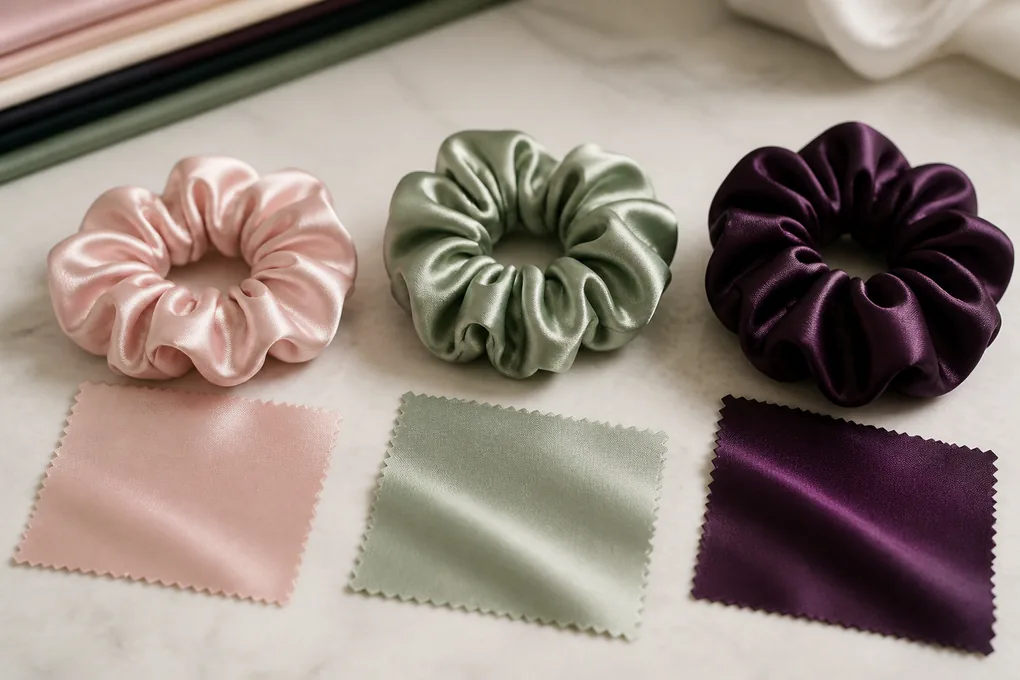
The buyer nominates a physical target, Pantone direction, lab value or existing cutting and states which controls. Silk is viewed under consistent light and from several orientations because gathered surfaces reflect differently. Instrumental comparison can support an agreed tolerance; visual review confirms the actual cast, depth and luster. Pale shades receive attention to internal shadow, contamination and seam visibility.
Commercial names such as champagne, rose gold or navy vary between brands. We pair the approved name with a stable code linked to the physical reference. A marketing rename does not become a dye instruction. Multipacks and coordinated sets define whether pieces should match, form a tonal story or intentionally contrast. Pack artwork and online swatches use the same identity.
Color and print approvals consider the seam zone. A solid join should not show a noticeably different luster from twisting or pressing. A print seam may interrupt motif or reveal a white gap if the artwork or process leaves insufficient coverage. We agree whether the join should be discreet or can form a natural part of random placement. Bulk limits follow that approved result rather than an idealized flat repeat.
Bulk color review uses both relaxed rings and gently opened fabric areas. The gathered view represents the product, while a controlled opening can help distinguish optical fold variation from a dye or print concern. Inspectors do not overstretch the elastic solely to flatten the fabric. The method is demonstrated with approved references. This balances the need to examine textile quality with protection of the finished functional component.
Prepare Print Files for a Narrow Gathered Product
Repeat and motif scale must survive heavy folding
Ownership and colorway remain controlled
The buyer supplies rights-cleared artwork, editable or project-suitable files, physical scale, repeat and color targets. Directional motifs, stripes, logos and borders are considered against tube width and seam. A small repeat may read continuously; a large hero image may rarely appear complete after gathering. We explain that behavior before sampling rather than promising flat-file composition on every unit.
Strike-offs assess color, detail, hand, registration and unwanted marking on the nominated silk. Finished samples then reveal motif distribution, twisting, seam interruption and worn appearance. Artwork version, scale, colorway and fabric reference are recorded. Changes with material impact reopen the appropriate strike-off or product approval.
Print and solid lots are segregated during packing according to the matrix. Similar commercial names are paired with stable codes. Warehouse and inspectors can therefore identify the intended recipe without judging subtle shade differences from memory.
Inspect Solids and Prints for Their Distinct Risks
Shade grouping differs from artwork verification
Finished-ring appearance completes both routes
Solid bulk checks examine shade relationship, spots, streaks, pressure marks, luster and contamination across relevant lots. Printed checks add file version, repeat scale, orientation rules, registration and transfer. Both examine seam, gather and surface damage in the finished ring. Directional shine is distinguished from true shade inconsistency by turning pieces under controlled light.
Random-placement prints use agreed natural variation limits; engineered placements use tighter positional rules and may change yield. Multipacks reconcile colorways exactly. Packaging should not press dark print or inked inserts against pale silk. Product photography represents the approved route without digitally creating a pattern or shade project cannot reproduce.
Print color and solid color can coordinate without being forced into impossible identity. The same named navy may appear optically different when one surface is a continuous solid and another is interrupted by light motifs and tight gathers. We agree whether the design calls for matching base color, tonal coordination or intentional contrast. Physical samples are viewed together in the planned set. The decision is documented so inspectors do not reject an approved tonal relationship or accept a print whose base has drifted outside it. This approach respects both textile reality and the brand palette.
State Silk Material Facts without Overpromising Hair Benefits
A smooth silk surface and covered elastic are relevant physical features, but claims such as no breakage, no creasing, anti-frizz or guaranteed hair protection depend on hair condition, styling tension, wear duration and comparison. Identify which fabric areas use silk, describe construction and evaluate observable removal and contact behavior. The buyer’s claims are reviewed against evidence rather than copied from high-ranking marketplace listings.
Define Which Parts Are Silk
Fabric body, elastic, thread and labels have separate scope
Fiber language follows the bill of materials
The visible scrunchie tube can use the nominated silk fabric while the internal elastic and sewing thread use functional materials. Brand labels, charms or packaging are also separate. We state the fabric scope accurately and provide component data for the buyer’s destination review. A broad “100% silk scrunchie” statement should not imply that elastic is silk or that every auxiliary material shares the same fiber.
If documented scope or check wording is requested, the current document must cover the relevant product or fabric and the claimed attribute. Do not turn a fabric supporting document into proof of factory coverage, every component, hair performance or environmental impact. Artwork remains pending until the statement and scope are approved.
Material communication includes country-specific fiber labeling and business information handled by the buyer’s qualified reviewer. We provide actual component facts and sample data; we do not decide legal sufficiency for every destination. Where a small sewn label would harm the product, packaging may carry supplementary information, but durable requirements remain satisfied where applicable. Marketing terms such as mulberry silk, Grade 6A, fabric-weight reference or charmeuse are used only when the nominated material and evidence support them. A popular keyword does not override the bill of materials.
Describe Surface and Construction before Hair Outcomes
Smooth contact and covered elastic are observable
Individual hair responses remain variable
A buyer can describe a silk fabric surface, fabric-covered elastic, seam placement and absence of exposed hardware where true. Wear trials can note snagging, removal effort, hold and visible marks under stated conditions. They cannot prove that no user will experience breakage or creasing. Hair texture, condition, products, tie tightness and sleep or activity all influence the result.
Customer copy can explain the intended lower-friction contact without making medical or guaranteed beauty promises. Comparison terms such as “less damage” require a named comparator, method and result. The buyer’s qualified reviewer assesses final destination language. Detailed physical facts make the product credible even when risky absolutes are removed.
Hair-benefit language should also avoid implying that silk replaces appropriate styling technique. Any elastic can create tension if wrapped too tightly, and one loop cannot suit every hair volume. We provide numeric and construction information that helps customers choose. The buyer can explain gentle handling and correct sizing without shifting responsibility for component failure. Honest guidance supports satisfaction more effectively than a guarantee no physical accessory can make universally.
Benefit copy should explain selection. Numeric width, intended visual volume, covered elastic and piece count help customers choose; vague “all hair types” language does not. If the brand has performed a specific panel or test, its scope can be described after review. Otherwise, we keep recommendations conditional and invite customers to select according to hair volume and desired hold. This reduces overclaim risk while providing more useful detail than repeated promises of gentleness.
Set Care and Use Guidance for the Complete Ring
Silk and elastic must survive one instruction
Tension advice helps prevent misuse
The proposed care route is tested on the finished scrunchie. We observe shade, surface, seam, gather, elastic recovery, print and logo. Generic silk care copied from an unrelated item may not address internal elastic, decoration or multipack color transfer. Instructions state relevant washing, drying and storage actions in language approved for the destination.
Use guidance can suggest avoiding excessive stretching beyond the intended loop and selecting a size suited to hair volume. It should not blame customers for a weak join or poor recovery. Complaint analysis compares actual use with the released specification and retained samples. Confirmed patterns lead to material or construction correction, while clear guidance addresses foreseeable misuse without weakening warranty obligations.
Proposed benefit claims are checked across title, bullets, label, insert and icons. Removing an absolute promise from one paragraph is insufficient if a badge still says “no breakage.” The released copy set uses consistent, evidence-based scope.
Apply Small-Scale Branding without Creating a Rough Join
A scrunchie offers little flat area. Woven labels, printed tabs, embroidery, charms and logo prints can distort in gathers, rub the hair or create one heavy point. We choose a method and position after body width, loop and seam are defined. Branding should remain identifiable in the pack and worn state without becoming the most rigid or failure-prone part of the ring.
Select a Method that Fits the Body Width
Mark size and substrate determine feasibility
Backing and attachment remain visible inputs
A narrow woven tab may suit a larger body but dominate a 1 centimeter style. Embroidery can add density and backing; print may follow silk better but fold unpredictably; a charm introduces metal, coating, attachment and contact concerns. We assess artwork at actual size and simplify fine details that cannot remain legible. Buyer-supplied components carry approved reference and substitution rules.
The skin and hair side of the branding is examined. Rough label edges, exposed knots, hard crimps or adhesive strike-through can snag. Pale silk may show dark backing. The selected method follows the care route without peeling, corrosion, transfer or excessive puckering. A logo is not approved solely from a supplier mockup.
Charms or small components require target-audience and attachment review. If their commercial value is low, pack-level branding offers a safer alternative. Do not add hard decorative parts merely because another marketplace item uses them.
Place the Mark relative to the Fabric and Elastic Joins
Stacked joins create an unwanted lump
Worn and packed views need different checks
The fabric closing seam and elastic join are located, and the brand element is placed to avoid stacking all three when possible. On a worn scrunchie, gathers can hide the mark or turn it inward. In a retail pack, the fold or restraint can present it deliberately. We approve both states and avoid moving the mark during bulk project merely to improve one photograph.
Placement tolerance follows visual importance and construction. A centered tab near the closing seam may have a defined offset; random all-over logo print follows repeat rules. The sample card records position, orientation, dimensions and attachment. If width changes, placement is reassessed because the same offset may no longer look balanced or may move closer to hair contact.
Small-scale branding may be tested by abrasion against a standardized surface or representative hair bundle when roughness is a concern. The goal is not to claim zero snagging for every user; it is to compare candidate label edges, stitch backs or charm attachments and remove obvious hazards. We also check whether a logo catches on pack slots during removal. A brand can decide that a clean unmarked ring in a strongly branded pack provides a better experience. Custom product-development includes the decision not to add an unnecessary component.
Control Artwork and Component Versions in Bulk
A small mark can fail every unit systematically
Early line checks protect the full allocation
Approved artwork includes size, color, method and project file. Licensed graphics require buyer-provided rights. Obsolete files are removed from active use. Early project units are checked for legibility, position, attachment, hand and appearance across representative colors. High-contrast combinations can expose placement or transfer problems not visible on the easiest colorway.
Final inspection verifies the correct mark on the correct variant and pack. Missing, doubled, inverted or detached labels are classified according to the agreed standard. Charms and small parts receive security and audience review. The buyer decides whether branding is mandatory on every piece or only packaging; that decision is reflected in quantity and inspection, not left to factory interpretation.
Branding can be concentrated on the pack when piece-level marking would compromise a narrow body. This is a legitimate design decision, not a reduction in customization. The pack carries logo, color identity and material statement, while the scrunchie remains smooth. For larger widths, a small fabric tab may be suitable. Compare both routes in the selling context and commercial value only the selected components.
Brand components are counted like any other material. A sewn label on every piece requires the same quantity as scrunchies plus an agreed allowance; a hangtag per selling unit follows pack count; a charm can need left-right orientation or protective film. The bill of materials and quotation identify that basis. This prevents an artwork approval from arriving without enough components or a pack-level quantity from being mistaken for piece-level branding.
Design Single, Multipack and Color-Set Selling Units
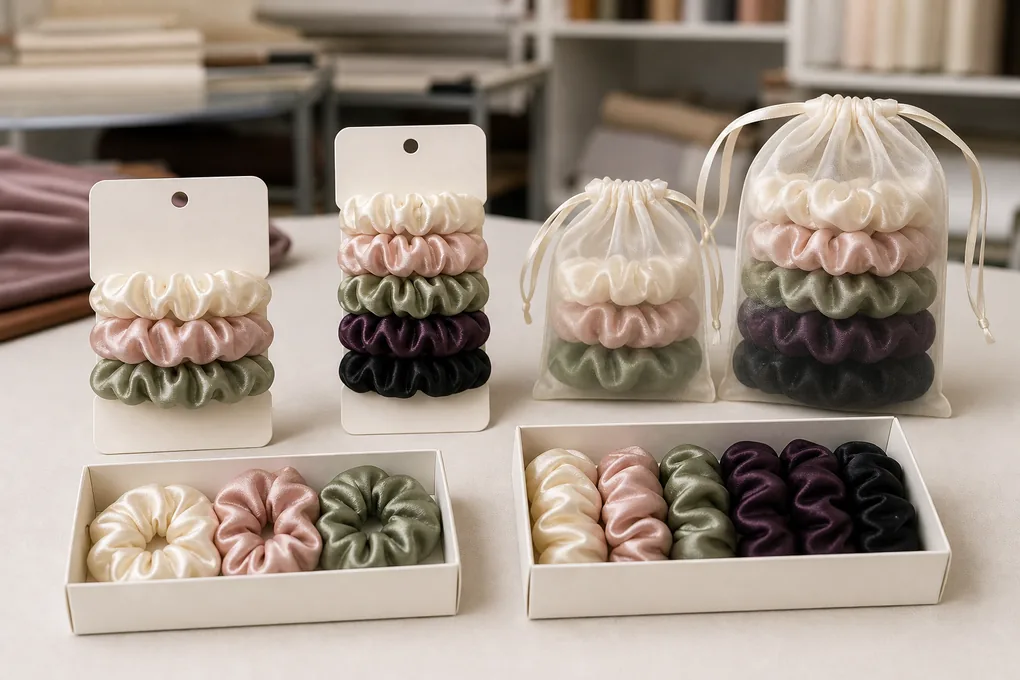
A scrunchie may be sold singly, in same-color quantities, in curated palettes or in mixed-width sets. The selling unit determines piece demand, color reconciliation, barcode, fold or restraint and package claims. We name every included piece and avoid random assortment unless the buyer explicitly defines an acceptable allocation method. Customers should know the count, widths and colors before opening.
Choose the Pack Logic before Finalizing Variant Quantities
Single, pair and multipack use different arithmetic
Selling units reconcile to finished pieces
One thousand single packs require one thousand scrunchies. One thousand three-packs require three thousand pieces, divided according to the exact color and width recipe. A pack can contain three identical pieces, three colors of one width, or several widths; each configuration receives a separate identity. We calculate both sellable units and component pieces in the RFQ and packing instructions.
Assorted packs are not filled from available leftovers unless that commercial rule is explicitly approved and disclosed. Curated palettes list colors and positions. If pieces are meant as replacements or open stock, their identifiers remain available. This arithmetic protects elastic, fabric, label and packaging purchasing and reduces wrong-count complaints.
Multipacks also need shade relationship approval. A tonal set may intentionally include three nearby hues, while a monochrome set should contain three pieces from the approved grouping. We label the recipe and avoid replacing a missing color with the nearest available shade. If the buyer wants flexible assortment percentages, those percentages and acceptable substitutions are written, reconciled by carton and represented accurately to customers.
Set photography uses the exact palette and widths in the released recipe. If the camera composition hides one piece, the listing still states it; if styling includes extra scrunchies, they are identified as not included. The buyer can produce alternate lifestyle images, but the principal contents view should be unambiguous. This simple discipline addresses one of the most preventable marketplace complaints: receiving fewer pieces or different colors than the image suggested.
Present the Product without Crushing Gathers
Cards, bands, pouches and boxes change the ring
Restraint should release cleanly
A display card or band can hold the scrunchie visibly, but tight slots or ties may flatten silk, pull the elastic or leave marks. A pouch protects the surface while hiding color unless artwork is clear. Boxes support gifting but add space and compression concerns. We trial the actual selling unit and check removal for snagging on staples, sharp card edges, adhesives or rough openings.
The pack fold or arrangement shows each included color where possible and keeps brand marks legible. Pale and dark pieces may require separation to avoid transfer during storage. Packed samples are reopened after representative holding to examine gather recovery, odor, abrasion and deformation. The customer should not need to stretch the ring excessively merely to free it from packaging.
Package restraints are sampled after likely warehouse storage. A card that bends or a band that dents the silk can damage every unit while individual product inspection still passes. Pack and ring therefore receive one combined release.
Make Pack Artwork Match the Exact Contents
Count, width, color and material scope stay consistent
Barcode and carton identity follow the selling unit
Artwork states piece count and identifies widths or size names with numeric support where useful. Lifestyle images do not imply colors or quantities outside the pack. Fiber and care language follows the actual fabric and components. Barcode data matches the chosen palette and configuration. If the same colors appear in different widths, pack identifiers make the difference unmistakable for warehouse and customer selection.
Master cartons specify selling units, not loose-piece totals alone. Variant marks and mixed-carton maps support receiving. Final pack checks verify count, color recipe, orientation, cleanliness, artwork version and protective arrangement. This closes the gap between a correct individual scrunchie and an incorrect set, which is a separate customer failure.
Multipack recipes are locked before color project allocation. The factory needs to know whether each carton contains only one selling-unit recipe or several, whether palettes share pieces and how replacements are handled. We calculate component demand by multiplying units through each recipe, then reconcile totals with fabric and elastic plans. During packing, a visual master and barcode identify the recipe. Random mixing is prohibited unless the buyer explicitly purchases a variable assortment and describes it accurately. This prevents unavailable colors from being replaced casually and protects promotional photography from drifting away from shipped contents.
Approve Each Variant with a Scrunchie Sample Review Card
A sample card brings body width, gather, elastic, seam, color or print, logo, wear result and pack into one variant-specific decision. Without it, comments such as “make it fuller” or “elastic is weak” float between sizes and colorways. Identify the sample and record measurable observations, then preserve accepted features while correcting the failed one. This reduces repeated sampling and keeps aesthetic approval connected to function.
Record the Physical Construction and Materials
Dimensions and component identities accompany the sample
Photographs support rather than replace measurements
The card names SKU or option, body width, fabric length or gather direction, relaxed loop, elastic reference, join method, silk fabric, solid color or artwork version, logo and pack. Measurements use released states. Front, join and worn photographs include scale where helpful. If a temporary material or hand correction appears, it is disclosed and cannot silently become approval for bulk.
A material swatch may support color or print approval but does not answer finished gather, seam or elastic. The card links separate approved references to the complete sample. Reviewers can see which decisions remain open. If the buyer changes width or elastic, affected appearance and pack checks reopen; unrelated approved artwork may remain valid where technically appropriate.
Review cards can include an issue severity agreed by the buyer. A color preference adjustment is different from an exposed elastic or unsafe hard component. Separating critical, functional, visual and informational findings helps teams prioritize corrections without accepting a severe fault because the sample is otherwise attractive. The card also records whether a comment applies to one color, one width, one pack or all related variants. Clear scope prevents a local correction from changing an approved characteristic across the range and gives the next sample a precise purpose.
Run a Defined Wear and Recovery Trial
Wraps, hold and removal are observed on a named reference
Subjective comments receive physical context
The reviewer states hair volume or check bundle, styling action, number of wraps, wear interval and movement. Observations cover hold, local pressure, slipping, snagging, seam exposure and removal. The ring can then rest for a stated recovery interval before relaxed loop and appearance are rechecked. This information is more actionable than a score without conditions.
Representative comparisons can include minimum and maximum intended hair volumes, but a small panel is diagnostic rather than universal research. A failure at one edge can prompt another loop size, changed elastic or narrower customer guidance. Do not average it away. The buyer chooses the balance appropriate to its audience and claim language remains within the observed scope.
Sample-card comments preserve scope. Approval of elastic hold in one width does not authorize a different loop across every body. Approval of a print strike-off does not prove a sewn ring has acceptable motif distribution. We link decisions where materials and processes are shared but retain a finished sample for each high-risk configuration. This produces efficient coverage without pretending that one attractive sample represents unrelated variants.
Approval status is summarized in a release table: physical dimensions, elastic, wear result, solid or print, logo, care, pack and barcode. A pass requires responsible review for each applicable item. Pending fields do not become approvals because the target date is near. When all required decisions close, the exact sample and files are issued to project. The buyer receives the same summary, making scope easier to verify before authorizing the order.
Approve the Selling Unit after Product Performance
Pack count and presentation complete the review
One final release consolidates departments
The accepted scrunchies are arranged in actual cards, pouches or boxes with labels and barcode. We examine color recipe, count, deformation, snag risk, odor, artwork and opening. Brand, product, quality and purchasing teams review their responsibilities, but one release identifies the approved combination. A photography approval does not substitute for elastic or pack acceptance.
Retained samples are accompanied by measurements, material and artwork references because physical items age and can be handled differently. The release states accepted natural variation and any limits. Project receives a reproducible instruction set, and purchasing knows which aspects were tested before quantity, commercial value and schedule are confirmed.
A correction request states location and target outcome. “Fabric seam opens by 4 mm after cycling” is actionable; “make better” is not. Specific comments reduce resampling and preserve accepted color, print or elastic decisions.
Inspect Bulk Scrunchies for Elastic, Seam, Size, Shade and Pack
Bulk inspection follows the failure risks of the selected scrunchie, not a generic textile checklist. Identity and material come first; finished width, loop and gather establish shape; elastic extension and join establish function; seam and surface protect hair contact; color or print protects assortment intent; packaging confirms count. Sampling covers relevant variants and lots under agreed acceptance rules.
Verify Variant Identity and Finished Geometry
Width, loop and gather are independent checkpoints
Samples represent colors and constructions
Inspectors confirm SKU, width family, color or artwork, branding and selling-unit configuration. Finished body width is measured without stretching, relaxed loop follows the stated condition, and visible gather distribution is examined around the ring. Selected units can be compared with approved silhouette references. A correct color in the wrong width is a variant failure, not a pass because the shade matches.
Sampling reaches relevant material, elastic and print lots. Measurement results retain individual readings rather than only averages. If one section tapers or the join creates a large lump, the location is recorded. Silk luster is viewed from several orientations to distinguish optical change from stains or genuine shade inconsistency.
Inspectors verify multipack counts by exact recipe, not only total pieces. Three correct colors in the wrong widths remain a failure. Barcode and carton marks are reconciled with the same selling-unit identity before release.
Check Elastic and Seam Function on Selected Units
Presence is not the same as secure performance
Failure mode guides corrective action
Sampled rings are extended or cycled according to the agreed check, then examined for retained length, breakage, join opening, cover restriction and exposed elastic. Wear or bundle trials may be included where defined. Fabric closing seams are checked for complete capture, secure closure, rough edges, loose threads and stacking over the elastic joint. Surface snags and contamination receive separate classification.
Findings identify whether the elastic material failed, the join failed, stitching damaged it or the fabric seam opened. This matters because adding stitches cannot correct weak elastic and stronger elastic cannot close an exposed seam. In-process checks on first project and component lots can catch systematic issues before final pack. Final sampling confirms that approved function remained through project.
In-process inspection is valuable at elastic joining and fabric closing because failures can be hidden by gathers. Operators and quality staff check join security, complete seam capture and absence of exposed elastic before large quantities accumulate. First-off pieces from each major width or construction are compared with the approved shape and measurements. Final inspection then samples finished and packed goods. This layered approach does not eliminate the buyer’s release decision, but it gives the project team an earlier opportunity to correct systematic setup problems before silk, labor and packaging are consumed.
Reconcile Color, Artwork and Selling Units
Every pack needs the approved recipe
Cartons preserve variant traceability
Solid shades are compared with the approved physical reference and grouped as specified. Printed styles verify artwork version, scale, colorway and natural placement limits. Logos use the released file and attachment. Multipacks are opened to confirm piece count, width and color recipe, barcode and cleanliness. Packaging should not flatten gathers or introduce transfer and odor.
Inspection reports state sample size, affected units, defect location and requirement, supported by measurements or photographs. Purchasing can decide sorting, repair, repacking, additional sampling or another disposition. No sample inspection guarantees every unit, but transparent coverage and traceability provide a rational release decision and useful corrective feedback for reorders.
QC also examines hair-contact cleanliness. Needle damage, sharp thread ends, exposed elastic, adhesive residue, metal burrs and loose fibers can affect use even when dimensions pass. Work areas and pack materials should protect pale silk from soil. Inspectors handle samples with clean methods that do not create the marks they are evaluating. Findings specify exact location around the ring.
Inspection findings should preserve defect location around the ring. A seam opening at the fabric join, an elastic lump opposite the seam and a snag on the body have different causes. Marked photographs and sampled-unit IDs support sorting and repair decisions. If the pattern is systematic, project can stop and correct it. If isolated, the agreed defect classification and sampling result guide disposition without exaggerating one unit into an unsupported claim about the entire lot.
Submit a Variant-Quantity RFQ for Custom Silk Scrunchies
A quote-ready scrunchie inquiry describes every orderable combination and its selling-unit quantity. It names body width, loop or elastic direction, silk fabric, color or print, logo, pack recipe, destination and quality needs while marking open values for our proposal. Do not display retail commercial comparison or universal minimum quantity and timing commitment. Commercial review follows the real allocation and development work.
List One Row per Width, Color, Construction and Pack
Piece and selling-unit quantities remain separate
Alternatives are commercial valued as defined options
Each row states width reference, intended hair-use range, finished loop or elastic direction, material scope, solid color or artwork version, logo method, single or multipack, exact contents and requested selling units. Total piece demand is calculated. A 5 cm navy single does not share one row with a printed three-pack; a color alternative does not enter the base quantity until selected.
The allocation exposes fragmentation. Six colors across four widths and two pack formats create forty-eight cells before artwork versions are added. Identify which choices drive dye or print, cutting, sewing, elastic, branding and packing setup. Buyers can consolidate low-value variation, stage a pilot or deepen core quantities without sacrificing the functions their customers need.
The RFQ states the response stage: feasibility, development sample, budgetary comparison or formal quotation. Early concepts receive defined choices and missing-input questions; released variant matrices receive scope-based terms. This prevents provisional colors or loops from being treated as commitments. It also lets purchasing schedule artwork, color and packaging approvals in the order that protects launch timing.
The commercial response states sample cost or credit treatment, packaging basis, tooling or artwork preparation where applicable, payment and delivery terms in the agreed format, while keeping credentials and private files out of public content. Purchasing reviews these beside the product matrix. A changed multipack or logo can alter more than unit consumption, so revisions are quoted openly. The final order references one approved scope and a named commercial revision rather than a chain of incompatible preliminary figures. Both parties retain that revision for reorder comparison.
Attach References That Define the Product
Dimensions, artwork, claims and pack files remove assumptions
Marketplace links remain annotated visual examples
Useful inputs include target body widths, hair-use direction, relaxed loop or desired wraps, elastic performance priorities, physical colors or print files, logo artwork, proposed material and benefit claims, required tests or documents, pack dielines, barcode data, destination and target dates. Buyer-supplied components have ownership and delivery status. Missing data is marked for proposal rather than invented.
A marketplace link may illustrate volume, join concealment or card presentation, but it does not prove fiber, elastic or dimensions. The buyer identifies the desired feature and excluded elements. We convert that feature into measurable construction without copying competitor text, artwork, reviews or unsupported promises. This gives quotation and inspection a common physical target.
Commercial validity belongs to the approved allocation and date. A future reorder is reviewed for material, color, components, packaging and destination changes. Previous commercial comparison does not silently authorize a changed product.
Confirm the Commercial Scope and Approval Path
Assumptions remain visible beside the offer
Changes reopen the affected work only
Our response repeats variant rows, quantities, fabric and color route, elastic, logo, packaging, samples, destination and buyer inputs. Proposed options are separated. Timing follows artwork, color, component and sample readiness. Purchasing can compare offers for the same scrunchies rather than selecting a headline figure attached to different widths, loops or pack counts.
If width, gather, elastic, color allocation, print, logo or pack changes, we review consumption, setup, samples and schedule. The revision is named and approved. Released values become project and inspection instructions. This turns a broad wholesale scrunchie request into a project-ready program whose shape, hold and selling-unit contents can be verified.
A quote-ready request also specifies confidentiality and artwork handling where proprietary prints or launches are involved. Files are supplied through an agreed secure route, linked to the correct variant and used within the authorized scope. Public marketplace images are not treated as project ownership. The buyer confirms logos, licensed elements and color references it has authority to use. Commercial responses can then discuss samples, tooling and file preparation without exposing confidential artwork beyond the authorized project team. This protects original development while keeping the RFQ detailed enough for product-development review.
Buyer questions about wholesale silk scrunchie development
Does a public size name define scrunchie fullness?
No. The measurement condition, strip, gather, and elastic route need to be stated.
Can this page promise elastic recovery?
No. Recovery must be reviewed against the selected construction and sample basis.