
P027
Custom Silk Corporate Gifts for B2B Recognition and Event Programs
When a corporate gift must feel deliberate rather than promotional, the product details deserve as much care as the brand presentation. We help B2B buyers shape a tailored silk pillowcase pair, eye-mask presentation, hair accessory, or other textile gift unit around the recipient, the visible article, buyer-owned artwork, the recipient unit, and the buying choice still open.
Published by China EverBen Silks Reviewed by Mark Liu
Keep gift presentation tied to the actual item and count
State the selected article, recipient context, artwork or label input, pack hierarchy, and buyer decision.
Define the Recipient, Occasion, and Role of the Corporate Silk Gift
We start a corporate silk gift conversation with the person receiving the product and the moment it is meant to mark. An executive recognition gift, a speaker thank-you, a client welcome, an employee milestone, a seasonal brand gesture, or an event-level presentation can all require a different product hierarchy. Naming the recipient group does not mean making assumptions about their preferences. It gives the buyer a way to choose a suitable silk article, decide what one person receives, and create a presentation that feels deliberate rather than like a generic logo giveaway.
Start With the Recipient Experience, Not With a Promotional Object
Define when the recipient will encounter the silk article
The gift moment gives the product a meaningful role
We ask who the company is recognising and when the gift will be opened. A silk pillowcase pair can suit an executive or client gesture. An eye mask presented with a small drawstring pouch can support a speaker welcome, travel-themed occasion, or premium brand experience. A bonnet or hair accessory can belong in a beauty-led selection when the buyer has defined the recipient and message. Name the occasion before choosing the article. “For a leadership recognition dinner” and “for a conference attendee welcome” are distinct starting points, even when the colour palette or brand mark is shared.
Recipient context also changes the visual hierarchy. A formal recognition gift may put the silk article and a discreet buyer-approved card at the centre. A broader event programme may need a single, easy-to-understand customer unit that still feels considered when opened. A client relationship gift may focus on a refined pillowcase pair, a mask, or a small set that does not need to look like event merchandise. We help a buyer turn the intended gesture into product questions: which silk item should lead, what does one person receive, which surface is visible first, and which brand element supports rather than overwhelms the gift.
Choose a Silk Article That Fits the Intended Gift Moment
Let the occasion guide the article, unit, and presentation choices
A corporate gift is clearer when it has one identifiable hero item
We avoid treating “corporate gift” as a product category. It is a business purpose that can be expressed through several silk articles. A buyer may choose a pillowcase pair as the central gift, a single sleep mask as a compact appreciation piece, a mask-and-pouch combination as a travel or event concept, or a small beauty accessory set when its brand position supports that route. Each option creates different questions about the visible silk face, closure, trim, fold, pouch, card, and the number of pieces in the unit. Giving the gift purpose a name helps a team decide which route deserves a full product conversation.
We then look at what the recipient should understand without an explanation. If the product is a pillowcase pair, the folded face, edge, and sleeve or card position may matter first. If it is a mask gift, the mask silhouette, visible binding, and pouch relationship may carry the experience. If it is a small set, the buyer should decide which article leads and which remains a companion piece. These choices help a corporate gift feel coherent without requiring a loud logo or a bulky presentation. They also give procurement and brand teams a shared way to compare different silk product ideas before they become a final selection.
Frame the Gift Brief So Stakeholders Can Make the Next Choice
Give brand, procurement, and event teams a common starting point
A focused brief avoids generic gifting language
A concise corporate gift brief starts with four points: the recipient group, the occasion, the proposed silk article, and the next decision. You might say, “We are planning a recognition gift for senior partners, considering a silk pillowcase pair, and need to decide whether the presentation should reveal a contrast edge or remain tonal.” Or, “We are selecting a sleep-mask gift for event speakers and need to compare a single-mask pouch unit with a mask-and-card presentation.” These are early, concrete questions about a stated silk gift format; they invite informed review while leaving brand treatment, budget, schedule, and distribution choices genuinely open.
A marked image, colour direction, or layout can clarify the intended moment. Say whether the reference is guiding surface colour, gift hierarchy, pouch fold, card position, or silhouette. Then name the colleague making the next selection. A brand lead may govern artwork; a product manager may determine the article configuration; a purchasing lead may organise the commercial inquiry. We can discuss a specified silk gift configuration while the buyer controls its brand language, recipient strategy, event planning, and related business choices.
Choose the Custom Silk Article and Gift-Set Structure
A corporate silk gift needs one named anchor article before the buyer discusses presentation, recipient counts, or brand assets. We help purchasing teams distinguish a single pillowcase, a paired-pillowcase arrangement, a travel eye mask, a bonnet, a gathered hair accessory, a presentation pouch, or another coordinated textile unit. Each route has different visible surfaces, components, and recipient-unit questions. That clarity stops a broad phrase such as “custom silk gift box” from hiding the article the recipient is actually meant to recognise and keep.
Name the Hero Silk Article Before Building a Gift Set
Let one clear product lead the recipient experience
A defined anchor makes every companion piece easier to judge
We start by asking which silk article should make the gift memorable. A pillowcase pair can be the central gift for a formal recognition programme. A sleep mask can lead a smaller travel, wellness, speaker, or event concept. A bonnet or scrunchie can lead when a buyer has chosen a beauty-oriented recipient experience. A pouch can be a supporting presentation component, or it can be a separate accessory only if the buyer wants it to be. This hierarchy matters because the hero article determines which visual detail is most important: a pillowcase face and edge, a mask silhouette and binding, or a bonnet crown and band.
The word “set” cannot replace product detail. Explain whether the concept contains a single pillowcase, a two-pillowcase arrangement, a travel eye mask, a bonnet style, or a particular combination. Then identify the item seen first and the pieces that support it. An eye-mask-and-pouch pairing follows a different logic from pillows paired with an information card, while both differ from a multi-item beauty selection. By making the structure explicit, we can help a B2B buyer prepare a request that product, brand, and purchasing colleagues understand without assuming every item shown in an inspiration board belongs in the final recipient unit.
Define the Visible Silk Face, Closure, and Companion Components
Keep construction choices attached to the article they change
The finished gift is more than a colour and a logo
For every proposed article, separate the presentation surface from the opening, edge, trim, reverse, or supporting piece. A pillowcase brief can identify a face colour or print, the opening direction, and whether the edge stays quiet or carries contrast. An eye-mask brief can identify the front, binding, strap approach, and pouch role. A bonnet brief can distinguish the crown, headband, tie treatment or elastic location, and a buyer-selected label position. These choices make the gift more intelligible than a generic request to customise silk with a brand mark.
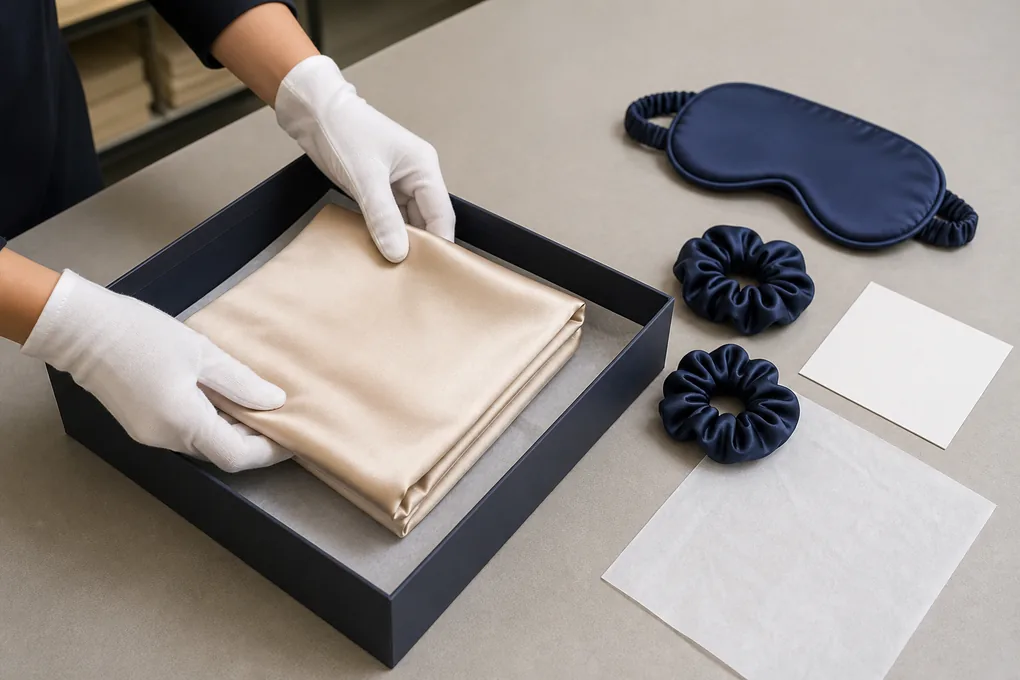
The same principle applies to companion pieces. A card, sleeve, pouch, tissue layer, or ribbon may support the chosen silk article, but it should not conceal what the recipient is receiving. A buyer can decide that the silk face remains visible when the unit is opened, that a pillowcase pair is folded to show a border, or that a mask front appears above the pouch opening. We help organise those physical choices into a coherent gift configuration. The buyer keeps control of brand copy, artwork, and any message content while we keep the product conversation anchored to the actual article and its visible components.
Build a Gift Unit That a Recipient Can Understand at First Look
Use a simple item hierarchy instead of a crowded bundle
A premium gift should make its main silk article obvious
A recipient should not need to sort through unrelated accessories to understand the gift. We recommend deciding first what one person receives, then adding only the pieces that serve the anchor article. A silk pillowcase pair may need only a discreet sleeve or a buyer-approved card. A sleep mask may be presented with one pouch. A beauty-oriented set may include a mask, a scrunchie, and a pouch only when each item has a defined role. This approach lets the buyer create a polished corporate gift without confusing the customer unit with display props, event materials, or outer delivery materials that the recipient may never see.
For a clear inquiry, list the unit in the opening sequence: principal silk article, companion textile piece, then any buyer-selected information piece. Add the one design choice still unresolved. For example, “two silk pillowcases in a narrow sleeve; should the border stay tonal or move to contrast?” or “an eye mask inside a pouch; should the pouch reveal the front of the mask?” We can then discuss the product configuration in a way that respects a corporate buyer’s need for a thoughtful gift while avoiding unsupported claims about personalisation, availability, delivery, or programme outcomes.
Turn Buyer-Owned Artwork Into a Useful Silk Gift Direction
A logo file alone does not tell us how a corporate silk gift should look when it is opened. We begin with the buyer’s intended visual role: a quiet maker mark, a colour-led gift, a printed motif, a message card, or a presentation that lets the silk article do most of the talking. That decision keeps artwork from becoming an afterthought and lets brand, product, and procurement teams discuss the same physical gift unit.
Choose the First Brand Element a Recipient Should Notice
Make the silk article, not the logo, carry the gift experience
A restrained visual hierarchy often feels more considered
We start with the moment a recipient opens the unit. A silk pillowcase pair may lead with a tonal face and a discreet edge detail, while a sleep mask may lead with its front silhouette and a small card placed beneath it. A buyer can choose whether a brand mark belongs on an outer sleeve, a pouch, a card, or a limited visible position on the textile. That choice should reflect the gift purpose rather than a general expectation that every surface needs branding. A large mark can change the quiet character of a silk item; a carefully placed mark can allow the material, colour, and fold to remain central. Tell us which part of the gift should be noticed first, which part should be discovered second, and whether the brand voice is formal, celebratory, understated, or event-led. We can then discuss the layout around a named silk article instead of treating a supplied logo as a complete product direction. The buyer retains control over all artwork, wording, and brand use, while our conversation stays focused on the visible surfaces and components that need to work together.
Give Artwork a Clear Product Surface and Viewing Direction
Connect each proposed mark or motif to one real component
A fold, border, pouch face, or insert can change what is visible
A useful corporate-gift brief identifies the component before it describes the graphic. For a pillowcase, state whether the visual idea belongs on the main face, a border, a concealed opening zone, or a presentation sleeve. For an eye mask, distinguish the visible front from the binding, strap, pouch, and card. For a bonnet, identify the crown, band, or supporting presentation element rather than using a broad instruction such as “add our branding.” A motif that suits a flat digital image may appear differently across folded fabric, a curved eye mask, or a narrow border. Share a reference when it explains colour mood, placement, or scale, then identify the physical question it is meant to answer. This makes buyer review easier: brand teams can assess presentation, product teams can assess the article, and purchasing teams can prepare a commercial discussion around a coherent concept. It also avoids turning an early visual idea into an assumed final arrangement before the relevant product details have been discussed.
Separate Gift Messaging From the Textile Itself
Use a card or insert when the written message deserves its own space
The recipient can receive the message without crowding the silk article
Many recognition and event gifts need a message, but the message does not have to compete with the silk article. A buyer may prefer the textile to remain visually calm and use a card or insert for a thank-you, programme note, recipient name, event theme, or brand story. Decide whether that card is the first thing seen, a second layer under the product, or a separate element presented after opening. Then keep the content and artwork under the buyer’s own approval process. We do not assume wording, personal names, print treatment, or any individualisation method from a generic request. Instead, we can discuss the practical relationship between the chosen card format and the silk article: whether it should sit beside a folded pair, under a mask, inside a pouch, or in a sleeve. A direct enquiry can say, “Our card is buyer-approved; we need to decide whether the pillowcase pair or the message appears first.” That is a clear B2B question that respects brand ownership while moving the gift concept beyond an unstructured mood board.
Design the Unboxing and Presentation of a Corporate Silk Gift
The way a silk corporate gift is folded, revealed, and accompanied changes the recipient’s first impression. We help buyers consider the visible silk face, an optional pouch or sleeve, a card position, and the order in which each piece is encountered. The aim is not to prescribe a box or promise a pack format. It is to give the buyer a concrete presentation question that fits the chosen article and the intended recognition moment.
Decide What the Recipient Sees Before Touching the Silk
Use the opening sequence to reinforce the gift’s main idea
The opening layer should explain the gift without a long introduction
We ask buyers to describe the opening sequence in plain terms. Does the recipient first see a colour-led sleeve, a message card, a pouch, or the folded silk itself? A pillowcase pair can be folded so the face or edge is visible immediately; a sleep mask can sit above its pouch when the mask is intended to lead; a compact accessory can be positioned beside a card when the message gives the gift context. There is no single presentation hierarchy for every programme. An executive recognition gift may call for a reserved textile-first reveal, while a conference speaker gift may require the product and message to be understood quickly. By naming the intended first view, buyers avoid a common problem: a polished outer concept that leaves the recipient unsure what the actual gift is. We can discuss the relationship between the selected silk article and the proposed presentation components without assuming that a particular sleeve, box, tissue, ribbon, or insert is available for every project. A drawing, image, or internal pack sketch is most useful when it shows the intended order, not when it is treated as proof of every construction detail.
Keep Supporting Materials in Proportion to the Silk Article
Let cards, pouches, and outer layers support rather than bury the gift
Premium presentation comes from clear priorities, not extra pieces
A presentation component earns its place when it helps the recipient understand, protect, or enjoy the central silk item. A pouch can frame a sleep mask; a sleeve can hold a folded pillowcase pair; a card can carry the recognition message; a tissue layer can create a pause before the textile is revealed. But each additional layer should answer a purpose. We advise buyers to identify the hero article, then ask whether each companion piece reveals it, organises it, or communicates something the textile should not have to say. This approach prevents a corporate gift from becoming a mix of unrelated packaging parts. It also helps brand teams make a deliberate choice about colour, contrast, and visible copy. A muted sleeve may support a bold printed pillowcase, while a simple card may be better beside a tonal mask. Bring us the article and the preferred presentation order, plus any buyer-approved visual assets. We will use that information to discuss a coherent gift unit rather than presume a final packaging solution from a broad phrase such as “luxury gift box.”
Plan for a Presentation That Works Across Internal Review
Give product, brand, and purchasing colleagues the same visual question
A simple comparison is easier to approve than a vague premium direction
Corporate gift teams often need to compare two presentation routes without losing the product details underneath. We recommend writing each option as a complete sentence: “A folded silk pillowcase pair with a quiet sleeve, revealing the tonal border first,” or “A silk sleep mask placed above a pouch, with the recognition card below.” This makes the difference visible to every stakeholder. A brand colleague can judge the expression; a product colleague can see the article hierarchy; a procurement colleague can request discussion around the intended unit. Keep the comparison focused on one or two choices, such as textile-first versus card-first, or sleeve versus pouch. Avoid combining several changes at once, because it becomes difficult to tell which choice people actually prefer. We do not make the approval decision for a buyer, but we can respond to a clear product-and-presentation question. Once the desired direction is chosen, the buyer can carry the article, visible components, buyer-selected artwork direction, and gift-unit count into the next commercial discussion with far less ambiguity.
Set Corporate Gift Counts Around the Actual Recipient Unit
Corporate-gift quantities become unclear when event attendees, invited guests, executive recipients, display pieces, and internal reserves are counted as though they were identical. We help buyers describe the intended recipient unit before discussing a silk article or presentation. A quantity question supports planning rather than offering a commercial commitment. It simply lets product, brand, and purchasing colleagues distinguish what one person receives from the audience population being considered.
Distinguish the Recipient From the Event Audience
Name the people expected to receive the silk gift
A recipient-based view prevents a broad headcount from becoming the product brief
We begin with the recipient group, not the largest number connected to an event. A leadership recognition programme may have a small named recipient group even when the wider meeting has many attendees. A speaker gift may be intended for a limited group while the event includes delegates, hosts, and support staff. A client thank-you may be directed to one relationship team rather than every visitor at a launch. These distinctions matter because a silk pillowcase pair, sleep mask, bonnet, or accessory set is a recipient unit, not an abstract event metric. Tell us whether the proposed gift is for all attendees, selected guests, a presenter group, a retail-facing customer group, or an internal recognition group. Then state whether every recipient is meant to receive the same article and presentation. This lets us discuss a coherent product concept without making assumptions about final quantities, commercial terms, or availability. It also helps the buying team see whether a sample, display piece, or internal review unit belongs in a separate conversation rather than inside the recipient count.
Describe One Complete Gift Unit Before Adding Variations
Make the item count visible inside every proposed unit
A clear unit makes set comparisons easier for purchasing teams
A quantity becomes useful only after the gift unit is named. A single silk pillowcase differs from a two-pillowcase gift; an eye mask in a pouch differs from an eye mask, pouch, and card; a beauty-led selection may contain several pieces, each with a visible purpose. List the proposed unit in recipient order: principal textile item, optional companion, then any buyer-approved message piece. State whether each recipient receives the same arrangement. This avoids the familiar purchasing problem where a slide says “gift set” but nobody can see how many silk articles are included. When comparing two approaches, describe them separately rather than blending them into one headcount. For example, compare a sleeved pillowcase pair with an eye-mask pouch option, not “two gift options for 100 people.” The buyer can then choose the recipient experience to carry into a project-specific commercial discussion.
Keep Review and Reserve Needs Separate From Recipient Gifts
Identify why any non-recipient unit is being considered
Internal use should not quietly alter the recipient-facing concept
Corporate gift teams often need pieces for visual review, stakeholder comparison, photography planning, or an internal presentation. These are legitimate planning needs, but they should not be confused with what the recipient will receive. We encourage buyers to list them in a separate line: recipient unit, internal review unit, display concept, or sample question. That separation keeps the buyer’s core product brief readable and prevents a temporary internal need from becoming part of the audience-facing gift story. It also helps a procurement manager explain a count difference without turning the product conversation into a vague forecast. If the recipient group is still being finalised, say so plainly and focus first on the named silk unit, the visual direction, and the next choice. We can discuss the product details that matter now while the buyer’s team resolves its own event roster, recognition policy, or distribution approach.
Bring Event Timing Into the Conversation Without Treating It as a Promise
A date can be important to a corporate gift programme without becoming a claim about delivery. We ask buyers to describe the event moment, the product decision still open, and the internal approval sequence that sits between them. This gives a B2B conversation useful context while keeping programme timing, manufacturing feasibility, transport arrangements, and final commercial terms subject to a project-specific discussion.
State the Moment the Gift Must Support
Connect the date to a real recipient occasion
An event date is more useful when the intended gift moment is named
A corporate gift may be opened at a recognition dinner, presented to a speaker, placed in a welcome package, offered at a client meeting, or used in a seasonal brand gesture. We invite buyers to identify that moment and the date or date range that matters to their own programme. The purpose is not to turn a calendar entry into an assurance. It is to help us understand whether the buyer is choosing a single silk article, a coordinated set, or a presentation detail that needs a timely internal decision. A sleep mask for a speaker thank-you may call for a compact, instantly legible unit; a pillowcase pair for an executive occasion may require more consideration around folding and brand expression. State the event purpose, the desired product concept, and the next choice that must be made. This provides a practical starting point without assuming a production schedule, shipping method, lead time, or final project outcome.
Work Backward From the Buyer’s Own Approval Decisions
Identify the choices that still need internal agreement
A gift concept moves faster when unresolved choices are visible early
Timing pressure often comes from an unresolved product choice rather than the silk article itself. A team may still be selecting a pillowcase pair or eye-mask pouch arrangement, deciding whether the card should appear first, or waiting for a brand colour decision. Name these open choices rather than sending a broad urgent request. Explain which colleague reviews artwork, who owns the gift hierarchy, and which decision will make the enquiry more specific. This is helpful when a purchasing lead gathers input from brand, event, and product colleagues. We can discuss the stated product questions and help the buyer compare the visible article, companion pieces, and presentation. A hard event date is not a guarantee of timing, fulfilment, or delivery. A clear buyer approval sequence simply makes it easier to bring the right details into a later project conversation.
Use a Dated Enquiry to Clarify Rather Than Compress Decisions
Keep urgency focused on the item that needs an answer
A specific question is more helpful than a broad rush request
When a date is relevant, include it with the particular decision it affects. A useful enquiry might say that an executive event is planned for a stated month, the buyer has selected a silk pillowcase pair as the proposed gift, and the remaining question is whether the visible border should be tonal or contrasting. Another might identify a speaker programme, a silk sleep mask with pouch, and a need to review the opening sequence before internal approval. This is far more useful than asking whether a generic custom gift can be completed by a date. It keeps the conversation centred on a defined article and an achievable next step. The buyer remains responsible for its event plan, recipient list, and commercial decisions; we remain focused on the silk-product and presentation questions that can be discussed from the materials provided.
For a multi-city recognition programme, identify the event moment and the product choice separately for each recipient group. This allows the buyer to resolve the silk gift concept first, then address its own event planning and distribution decisions through the appropriate commercial discussion.
Ask Direct Questions About Individual Names, Messages, or Variations
Some corporate gift concepts involve recipient names, different messages, or more than one visual version. We do not assume that any individualisation method is available from a general request. Instead, we ask buyers to identify the named silk article, the proposed variation, and the business reason for it. That keeps a sensitive or complex idea connected to the actual gift unit instead of being treated as a marketing shortcut.
Decide Whether the Recipient Needs an Individual Treatment
Separate a personal gesture from a general corporate identity
Not every gift programme needs names or multiple versions
A corporate gift can feel personal because of the occasion, the article, and the presentation without adding an individual name to the textile or pack. Before raising an individualisation question, decide whether the recipient needs a distinct message, a named card, a different colour direction, or simply a more considered standard unit. An executive recognition gift may use a shared silk pillowcase presentation with a buyer-prepared card, while a speaker programme may need a consistent sleep-mask unit and a different written note. These are different requests. We ask buyers to describe the intended difference and where it should appear: on an information piece, a visible pack component, or as a product-specific question for later review. This helps a brand team protect its tone and helps procurement avoid assuming that a personalisation idea has already been agreed, priced, or made available.
Keep Variable Content Away From Undefined Product Assumptions
Attach each requested variation to a real silk article or component
A name, message, or colour change should have a clear home
When a buyer needs more than one version, link each variation to the gift element it changes. A revised card message is a different question from a revised pillowcase face. A recipient name on a card differs from a name on a pouch. A colour direction for recognition tiers differs from a changed gift composition. Write each proposed variation as a separate, straightforward statement and identify the version to examine first. That creates a useful conversation around genuine textile surfaces and presentation elements. It also keeps variable content under the buyer’s brand and approval control. We do not infer personalisation, print treatment, named-recipient handling, or a complex range of versions from a simple artwork reference. Bring the proposed article, the variation location, and why it matters to the recipient experience.
Choose a Review Path That Keeps the Gift Concept Coherent
Compare variations without losing the central silk product
A focused comparison is easier for every stakeholder to judge
The strongest corporate-gift concepts retain a recognisable core even when one detail varies. A buyer can keep the same silk sleep mask and pouch while comparing two card directions, or keep the same pillowcase pair while considering a tonal versus contrast border for different recipient groups. Start by naming what stays the same: the silk article, the intended unit, and the primary gift moment. Then identify the single detail that changes. This makes it possible for internal reviewers to comment on the actual choice instead of reacting to several moving parts at once. It also gives procurement a cleaner path to later project-specific questions. We can discuss the product implications of a defined variation, but the buyer should retain authority for its audience segmentation, brand wording, and any use of personal information.
For a larger recognition programme, describe the variation as a simple buyer-owned grid: recipient group, unchanged silk article, one proposed difference, and the intended message. That format prevents a premium pillowcase, mask, or accessory set from becoming a confusing mix of colours, names, inserts, and audience rules before the core gift has been agreed.
Define the Distribution Question Before It Distorts the Gift Concept
A recipient gift can be presented in person, placed in a welcome setting, handed out at an event, or considered for a buyer-managed distribution model. These are different commercial and operational conversations. We help buyers keep the silk product, presentation unit, and recipient experience clear first, then identify the distribution question that needs separate attention. That prevents logistics assumptions from overwhelming the article the recipient is meant to receive.
Describe How the Recipient Is Expected to Receive the Gift
Name the handover moment without making a fulfilment claim
Distribution context changes the presentation question
One silk article can need different presentation depending on how the recipient encounters it. A gift handed over during recognition may need a polished visible face and deliberate card order. A unit in a welcome setting may need immediate identification without explanation. A buyer-managed mailing concept can raise outer-presentation questions separate from the pillowcase, mask, bonnet, or pouch. Ask how the recipient is expected to receive the gift and which part of the experience matters most. That context is not a promise concerning packing, dispatch, addressing, shipping, or fulfilment. It distinguishes the product question from an operating question. After the buyer names the article and immediate presentation, its own team can decide what further distribution detail belongs in a project-specific commercial discussion.
Protect the Recipient Experience From Outer-Handling Assumptions
Keep the visible silk unit distinct from external distribution materials
The recipient should still understand the gift when outer materials are removed
Corporate teams sometimes describe a gift through transport cartons, mailers, event crates, or address labels. Those may matter later, yet they do not explain the unit a recipient sees. Start with the inside experience: the silk article, its companion pieces, opening order, and message. Identify any outer-handling question separately. A pair of silk pillowcases might sit in a sleeve for the recipient; an eye mask might be shown with a pouch and card. Whether the buyer later adds a mailer or event handling process is a separate question. This keeps brand and product discussions from being driven by assumptions about fulfilment or delivery. It also lets stakeholders work at the right level: product and brand can approve the recipient-facing unit, while the buyer’s operational team defines its own distribution requirements.
Give Procurement a Clear Distribution Question to Carry Forward
State the open operating issue beside the named gift unit
The next conversation should not guess what the buyer needs
A useful inquiry does not need a fully formed logistics plan. It can identify a single open question such as whether a pillowcase pair should remain visible in a recipient-facing sleeve, whether a mask-and-pouch unit needs a card that can travel separately, or whether an event handover requires a more compact presentation. We can discuss the visible silk configuration and the product-level implications of the buyer’s idea. The buyer can then address any proposed delivery destination, recipient data, shipping arrangement, or distribution partner through its own approved process. This division keeps the enquiry honest and useful. It avoids representing services, timelines, or handling capabilities that have not been confirmed, while still giving a procurement manager language that can move the corporate-gift concept forward.
For a conference or employee-recognition order, a buyer can list the recipient-facing unit first, then note the one outer-presentation issue that needs discussion. A clear distinction between a gift sleeve, card position, or presentation pouch and the buyer’s own later distribution plan protects the silk product story from being reduced to a transport problem.
Align Product, Brand, and Procurement Before the Gift Brief Goes Forward
A well-planned silk corporate gift needs more than a beautiful reference image. Product, brand, event, and procurement colleagues must agree on the recipient unit, the visible silk article, the buyer-owned artwork, and the next decision. We help bring those questions into one concise brief so the gift concept can be discussed without pretending that every commercial or operating detail has already been settled.
Give Each Stakeholder One Clear Decision to Own
Avoid asking every team to approve an undefined gift idea
Ownership is clearer when the question is product-specific
Separate decisions according to the person best placed to make them. A brand lead may guide visual expression and written message. A product manager may select the silk article, visible construction detail, and gift-unit hierarchy. A purchasing manager may collect information for a commercial enquiry. An event colleague may explain the recipient moment and internal timing. These roles can overlap, yet the brief becomes easier to use when every open question has an owner. Rather than asking everyone to approve “a luxury silk gift,” ask whether the selected gift should be a pillowcase pair or eye-mask unit, whether the card is presented before the textile or beneath it, and which buyer-approved artwork direction is under review. We can discuss defined silk and presentation questions while the buyer’s team keeps approval authority.
Compare Options on the Same Recipient and Article Basis
Hold the hero item steady while reviewing one change
A clean comparison prevents attractive ideas from becoming mixed concepts
A corporate-gift review is most productive when the central silk item stays visible. If the buyer is deciding between a tonal edge and a contrast edge for a pillowcase pair, keep the recipient group, fold, and card role constant. If the buyer is comparing a mask with pouch against a mask with sleeve, keep the intended audience and brand direction constant. This allows reviewers to see the actual trade-off. Mixing a new article, new message, new pack style, and new recipient group into one comparison creates noise and makes it difficult to reach a decision. We encourage buyers to bring one or two clearly labelled routes rather than an unfiltered collection of inspiration. That is not a restriction on creativity; it is a way to give product, brand, and procurement teams a practical choice they can resolve.
Finish With the Next Buying Question, Not a General Invitation
Use the open decision to shape a useful B2B enquiry
A defined next step makes the gift idea actionable
Before contacting us, identify the question that will unlock the next stage. It may be whether a proposed silk article fits the desired recipient moment, how a border or binding should support a brand direction, how many pieces make up one customer unit, or how a card should relate to a pouch or folded pair. Include the known details and describe the one choice your team is still considering. We can then discuss the gift as a product concept rather than respond with generic corporate-gifting language. A concise brief also helps your colleagues see what remains within their control: brand approval, event planning, audience selection, commercial decisions, and any operating arrangements. This produces a more useful conversation for everyone involved.
At bulk-gift scale, a concise one-page request can identify the recipient group, chosen silk article, presentation concept, artwork direction, quantity context, and the single decision blocking progress. This helps product, brand, and purchasing colleagues evaluate the same proposed unit before anyone treats a mood board or event idea as a settled commercial arrangement.
Keep Artwork Authority With the Buyer Throughout the Gift Conversation
Corporate gift artwork represents the buyer’s brand, message, and relationship with its recipients. We keep artwork authority with the buyer from the first concept through the detailed product discussion. A clear silk article and a proposed visual location are enough to start talking about placement; they are not permission to use a mark, a message, recipient information, or a reference image outside the buyer’s own direction. This approach lets a brand team protect its identity while procurement and product colleagues can still define a credible silk gift unit.
Keep Brand Marks, Messages, and Recipient Information Under Buyer Control
Introduce buyer-approved assets after their intended placement is clear
A buyer-owned asset should have a named purpose on the gift unit
We treat a logo, event name, recipient message, personalisation field, print artwork, or campaign graphic as a buyer-owned asset. The buyer decides whether it is ready to be used in a product discussion, which version is current, and which colleague has authority over it. A silk pillowcase pair, sleep mask, bonnet, or pouch can be described clearly without guessing at a brand mark or reproducing a message from an inspiration image. When the buyer is ready to discuss a placement, it can identify the article, the intended visible area, and the type of artwork involved. This gives a product team a focused physical question without turning an early concept into permission for broader use.
For a corporate gift, the same principle applies to recipient names and event-specific copy. A gift programme may eventually include a card, sleeve, or pouch insert selected by the buyer, but those pieces deserve a stated purpose. Explain whether the information is intended for a removable card, a presentation layer, or a buyer-selected label position. Keep the actual copy and its approval with the brand team. We can then discuss how the information layer relates to the silk article: what the recipient sees first, what stays discreet, and whether the visible silk face remains the central part of the experience.
Choose a Physical Artwork Location Instead of a Vague Branding Request
Connect the visual direction to one article and one surface
Placement has a different meaning on a pillowcase, mask, bonnet, or pouch
A request to add branding becomes useful when the buyer describes where the visual element belongs. On a pillowcase pair, the discussion may concern a small label placement, a border relationship, a printed surface direction, or a card that accompanies the folded unit. On a sleep mask, it may concern the front face, an edge detail, the pouch, or a sleeve. On a bonnet, it may concern a chosen label location, an exterior visual feature, or a card that sits with the customer unit. Each choice affects the way the recipient reads the gift. A flat artwork file cannot answer those physical questions by itself.
A buyer can attach a simple marked layout when it helps. It may show the front and reverse, fold line, visible edge, card position, pouch opening, or the gift-set area intended to carry a visual cue. The mark-up can remain an early working sketch rather than a finished production drawing. Its role is to make the product conversation specific: this silk article, this side, this placement question. A brand lead can protect the visual language while product and purchasing colleagues compare the configuration without confusing a card, sleeve, pouch, or product surface with another part of the gift unit.
Keep Concept References Separate From Buyer-Approved Assets
Use an inspiration image for the feature it actually illustrates
A visual reference can guide one decision without defining the entire gift
A room image, retail image, gift photograph, or colour reference can inspire one decision without becoming a complete instruction. A buyer can say that an image guides a colour relationship, a pillowcase fold, an eye-mask silhouette, or a pouch proportion. It may omit the reverse side, opening detail, item count, brand message, or approved printed surface. Naming the relevant feature stops a team from assuming every other visible detail in the image belongs to the selected corporate gift. It also helps the brand team distinguish a visual idea from assets formally chosen for its programme.
For a smooth review, keep the gift concept, the silk article, and the buyer-approved asset in separate lines. The concept establishes the intended recipient moment. The article identifies what one person receives. The asset is the buyer-controlled mark, message, or artwork that may appear in a selected place. This structure does not make the gift less creative. It makes the next decision easier to approve: whether the silk pillowcase pair needs a discreet card, whether the mask pouch should carry the visual cue, or whether a presentation sleeve is necessary at all. We can discuss those physical choices while the buyer keeps complete authority over its brand and recipient information.
Match the Corporate Gift Concept to Its Intended Market and Recipient Context
A silk corporate gift can be considered for different regions, customer groups, employee programmes, or events, but the buyer should define the audience context rather than assume that one product language fits every market. We help connect the recipient, article, presentation, and brand tone to the people the buyer knows best. This gives an enquiry useful commercial context without making claims about market suitability, distribution arrangements, legal review, or shipping performance.
Describe the Audience and Occasion in Buyer-Owned Language
Give the gift a context before selecting its message and presentation
Recipient knowledge belongs with the organisation giving the gift
We invite buyers to describe the recipient group in their own business terms: clients, employees, leadership participants, speakers, partners, retail customers, or another defined audience. Add the occasion if it helps select the right silk article: recognition, welcome, milestone, seasonal relationship-building, executive meeting, conference, or a buyer-defined event. This information helps a team decide whether paired pillowcases, an eye mask, a bonnet, a hair accessory, or a small textile presentation is the most appropriate anchor article. It does not ask the buyer to disclose private recipient data or turn a general corporate gift concept into a personalisation promise.
The occasion can also guide the level of presentation. A formal client gift may call for a quiet, refined pillowcase pair and a buyer-approved card. A speaker gift might put a silk mask and pouch at the centre. An employee milestone may lead the buyer toward a defined accessory unit or a small coordinated set. We do not assume a universal preference for any audience. Instead, the buyer can tell us the experience it wants to create, the product it is considering, and the one visible or structural decision it needs to compare. This keeps the conversation focused on a credible silk gift rather than a generic corporate promotion.
Adapt the Gift Unit to the Buyer’s Brand Tone and Channel
Choose a product hierarchy that fits the intended setting
A premium gift can remain clear across different presentation channels
The same silk article can be introduced differently depending on the buyer’s own channel and brand tone. A pillowcase pair may be a discreet relationship gift, a selected retail article, or a part of a larger recognition set. A mask can be a standalone gesture or a companion within a pouch-based unit. A buyer may choose a more minimal presentation for a professional audience and a more expressive colour or print direction for a consumer-facing brand programme. We do not tell a company what its market should prefer. We help it define the actual customer unit, visual priority, and supporting components so an internal team can compare product routes with a shared understanding of the intended context.
This is also why an image should be read carefully. A retail photograph may inspire a colour family or fold, but it does not dictate the count, card wording, selling unit, or outer presentation of a corporate gift. A buyer can retain the visual element it values while deciding separately how one recipient receives the silk article. We can discuss a product-specific route such as a pillowcase pair with a slim sleeve, a mask with a pouch, or a compact accessory configuration. The buyer maintains ownership of the channel, brand language, market decisions, and the commercial context surrounding that defined gift unit.
Keep Market, Recipient, and Operating Questions Outside Product Claims
Separate the selected silk article from wider programme assumptions
A thoughtful gift brief does not need unsupported promises
A buyer may have questions about its own market language, event arrangement, retail channel, data process, or distribution route. Those topics can matter, yet they are not features of a silk pillowcase, eye mask, bonnet, or gift pouch. We do not claim that a proposed gift suits every market, that a presentation will meet a retailer’s rules, or that a concept guarantees a programme result. We keep the finished article visible while the buyer takes separate market, legal, operational, and commercial questions to the people responsible for those decisions.
This separation is useful for the buyer as well as the supplier. A product manager can focus on the silk article and its construction. A brand lead can approve the message and visual direction. A procurement lead can decide what information is needed for a commercial enquiry. An event or market colleague can supply the business context. When each part is clear, we can discuss the gift configuration without overstepping into claims that no product photograph, mood board, or preliminary enquiry can support. The result is a cleaner B2B conversation and a corporate silk gift brief that is easier for every stakeholder to use.
Send a Corporate Silk Gift Enquiry That Leads to a Useful Next Decision
A productive first enquiry avoids a long list of unrelated wishes. It centres on the recipient occasion, proposed silk article, gift unit, buyer-owned visual direction, and the one choice preventing progress. That gives us a concrete B2B product concept to discuss. The buyer keeps control of its event plan, brand approvals, commercial decisions, and wider programme arrangements.
Start With the Article, the Recipient Moment, and the Customer Unit
Give us the product picture before attaching a broad concept deck
A concise opening creates a more useful corporate-gift conversation
Open with the silk article under consideration and what one recipient is meant to receive. It may be paired pillowcases, an eye mask, a bonnet, a hair accessory arrangement, a pouch, or a defined combination. Add a brief occasion: client recognition, employee milestone, speaker thanks, seasonal relationship gift, or another buyer-defined use. Then state the open part of the unit. You may be comparing tonal versus contrast edging, a pouch against a sleeve, one item against a paired unit, or two presentation directions. This is enough to start a serious B2B product discussion without requiring the buyer to finalise every programme detail first.
Keep the product identity stable throughout the enquiry. A buyer can provide a reference name, product sketch, swatch, or marked image, while explaining what that item is meant to show. A colour image may guide the silk face; a sketch may explain an opening or pouch fold; a layout may show where a buyer-selected card sits beside the product. We can use those materials to understand the visible or construction choice the buyer wants to address. The buyer keeps authority over its event, recipient strategy, brand content, and broader commercial planning.
Include the Brand Direction Without Treating It as a Finished Product Specification
State what a reference image or asset should guide
A defined visual purpose helps us discuss the correct component
A corporate brand can bring a powerful visual direction to a silk gift, but that direction becomes practical only when it is attached to a physical product choice. Tell us whether the priority is the colour family, a print position, the product fold, the card relationship, the pouch opening, or the contrast between a silk face and its edge. A buyer-approved logo, message, or graphic remains under the buyer’s authority. We do not create claims or copy for the buyer’s brand, and we do not assume that an inspiration image grants a right to reproduce every detail visible in it. We use the buyer’s description to keep the silk product and presentation conversation precise.
For example, a buyer might say: “Use the reference only for its navy and ivory colour relationship; we are choosing the pillowcase edge,” or “Our approved card needs a position beside or inside the eye-mask pouch.” These instructions support a useful response because they name the article, the relevant component, and the visual purpose. They also avoid the common problem of a corporate-gift idea being approved generally while the product team still lacks information to compare a real silk article and recipient unit.
Use the RFQ Form for a Focused Wholesale Gift Discussion
Tell us the decision that will move your buying team forward
The form starts a B2B enquiry; it does not display retail prices
Open the on-page wholesale enquiry when the gift concept is ready for a direct China EverBen Silks discussion. Include company and contact details, the named silk article, recipient context, intended recipient unit, approximate quantity context, and the decision to resolve. You can also explain an image, swatch, sketch, or buyer-owned brand asset without publishing confidential material on the website. The form is for B2B and wholesale enquiries, not a retail checkout, and it does not display a consumer price for a silk gift article.
A short request often works best: “Our client-recognition concept uses paired silk pillowcases; we are comparing a tonal edge with a contrast edge,” or “Our speaker gift uses an eye mask and pouch; we need to choose the opening order.” Add the person responsible for the next decision when that helps the team. We will keep the discussion tied to the product and question you provide. This is how a corporate-gift idea becomes a usable silk buying brief: a named article, recipient occasion, defined unit, and a specific choice worth discussing.
Planning Custom Silk Corporate Gifts questions
What should a gift-program brief include?
The recipient group, proposed item, assets, presentation, count, destination, event constraint and next decision.
Does a hard event date create a delivery promise?
No. It is a project input that requires separate feasibility and commercial confirmation.