
P008
Private-Label Silk Accessory Range Planning
We help private-label teams turn a loose silk accessory idea into an orderable program. Begin with the item that should lead the offer, then decide which masks, scrunchies, bonnets, headbands, ribbons, curlers, or pillowcase companions add a real buying reason. Every form needs its own component, color, artwork, fit, and pack decisions. We connect those decisions in one usable brief without turning unknown values into promises. Send us the range you are considering, the visual direction, the intended sales channel, and the questions holding up your buying review.
Published by China EverBen Silks Reviewed by Mark Liu
Keep accessory formats from being quoted as one generic item
Identify the article mix, buyer use case, component controls, and pack decision for each accessory.
Build a Coordinated Silk Accessory Range Around One Anchor SKU
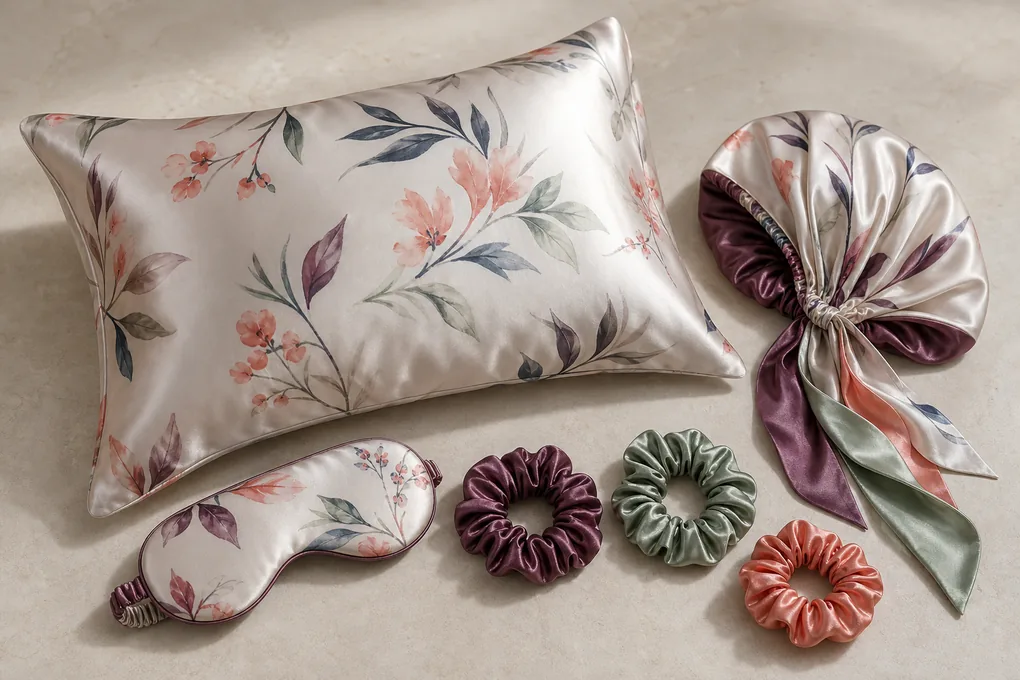
A coordinated accessory launch becomes hard to buy when every item is selected at once. We begin with an anchor SKU: the product that gives the range its clearest sales role, visual identity, or replenishment reason. It can be a pillowcase, sleep mask, scrunchie, bonnet, headband, ribbon, or curler. Companion pieces should support that anchor rather than simply repeat a color. This gives buying, design, e-commerce, and packaging teams one commercial reference while leaving every form free to meet its own requirements.
Choose the Product That Gives the Range Its Commercial Center
Anchor-SKU logic for a wholesale silk accessory collection
Decide what the buyer, merchant, and consumer should recognize first
We ask you to name the item that must make the range understandable at a glance. For a bedding brand, that may be a pillowcase with accessory companions. For a hair-care offer, the lead may be a scrunchie, bonnet, or curler. For a gifting program, a mask can carry the primary story. This is a commercial choice, not a decorative exercise. It tells us which SKU needs the strongest photography, which shade carries visual identity, where brand treatment is most visible, and which product deserves the deepest sample discussion. Without an anchor, a buyer may receive several attractive pieces but no obvious lead item, selling narrative, or replenishment priority.
After the anchor is chosen, we map only companions that make the customer offer more useful. A scrunchie can repeat the pillowcase palette without copying its construction. A sleep mask can complete a bedtime offer without needing the size logic of a bonnet. A ribbon may become a gift detail, while a curler introduces another use occasion. We record why every relationship exists: shared color, shared artwork, a gift moment, a hair-care routine, travel, or a defined set. That record stops the assortment from becoming vague matching items and gives a category manager a direct reason for every SKU in the line.
Separate Shared Range Direction from Individual Product Engineering
One assortment map and one construction brief for each orderable item
Avoid using a matching fabric idea as a substitute for a specification
We work with two connected documents. The assortment map records the anchor, companions, palette or artwork family, sales-channel purpose, and set relationships. Every item then receives its own product brief. A mask brief may need visible surfaces, internal treatment, edge finish, and securing decisions. A scrunchie brief may need fullness, elastic route, seam, and label choices. A bonnet brief can require crown, opening, and securing details. Those points cannot be copied from one product to another merely because all items are described as silk accessories. The split lets design assess the collection story while development reviews the physical object.
The separation also gives quality and procurement teams a stronger comparison base. If two routes remain commercially relevant, we can show what differs and which SKU the difference affects. An unselected measurement, fiber statement, component, or commercial value remains a project question; we do not insert a number or claim simply to make a document look complete. When a buyer later asks why one sample differs from another, the answer can be traced to a particular decision rather than a broad phrase about the collection.
Review the Assortment as a Buyer Would Present It
Check hierarchy, companion value, and practical gaps together
Use a range review before you broaden sampling or purchase scope
Before treating a line as finished, place the selected items in the order a buyer or customer would meet them: anchor first, companions second, any defined set third, and lower-commitment add-ons in their own role. This reveals questions that isolated samples cannot. Does the palette still read as one range? Does the primary product remain clear? Does a companion solve a meaningful use or gifting problem? Is brand treatment present in a sensible place? You can assess the group against the commercial objective: sleep, hair styling, travel, gifting, or an extension to existing silk bedding.
The result should be a decision list, not a general statement that the collection feels aligned. You may retain an item, remove it, shift it into an optional set, or ask for a second route. We associate the choice with the SKU so a change to a ribbon does not silently alter a mask or bonnet brief. This is valuable for bulk buyers coordinating purchase order lines, web listings, pack counts, color names, and feedback across departments. It turns a loose collection into a program that can be reviewed, compared, and replenished deliberately.
Give Every Silk Accessory a Clear Consumer Job and Buying Role
We do not assume an accessory earns a place because it shares silk, color, or a logo with another item. Each SKU needs a clear job for the end customer and a reason for a buyer to list it. That job guides construction, artwork, instructions, bundle logic, photography, and the questions a sample must answer. If its job is unclear, a sample can look polished but still leave a retail team asking why the product exists beside the rest of the range.
Write a One-Sentence Use Case for Every Proposed SKU
Turn a product title into a defined consumer moment
Prevent commercial overlap before samples are commissioned
We ask for a sentence that explains what the customer is intended to do with the item, in what context, and how that use differs from nearby products. A sleep mask may support a sleep or travel routine. A bonnet may be considered for hair coverage during rest. A scrunchie can be a hair accessory or an add-on to a care routine. A ribbon can serve styling, wrapping, or presentation. A curler needs a defined configuration and customer instruction concept. This does not create health, beauty, sleep, or comfort promises. It gives the product, packaging, and listing teams a practical basis for deciding what the offer is.
The use statement reveals duplication early. If two accessories are both described as giftable silk hair items, we ask what separates them: form, styling occasion, set role, recipient, color treatment, or pack count. If no answer exists, a buyer may inherit needless SKU complexity and a retailer may struggle to explain the difference online. We do not cover that weakness with superlatives. We help you decide whether one item becomes an add-on, whether two become a defined pair, or whether the range should focus on the stronger option.
Connect the Use Case to Product Boundaries
Identify what must be included, what may be considered, and what is still open
Keep physical function separate from broad marketing language
Once the customer job is clear, we identify the physical choices that support it. For a mask, that can include coverage shape, visible and reverse surfaces, internal treatment under consideration, securing approach, adjustment need, and presentation. For a scrunchie, the questions often include size category, fullness, elastic enclosure, seam route, and label method. A bonnet can require crown shape, opening treatment, securing route, and visible or interior material decisions. We do not declare universal dimensions, material grades, or components. We document which details require a buyer choice for the product being considered.
Clear boundaries prevent departments from working in different directions. A brief that says coordinated accessory set without stating whether an item is intended for gifting, travel, adult use, or a named hair-care occasion can lead design and packaging to make incompatible decisions. We turn ambiguity into direct questions. The answers can move into sample feedback, product imagery, pack artwork, and e-commerce copy. The retailer receives a product story with a real buying decision behind it, not a page of inspiration with no commercial boundary.
Cover Useful Occasions Without Creating a Repetitive SKU List
Build a focused private-label accessory offer
Balance cross-sell opportunity with manageable range breadth
We review proposed items by use occasion rather than fabric alone. A focused line might touch sleep, hair styling, everyday hair control, travel, and gifting, with a lead product in every relevant area. That does not mean every program needs all categories. Every item should deepen the anchor product's use occasion or open a distinct one. A pillowcase and mask can support a sleep set; a scrunchie may offer an adjacent hair-care moment. A ribbon can make sense when it supports gifting or packaging. It should not be retained merely because it can be cut from a matching fabric.
The buying advantage is control. A shorter list of clearly differentiated products is easier to quote, sample, photograph, pack, order, and replenish than a broad group of look-alikes. Your merchant can request side-by-side comparisons only where an alternative changes the commercial decision. We focus attention on the variables that matter for the specific accessory instead of repeating one sales message across the collection. Before a quotation is requested, the range should show what each SKU is for and what information remains necessary before an order can be discussed.
Define Silk, Lining, Elastic, Filling, and Trim as Separate Components
A silk accessory can contain several components that look alike in a photograph but do different work. We keep face fabric, reverse fabric, lining, filling, elastic, thread, hardware, piping, labels, and packaging materials distinct in the brief. That matters for accurate buyer communication and like-for-like comparison. A glossy surface does not establish the fiber content of every component, and a silk-facing detail should not be described as though it applies to a mixed construction in its entirety.
Map the Construction Before You Approve Product Language
Describe a silk accessory component by component
Make the product statement follow the actual build
We map a proposed accessory from outside to inside. A sleep mask can involve a face fabric, reverse fabric, internal layer if selected, edge finish, strap, adjustment component if selected, and label. A scrunchie can include visible fabric, enclosed elastic, seam route, label method, and decorative feature. A bonnet may include crown material, lining where applicable, edge treatment, and securing. The purpose is not unnecessary technical language. It is to prevent a supplier comparison from collapsing materially different routes into a single word such as silk. Once construction is understood, your team can decide which language belongs on the listing and which description must apply only to a named surface.
Map customer interaction—seeing, handling, stretching, fastening, or storing—against the accessory parts under review. Those actions reveal which components deserve focused sample assessment. A visible panel, concealed elastic, padded interior, and packaging ribbon have distinct roles and cannot be assessed from a loose swatch. Where brand wording has requirements, share them early so they can be linked to the relevant part. We do not create unsupported fibre, performance, or certification claims. We document the proposed build and identify what product, legal, or compliance colleagues may need to confirm before customer-facing language is released.
Use a Bill-of-Materials View to Compare Proposals
Expose construction differences behind the same product name
Ask which component changes appearance, handling, or commercial scope
For a meaningful comparison, ask prospective suppliers to describe the same component list. If one proposal uses a different reverse material, elastic approach, interior layer, trim route, or pack component, that difference should be shown rather than hidden in a broad title. Small accessories are sensitive to this because a minor component change can affect how an item feels, stretches, holds shape, or presents in a gift set. We can structure the question set so your team sees alternatives without being told that one is automatically better. The suitable route depends on product role, use context, customer expectation, and selling unit.
We keep the comparison honest about open fields. If no material specification, measurement, tolerance, or component choice has been selected, it is named as a project decision rather than filled with an assumption. If you provide a physical reference, we treat it as a reference for discussion and identify what still needs confirmation. This preserves the integrity of your buying request. It also gives later revisions a clear trail: the team can see the component that changed instead of arguing about whether a finished accessory matches an unstructured idea.
Judge the Finished Accessory Under Normal Handling
Review sewn, turned, gathered, stretched, and packed components in use
Assess the assembled object, not material pieces in isolation
We encourage sample review on the completed item. A swatch can help with visual direction, but it cannot show how an elastic enclosure behaves, how a seam lies on a gathered scrunchie, how a mask edge sits, or how a bonnet opening is handled. The review should use the condition that matters for the SKU: wearing, adjusting, folding, opening, closing, placing in a gift box, or arranging within a set. If a concern is found, note the component, location, condition, and requested decision. That feedback can be used for a second sample or a commercial comparison instead of becoming a vague impression.
Visual and construction approval should remain separate. You may accept a color direction while holding a securing method open. You may accept a bonnet profile while requesting another edge solution. You may like scrunchie fullness but need a separate check on the elastic route. Recording decisions independently avoids treating a presentation sample as approval of every hidden part. It gives product teams a more accurate source for bulk discussion and helps protect the accuracy of later product, pack, and sales language.
Coordinate Color Across Silk Accessories Without Losing Product Identity
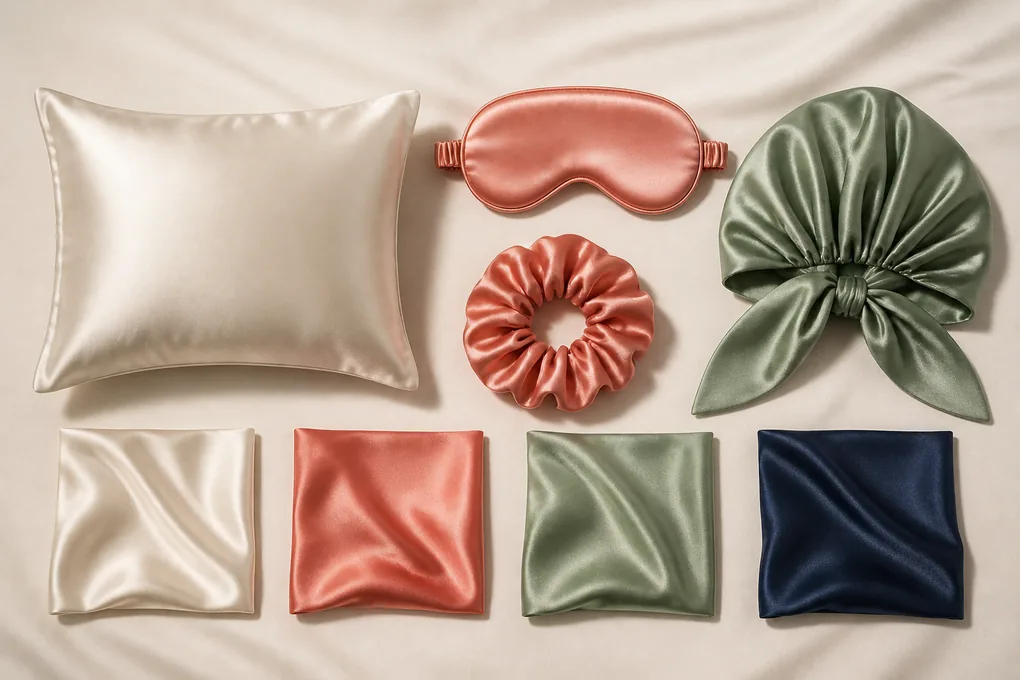
Color coordination often motivates a silk accessory range, but a shared palette must be translated for every form. A gathered scrunchie, flat ribbon, shaped mask, banded bonnet, and pillowcase panel do not show color in the same way. We help define palette direction, choose an anchor shade or print, and decide which products carry it fully, partially, or as an accent. That creates a recognizable collection without forcing every item into an identical treatment.
Create a Palette Hierarchy Before Naming Variants
Anchor color, supporting shades, neutral, and limited accent choices
Give every planned color a commercial job
We suggest assigning a role to every color before deciding how many SKUs carry it. The anchor shade is associated with the leading product and strongest imagery. Supporting shades extend the range without competing with it. A neutral can simplify presentation or a future reorder. An accent color or print can add a smaller visual event to a particular item. This structure helps the collection look intentional when displayed together while allowing a scrunchie, mask, or ribbon to retain its own reason to exist. It also gives merchandising a practical tool for selecting variants that need initial photography, sampling, or buying attention.
A palette hierarchy is more useful than a long sequence of mood-based color names. Provide the references important to your brand, such as approved swatches, artwork, physical standards, or clear visual direction. If a color remains under selection, it should be shown as an open choice. We do not infer an exact shade from a screen image or make an unconfirmed consistency claim. We make the color discussion usable: decide which product carries the full tone, where an accent belongs, which set needs neutral balance, and what needs review before the range is confirmed.
Adapt the Color Story to Gathers, Curves, and Surface Scale
Consider folds, edge binding, pattern scale, and visible area
Do not assume one artwork treatment travels unchanged across every SKU
We discuss color in the form where it will be seen. A gathered scrunchie breaks a shade or print into folds. A flat ribbon presents a different scale. A sleep mask concentrates color on a small shaped field and may gain a boundary from edge treatment. A bonnet may show color across a larger curved surface, while a pillowcase can carry broader placement. These differences are not arguments against coordination. They are reasons to decide how a palette travels from one form to another. You may select shared solids for core pieces, a smaller print for an accent, and a neutral for gift presentation.
This is where artwork and merchandising need one conversation. A design that works on a large panel can feel crowded on a small gathered product. A dark edge may sharpen a mask but make a narrow ribbon look heavy. A brand color can work on a pack card while becoming excessive on the product. We collect those questions before prototypes are treated as final. The goal is a line a buyer can place on a line sheet, a retailer can merchandise, and a customer can recognize across forms.
Review Color on Product, Label, and Pack Together
Protect balance when products are sold alone or in a set
Use the right reference for later commercial discussion
Review color at three levels. First, assess the individual SKU. Next, place it beside intended companions. Finally, examine it with the proposed label, card, pouch, sleeve, or box. A color that works on silk can read differently against paper, print, trim, or another accessory in the set. The decision should state whether a variant is approved for standalone sale, for a bundle, or only for a named presentation. This prevents pack work from altering the palette hierarchy after a product was already reviewed.
For reorders, retain the references your own process requires and identify when a new review is needed. A color name by itself rarely settles a later question. Your team may use a physical reference, approved artwork, signed sample, or internal standard. We can identify which reference relates to each SKU and pack component, but we do not represent an unconfirmed standard as a guarantee. Clear revision control gives purchasing a better way to compare a repeat program with its prior route.
Place Artwork, Labels, and Brand Details on the Right Accessory Surface
Branding a silk accessory program requires more than choosing a logo. We need to know where the brand will appear, how the surface behaves, what has to remain legible, and whether the mark belongs on the product, pack, or both. A label tab, printed panel, embroidery area, ribbon end, carton sleeve, and insert card all serve different purposes. We help select a route that respects the accessory form and gives creative teams a realistic approval sequence.
Map the Surfaces That Can Carry Brand Information
Identify visible zones before choosing a branding route
Separate product identity, required information, and presentation
We begin with a surface map for every SKU. On a sleep mask, possible areas may include a fabric face, small label tab, interior label location, or presentation card. On a scrunchie, a discreet label can be more realistic than a large applied mark because the product gathers and moves. On a bonnet, an outer panel, inner label, or pack component can provide different visibility levels. A ribbon can carry a repeating treatment, a single mark, or no product marking if the pack tells the story. We do not assume one method suits every form. The map lets your team decide where identity should be seen and where detail is better carried by packaging.
The map keeps different needs from colliding. A customer-facing mark, care information, barcode element, and gift message do not necessarily belong in one location. Forcing all of them onto a small accessory can create a crowded presentation or impractical sample. We ask you to rank information: what must be on the product, what must travel with the selling unit, and what can be included in an insert or digital listing. That produces a useful artwork request and keeps a sample focused on a defined decision.
Match Brand Treatment to Shape, Seams, and Handling
Consider scale, placement, movement, and visual interruption
Preserve legibility without crowding a small silk item
We consider physical behavior before a placement is treated as final. Gathering can distort a centered motif. A seam can interrupt a small mark. A curved surface changes how an artwork block is read. A print scale that works on a pillowcase may not work on a narrow ribbon. A small label can serve a quiet signature, while a pack card can carry a fuller story. We work from your supplied artwork and direction. We do not promise that an untested application will behave a certain way. We identify where a physical or visual sample is needed to assess scale, color, position, and readability.
This review can avoid late changes. When artwork arrives after a pattern or pack layout has been assumed approved, it can force a reconsideration of placement, components, or set arrangement. Discussing the surface and purpose first lets creative teams prepare the right asset for a specific zone, boundary, color review, and named SKU. That is more actionable than a broad instruction to brand silk accessories. It reduces the chance that an unspoken assumption becomes the default production direction.
Align Product Branding with Packaging and Listing Requirements
Create a consistent handoff from product to retail presentation
Make the collection recognizable when products are sold differently
A consistent brand presentation does not require every item to carry a dominant mark. The anchor SKU may carry the most visible identity, while companion products use a smaller label or rely on a coordinated pouch, sleeve, card, or box. Ask whether the customer can understand the relationship when products are photographed separately, gifted together, or offered as an extension to an existing range. We can list visual materials needed for those situations: product artwork, label artwork, packaging artwork, buyer-supplied insert content, barcode space, and cross-sell references. Your brand retains control of final marketing and legal content.
The review should state what is and is not approved. Product artwork may be ready while a pack card remains open. A mark may be approved for a mask but not for a ribbon. A statement may require separate legal or compliance review. Keeping those boundaries clear gives e-commerce teams an accurate source for imagery, variant descriptions, and set content. It also stops a packaging draft from becoming an accidental approval of product construction or product claims.
Choose Product-Specific Construction Routes for Masks, Hair Accessories, and Bonnets
Silk accessories are not one construction category. A buyer can want masks, scrunchies, bonnets, headbands, ribbons, or curlers in a coordinated line, but every route creates different questions about shape, seams, layers, securing, and finishing. We help you move from a desired visual look to a product-level discussion. Your team can compare samples for the feature that matters rather than approving a broad appearance and discovering later that functional details were never selected.
Set a Construction Brief for a Silk Sleep Mask
Cover shape, surfaces, internal treatment, edge finish, and securing route
Review visible and functional parts that affect the product concept
For a sleep mask, we begin with the intended silhouette and parts that make up the finished object. Your brief may need face and reverse surfaces, internal treatment if considered, edge finish, strap or securing route, adjustment requirement, and pack format. We do not assume a fill, dimension, strap type, or material grade. Those choices should come from your product concept, target customer, reference sample, and development review. What matters is that they are discussed before alternatives are compared. Different routes can look similar in a catalogue image while behaving differently when worn, adjusted, folded, or boxed.
Review mask samples in the condition you expect customers to use them. Assess the relationship of shape to intended coverage area, alignment of visible features, edge behavior, and securing experience. If you need two routes, name the difference and commercial reason for comparing it. That may be visual profile, pack fit, adjustment concept, or your product positioning. Clear questions produce a stronger sample brief and keep a buyer from approving a design simply because its photograph looks attractive.
Write Separate Briefs for Scrunchies, Ribbons, and Headbands
Gathered, flat, and shaped accessories require distinct instructions
Do not transfer a pattern assumption from one form to another
A scrunchie is a gathered accessory with an enclosed elastic or comparable securing route. Its discussion can cover overall fullness, visible fabric width, seam placement, elastic behavior, finishing, and label handling. A ribbon is flatter and may require a separate conversation about width, length, end finish, print placement, knot use, and gift role. A headband introduces form, internal structure if selected, edge treatment, fit concept, and artwork position. We give every form its own brief so a shared color idea does not erase the decisions that shape the final product. This is useful for private-label teams seeking a coherent hair-accessory family without losing product control.
When you provide a reference sample, we treat it as a discussion tool rather than an unspoken instruction. Tell us what you want to retain, what should change, and what remains unknown. You may like a ribbon's visual scale but need another presentation route. You may like scrunchie fullness yet need a decision on label treatment. Put each point into the brief for its own accessory format. We do not make universal stretch, fit-range, or durability claims without a defined product and appropriate evaluation. The resulting dialogue gives a buyer a credible way to compare choices before a program is selected.
Treat Bonnets and Curlers as Functional Products, Not Matching Extras
Focus on shape, securing, user handling, and customer instructions
Build practical decisions into the sample request
Bonnets and heatless curler concepts deserve functional review of their own. A bonnet can require choices about crown shape, opening treatment, securing system, visible and interior surfaces, and how it is intended to be handled or stored. A curler concept can need an agreed format, fastening components, pack contents, and customer instructions prepared by your brand. We do not promise beauty, hair, sleep, or comfort results. We help define the object you want to assess and the questions a prototype should answer. This stops a coordinated accessory from becoming a product whose practical boundaries were never made clear.
Record any handling or instruction need beside the construction discussion. If a product needs a demonstration, insert, warning, or care message, your team should choose who owns the content and where it belongs. A physical sample can show product route, while a pack mock-up can show whether the explanation fits the presentation. Keeping those approvals separate creates a workable sequence: product format, instructions and artwork, then range presentation. Each decision attaches to a visible part of the item, making the program easier to review across development, commercial, creative, and quality teams.
Set Fit, Comfort, and Handling Questions at the Individual SKU Level
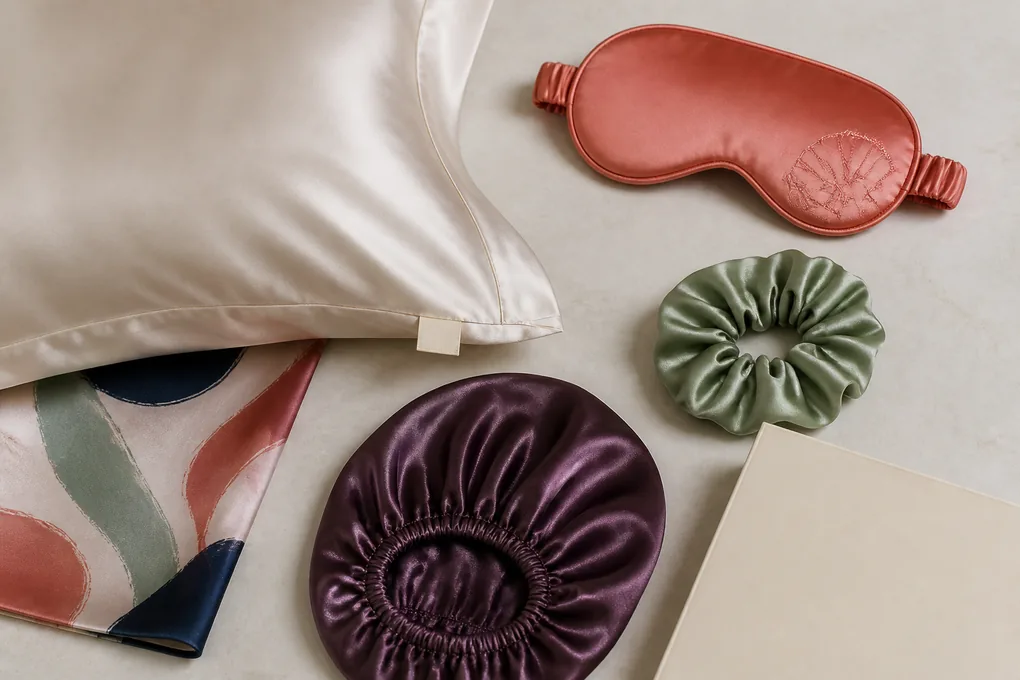
A coordinated palette is not a shared fit standard. We ask you to define the intended user, use condition, and handling concern for each product where size, adjustment, elastic, or shape matters. Do not treat this as a blanket comfort promise. It identifies what a sample must answer before it becomes a bulk reference. A small accessory can become a large customer-service problem when the fitting or handling concept was not settled in the original brief.
Describe Intended Use Without Universal-Fit Promises
Use a practical brief rather than vague comfort language
State the customer context your team intends to assess
We ask you to describe intended customer and use condition in practical terms. The program may be an adult sleep accessory, hair-care add-on, travel item, or gift product for a named sales channel. That context changes questions about adjustment, size categories, packaging, and instructions. It does not justify saying one construction will fit every person or solve every comfort concern. We keep the brief tied to the product you want to buy and identify where your team needs a prototype, fit session, or internal evaluation before selecting a route. That is more useful than adopting a marketplace phrase that may not match the actual item.
Use context changes handling too. A mask may be worn and adjusted. A scrunchie may be stretched, removed, and stored. A bonnet may be placed around hair and secured. A ribbon may be tied, untied, or attached to a pack. A curler may require customer instructions developed by your brand. Describing the interaction separates an appearance decision from a physical assessment. Sample feedback becomes more precise, and commercial teams gain a clearer basis for deciding whether the product belongs in the range.
Put Measurements and Adjustment Decisions in the Product Brief
Name the relevant measuring points and product condition
Do not use an undeclared standard across unrelated accessory forms
If your specification includes a measurement, name the measuring point, unit, and product condition. The right points differ across forms. A flat ribbon, gathered scrunchie, shaped mask, and bonnet opening cannot be assessed from one dimensions list. If you have a target or tolerance, provide it or agree it through your own review process. If you do not, flag the point for decision instead of inserting a number that may not suit your market. This supports consistent feedback and avoids a later conflict over a measurement that never appeared in the request.
Adjustment features deserve the same discipline. A strap, elastic, tie, or securing route should be examined on the completed item under its intended condition. We do not imply an automatic fit range or performance result. We help frame the buying question: what user experience are you seeking, what routes are being considered, and what observation will help select one? Once chosen, the route can move into the sample brief, product description, and pack information without being confused with another accessory in the collection.
Use Sample Review to Resolve Handling Risk Before Bulk Discussion
Record observations from the completed accessory
Turn feedback into a specific next action instead of an impression
Write every observation in a form another person can act on. Note the SKU, condition, part of the accessory, what happened, and decision requested. Saying a strap feels different from expectation offers little direction. Identifying the product, securing route, use condition, and desired comparison gives development a question it can investigate. The same discipline applies to scrunchie gathering, bonnet opening, a ribbon end, or headband feature. This is not bureaucracy; it prevents useful buyer feedback from disappearing into a generic comment about quality.
The decision after review may be approval, revision request, alternative comparison, or a hold until a buyer-supplied criterion is confirmed. Keep outcomes distinct. You can approve range appearance while holding a fit feature open, or approve a product sample while requesting another pack route. That stops broad approval from being treated as acceptance of every open point. The product later discussed for bulk is therefore an item whose relevant handling questions were addressed, not merely one that looked coordinated in a group image.
Define Private-Label Packouts and Gift Sets Before You Compare Quotes
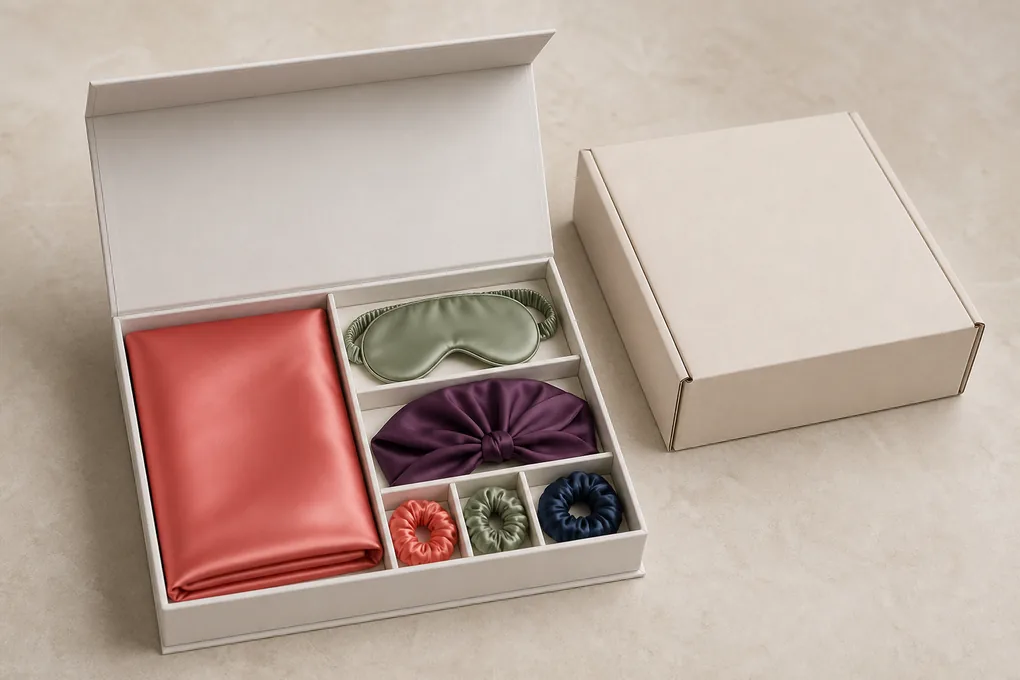
Packaging changes the commercial meaning of a silk accessory. The same scrunchie can be a single add-on, hair-care pair, color assortment, or element of a giftable sleep set. We help you define what the customer receives, how products are counted, how presentation supports the range, and which elements need artwork or approval. Quotes are more comparable when the selling unit is decided before product and packaging assumptions become mixed together.
Set the Retail Unit for Each Accessory Format
Set logic for wholesale and private-label programs
Make the selling unit visible in the buying brief
State the intended selling unit for each item. A single mask, pair of scrunchies, bonnet with matching ribbon, and pillowcase-and-mask set are different commercial products even if they share fabric direction. The selling unit affects count, pack artwork, barcode planning, photography, carton discussion, and listing language. When it is not settled early, teams can compare quotations for different things without noticing. One response may assume individual items in sleeves while another assumes a prepared gift set. Both can use the phrase silk accessory set, but packaging, operations, and commercial scope are different.
Set logic should also state deliberate exclusions. If a pillowcase is styled with a scrunchie but only the pillowcase is sold, record that boundary. If a mask and ribbon are optional companions rather than a required set, keep their orderable status separate. This matters to digital teams as much as purchasing. Customer images, titles, bullets, and pack descriptions must match the actual unit. We can organize the questions, but your brand decides the offer and final content. The result is a disciplined brief with fewer pack and listing errors.
Specify Count, Variant Mix, and Presentation Components
Create a pack definition that can be checked before shipment
Separate product, consumer unit, and transport arrangement
For every pack route, identify included products, quantity of each, color or print mix, label or card elements, buyer-supplied insert needs, and how the customer should encounter the set. A mixed scrunchie assortment may need an exact color sequence. A gift set may need defined placement so the anchor remains visible. A ribbon can be part of the product, attached to a box, or an optional presentation detail; those are different roles. Naming the role makes sample review clearer and helps a supplier see where every component belongs within the selling unit.
Keep consumer units separate from transport packaging. You can define retail presentation without assuming carton count, shipper arrangement, or pallet plan that has not been agreed. If logistics details become relevant to a quote, request them as buyer decisions rather than presenting them as universal facts. This keeps an accessory brief focused while ensuring commercial packing is not forgotten. It also gives e-commerce and retail operations an accurate description of the shopper-facing unit.
Review the Gift Experience Alongside Protection and Count Control
Check opening sequence, arrangement, and completeness
Make sure presentation supports the products it contains
A giftable accessory offer should be viewed as an opening experience, not merely a component list. Look at how the anchor is revealed, whether companions stay orderly, how color appears against pack materials, and whether cards or inserts compete with products. The practical question is whether presentation makes the range easier to understand and more compelling to give without creating an unrealistic packing instruction. A beautiful box is insufficient if it can be assembled inconsistently or if a small accessory can be mistaken for a loose extra component.
For buying teams, completeness is a control point. The final sample should allow a check of identity, variant, count, arrangement, pack components, and customer-facing copy your team has released. If you later add a seasonal shade, a companion, or different card message, treat it as a pack revision instead of assuming original approval covers it. This creates a practical path for expansion while protecting the clarity of the initial customer offer.
Prototype the Full Silk Accessory Assortment Before Judging Bundle Balance
Individual samples answer product questions; an assortment review answers commercial questions one sample cannot reveal. We encourage buyers to examine proposed silk accessories together before treating a collection as launch-ready. This makes it possible to assess whether the anchor remains clear, companions have a sensible relationship, colors and brand details feel balanced, and retail or gift units tell one coherent story. A range can contain capable individual pieces and still be difficult to sell as a group.
Assess Each Sample Before Assembling the Full Range
Do not hide product approval inside a collection photograph
Make separate decisions before judging group balance
We suggest an ordered review. Begin with each item and its own open points: construction, component wording, fit or handling, artwork, label, and pack definition. Only after those questions are understood should the team assemble the full line. This avoids a familiar trap: a group image looks persuasive, so a product-level issue is missed. A scrunchie may coordinate but still need a different fullness or label route. A mask may fit the palette yet require another edge or securing review. A bonnet may be visually strong but still need a clearer user-handling decision. The assortment review should support product approval, not replace it.
When arranging the range, identify each item by commercial role: anchor, companion, optional set member, add-on, or seasonal variation. This exposes a line in which too many products compete for the same place. It also helps merchants decide which SKU needs the strongest image, which pair should be offered together, and which item can wait for a later launch. We can structure material around those questions, while you control the final assortment and customer proposition. The outcome should be direct actions, not a conclusion that the range merely looks aligned.
Check Visual Balance, Hierarchy, and Quote-Comparison Readiness
Give commercial teams a practical view before price discussions
See where extra complexity creates no clear buyer value
A range presentation lets you assess balance across product scale, visual weight, color, and brand visibility. A set can feel overfilled when several small accessories use the same dominant treatment, or underdeveloped if the anchor lacks a useful companion. You can spot variation that creates work without customer benefit. Two similar ribbons in adjacent shades may complicate inventory and photography without opening a new occasion. Several hair accessories can be justified if their form and use differ; they are weaker if they repeat the same role with superficial changes. We turn those observations into keep, remove, combine, or compare choices.
This review prepares a useful quote comparison. When the lineup is stable, a buyer can ask focused questions about products that matter rather than circulate a changing master list. You can compare pack routes, branding treatments, or a core assortment against a broader seasonal concept when the decision needs it. We do not publish retail prices or claim an automatic commercial outcome. We clarify scope so responses are more likely to cover the same product, selling unit, construction, and presentation.
Turn the Range Review into a Launch and Reorder Record
Align product, creative, e-commerce, and procurement teams
Keep the working decision record useful after the meeting
Turn the final range review into a concise working record. It can list every SKU, its role, selected color or artwork direction, planned selling unit, sample status, and unresolved issue. Your organization can add launch or procurement fields as needed. The purpose is a shared view as the collection moves from concept into sampling and buying. The record can distinguish core products from conditional products, which stops a late optional item from changing the assumptions behind the primary program.
For future reorders or extensions, the record shows what requires a new review. A new color, print scale, set count, packaging, or component should not automatically inherit every prior approval. Naming the change lets you decide whether it is visual, product, pack, or a new SKU. This makes the assortment manageable as it grows and keeps teams from relying on old photographs or informal descriptions when a commercial question reappears.
Compare Bulk Silk Accessory Options by the Decisions That Change the Program
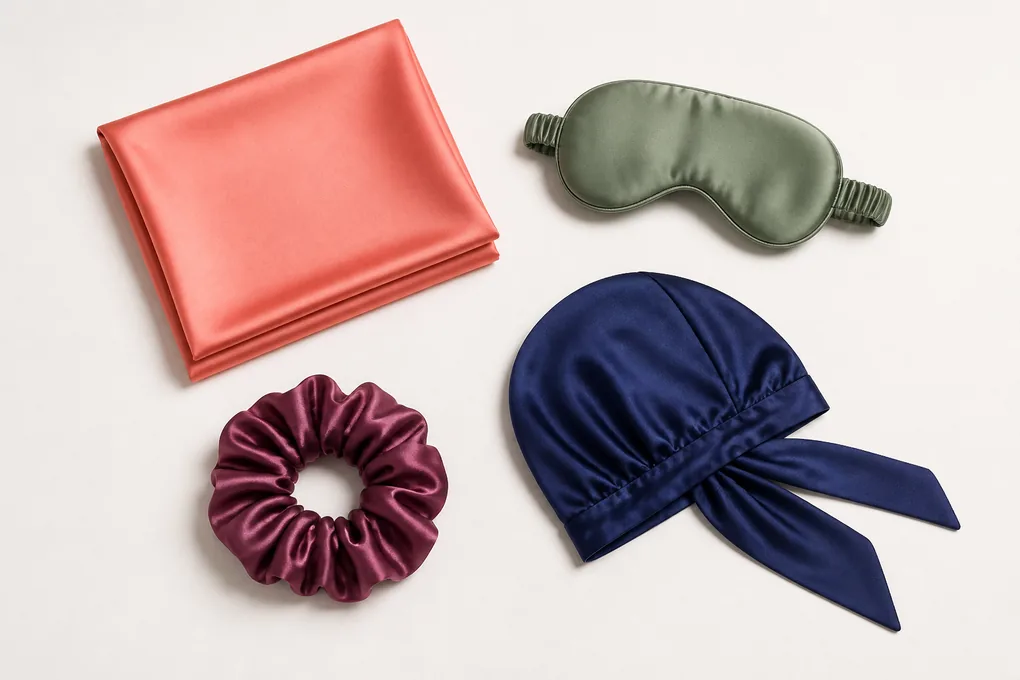
A credible B2B comparison does not begin with a headline price. It begins with decisions that make one program different from another: included products, selling units, component routes, color and artwork treatment, packaging, and sample or approval stage. We help organize those variables so procurement can ask for comparable commercial information without publishing retail pricing or accepting a response that hides differences behind a broad accessory description.
Start Every Comparison with SKU Scope and Selling Unit
Define what is actually being bought
Avoid comparing an undefined product family with a prepared set
Open every commercial comparison with the SKU list and selling unit for each item. State whether the request concerns a single accessory, pair, mixed-color group, or multi-item set. Identify the anchor and optional companions. If quantities are available, include them; if they are not, leave them as buyer input rather than inventing a minimum. This prevents one party from pricing separate pieces while another assumes a prepared gift unit. Both can call the offer a silk accessory set, yet packaging, operations, and scope are not the same. Buyers need to see that difference before asking for a decision.
Once units are clear, your team can decide which alternatives deserve comparison. You may compare two pack formats, component choices, palette routes, or a core range against a seasonal selection. Each comparison should name the choice and reason, not rely on an undefined better option. We do not make capacity, MOQ, timing, or price claims on this page. Those values require a defined request and business review. We help ensure quotation questions describe the same product scope to every party asked to respond.
Expose Component and Artwork Choices That Alter Scope
Show exactly where an alternative changes the product requested
Do not hide material or brand-treatment choices as small notes
A fair comparison makes construction and finish differences visible. List components or finish routes that are selected, optional, or awaiting recommendation. Apply the same discipline to branding. A plain accessory, one with a small label, and one with a printed or embroidered treatment are not the same request because the base form looks similar. A mixed-color set and a single-color pack may involve different artwork, sorting, or presentation work. Place these factors beside the SKU or selling unit they affect. The buyer can trace product decisions to commercial questions instead of discovering assumptions after terms are discussed.
This structure helps when a program evolves. If a buyer adds a ribbon, changes a mask edge, moves a logo from product to pack, or turns a companion into a set item, the revision can be evaluated against earlier scope. Nobody needs to reconstruct the project from scattered emails or reference photographs. We can identify fields that need comparison, but your business keeps authority over selection and commercial terms. The record remains accurate about what has been chosen and what needs a decision.
Sequence Sample and Approval Work to Support Commercial Decisions
Know what must be reviewed before scope is locked
Keep unresolved product questions out of price-only requests
Some accessory routes can be compared from a clear brief; others need a sample or visual mock-up before selection. If the question is pack count, a layout may be sufficient. If the question is a mask edge, bonnet opening, scrunchie fullness, or logo placement on a curved surface, a physical or visual sample can be more useful. The commercial request should say which decisions are fixed and which response should show an alternative. That stops a quotation from being treated as approval of a construction not reviewed by the buyer.
The final comparison should identify the next decision owner. Product development may choose construction, creative may release artwork, purchasing may confirm quantities or target date, and compliance may review a statement. We avoid filling those roles with generic process language. When responsibility and decision are visible, commercial discussion is easier to manage and the selected program is less likely to change after a supplier response arrives.
Use Samples and Change Control to Protect a Reorderable Silk Accessory Program
A first sample is a decision tool, not a permanent product definition by itself. We help buyers distinguish what was accepted in an individual product, what was accepted in range presentation, what was accepted in the pack, and what still needs a decision. This creates a more reliable base for repeat business because a later color, component, artwork, or pack change can be evaluated against a known reference instead of an old photograph or informal memory.
Record the Scope of Every Sample Decision
Product, color, pack, and assortment approvals are not interchangeable
Preserve the boundary of what your team actually reviewed
Label every review outcome by scope. A product sample may be accepted for general shape but not final artwork. A color may be accepted on a pillowcase but need another review on a gathered scrunchie. A gift box may be accepted for presentation while count or insert remains unresolved. Separating approvals lets the project move forward without pretending every detail is settled. Record the SKU, revision, component, or pack element reviewed, what your team observed, and what action is agreed. The record can be brief, but another team member must be able to understand it later.
The value appears when the program is extended. If you add a colorway, you can see whether an earlier decision covered item shape, palette, artwork, or packaging. If a logo moves from label to card, you can see that product construction may be unchanged while brand presentation needs a new review. We structure these distinctions because they make commercial work easier to manage. Your organization should use approval controls suitable to its buying process; this page does not prescribe a universal method.
Keep Retained References Useful Rather Than Decorative
Link each reference to the exact SKU and revision it represents
Do not apply a past approval beyond its actual scope
For a reorderable program, your team may retain signed samples, artwork, palette references, pack mock-ups, or internal product records. Identify the reference you intend to use and connect it to the exact SKU and revision. A retained item is useful only when later reviewers know what it represents. A sample that shows a scrunchie form may not establish an approved gift pack. A print file may establish artwork but not bonnet construction. This is why product, visual, and packaging references remain distinguishable. The approach keeps a previous decision from being applied beyond its actual scope.
Also identify events that trigger fresh review. A new component, changed material route, updated artwork, revised set count, different label, or altered packaging can require new attention. The threshold is a buyer decision and should not be invented in public copy. We provide a disciplined way to spot the change and request a relevant comparison. Procurement can maintain continuity without pretending every reorder is automatically identical to the first program.
Convert Findings into Specific Revisions Before Commercial Release
Use clear observations, owners, and next actions
Avoid generic feedback that cannot be checked later
When a sample needs revision, write feedback naming the SKU, physical location or pack element, observation condition, and requested next action. Saying an accessory needs improvement gives little direction. Identifying a mask edge, scrunchie seam, bonnet opening, artwork position, or pack sequence gives the team something concrete to discuss. If the desired solution is unknown, say so and request an alternative comparison. This preserves buyer authority instead of allowing an unrecorded assumption to become a default change.
Before commercial release, collect open actions in one place. Some may belong to design, development, packaging, or procurement. The range does not need to wait for every future extension, but it should not move ahead with unresolved decisions hidden behind a generic sample approval. We can transform range information into a clear next-stage request: sample revision, visual proof, packing mock-up, or comparable quotation. That gives the next order and later replenishment conversations a stronger handoff.
Plan Final Bulk Checks Around the Failure Modes of Each Silk Accessory
We do not use a generic end-of-line checklist for every silk accessory. A sleep mask, scrunchie, bonnet, ribbon, headband, and mixed gift set create different opportunities for mismatch. Final review should connect the agreed brief to the item actually checked: identity, selected construction, artwork, color, measurements where specified, workmanship, functional components, labels, pack count, and presentation. This gives a B2B buyer a useful basis for acceptance discussion rather than a broad assurance statement.
Write Checks That Match Actual Product Risks
Use a product-specific control list instead of a broad silk claim
Focus on what can go wrong in the selected configuration
Start with the agreed configuration. A sleep mask review may cover chosen shape, visible surfaces, edge route, strap or adjustment feature, label, and pack. A scrunchie review may cover fullness, seam, elastic route, visible fabric, label treatment, and color or print. A bonnet needs its own attention to crown form, opening or securing feature, selected surfaces, and presentation. A gift set adds count, product identity, order, and arrangement. These are examples of how a buyer can make final checks relevant to a selected product, not universal requirements that apply to every program.
The reviewer needs an agreed comparison point. If a measurement, artwork, color reference, sample, label text, or pack mock-up has been accepted through your process, identify it in the plan. If something was not decided, do not pretend a final check can confirm it. Escalate the open point to the appropriate owner. This keeps control grounded in the accessory you selected and avoids an assurance paragraph that gives purchasing no practical way to assess whether delivered goods match the requested program.
Check Mixed-SKU Packs for Identity, Count, and Presentation
Protect buyers from substitution and incomplete gift units
Review the complete selling unit as well as individual pieces
Review a mixed accessory pack as a complete selling unit. Check SKU identities, color or print mix, item count, labels or cards, and how products sit in the presentation. A small mistake can change the customer experience: an incorrect scrunchie shade, missing ribbon, duplicate item, or card placed with the wrong product can make a coordinated set feel inconsistent. These are practical matters that can be identified in a pack sample and included in a final commercial brief. We organize the information so it can be checked, without claiming an inspection frequency or acceptance limit that has not been agreed.
The same logic applies when the range changes. A new variant, altered count, or seasonal substitute creates a revised commercial unit. The original pack reference may remain helpful, but the updated route should be compared openly. This gives retail operations and e-commerce a stable source for pack descriptions and images, while giving purchasing a clearer view of what must be confirmed before the next order.
Close the Program with an Honest Release Record
Separate confirmed selections from decisions still owned by the buyer
Make the final handoff usable for purchasing and product teams
At the end of review, prepare a short release record naming the SKU, selected configuration, approved visual or physical reference, selling unit, and open decision. Do not state that unknown values are confirmed. If a commercial term, compliance statement, component detail, or timing question still needs written agreement, keep it visible to the responsible owner instead of hiding it in an assurance statement. This is a reliable handoff from development into purchasing: clear scope, clear reference, clear exception, and clear next action where one is required.
A well-closed program is easier to reorder because the team can see exactly what the original decision covered. It is also easier to expand because a new product, color, or pack route can be compared with a known base. Send us the range you are considering even if the initial brief is incomplete. We will identify product-specific questions needed for a comparable sample or quotation discussion, while your organization keeps control of final commercial, legal, and approval choices.
Questions for a Private-Label Silk Accessory Range
Which accessory families belong in a coordinated silk program?
Start with the anchor item, then retain only companion products with a distinct use, gifting, pack, or merchandising role. Masks, scrunchies, bonnets, ribbons, headbands, curlers, and pillowcase companions require product-specific briefs.
How should a mixed accessory selling unit be described?
List every included article, count, selected color or artwork route, product identity, pack role, and intended customer presentation. Keep optional companions outside the stated unit until you define them as a separate SKU or set.
Can a shared color or logo treatment approve every product in the range?
No. A shared direction can connect the range, but every product needs its own review of construction, surface, artwork position, component wording, fit or handling question, and pack treatment.