
P003
Wholesale Silk Pillowcases: Classic, Printed, and Two-Face Development
A silk pillowcase bulk inquiry becomes comparable when the finished case, pillow insert relationship, contact face, opening, edge, artwork, selling-unit pack, and approval question sit together. We help B2B buyers turn classic, printed, and two-face ideas into product-specific development conversations rather than generic retail listings.
Published by China EverBen Silks Reviewed by Mark Liu
Prevent a pillowcase quote from masking closure or edge choices
Name the style, insert reference, opening, edge treatment, artwork, and selling-unit question together.

Choose Classic, Printed or Reversible Silk Pillowcases by the Selling Job
A silk pillowcase range should begin with the customer promise and merchandising role, not with a long list of interchangeable colors. Classic solid cases support repeatable basics and color stories. Printed cases carry artwork and collection identity. Reversible cases create two visible faces but add alignment, turn-of-cloth and labeling decisions. We help buyers select the construction whose physical behavior supports the intended offer before multiplying sizes or packs.
Use Classic Pillowcases for Stable Replenishment Programs
Solid-color continuity, fit and closure remain visible
A dependable core SKU earns repeat orders
Classic pillowcases suit programs where the buyer values a clean silk face, consistent insert fit and a construction that can be reordered without rebuilding artwork. The brief still needs precision. Identify which faces are silk, the selected fabric-weight reference reference, finished dimensions, closure style, edge detail, color target, care expectation and selling-unit count. A plain appearance exposes rather than hides workmanship: twisted edges, zipper distortion, uneven flange width and shade variation are easy for customers to notice.
Core ranges benefit from deliberate SKU restraint. Standard and king dimensions, for example, should correspond to real inserts in the destination market instead of borrowing size names without measurements. Core shades can receive deeper allocations, while seasonal colors remain separate. We also ask whether cases are sold singly or in pairs and whether replacement units must match an established color. Those choices affect project allocation, labeling, pack artwork and replenishment communication.
The assortment brief also names what is deliberately absent. A solid core case does not automatically include piping, gift packaging or two-face presentation; a printed case does not inherit every classic color; a reversible SKU is not assumed to contain two separate pieces. Explicit exclusions keep sales imagery, sample requests and quotations aligned. When a buyer later adds a feature, a buyer can show which pattern, component, approval and pack decisions reopen. This is especially valuable when several departments join the project at different times and might otherwise interpret the family name in incompatible ways.
Select Printed Pillowcases When Artwork Drives the Product
Scale, repeat, placement and color are construction inputs
An image file alone is not a print specification
Printed pillowcases are appropriate when motif, collaboration or collection graphics create the reason to buy. The artwork must be translated into scale, repeat type, orientation and placement on the finished case. A tossed pattern behaves differently from a centered panel; artwork with an obvious direction needs an agreed top-to-bottom reading; a border print must meet seams with an agreed visual relationship. We request editable artwork, color references and ownership confirmation before treating the design as sample-ready.
Print development also considers the closure and fold. A motif that looks balanced on a flat fabric strike-off may disappear into an envelope flap or be interrupted by a zipper. Front and back orientations must be stated, as must any acceptable change near sewing margins. We review a representative printed sample for color, sharpness, hand, registration and finished-product placement rather than approving only a screen image. That links the graphic result to the object customers actually receive.
Range architecture also affects how customer reviews can be interpreted. If classic, printed and reversible cases use distinct SKU identities, returns can be linked to the actual closure, face construction, size or artwork. Merging them under one generic item hides whether complaints come from fit, print placement, zipper exposure or two-face balance. We recommend preserving construction-level data through ecommerce listings, wholesale line sheets and internal service reports. That feedback can guide the next project decision without treating every pillowcase as though it failed for the same reason.
Reserve Reversible Construction for a Genuine Two-Face Benefit
Two useful faces require intentional engineering
Contrast must survive seams, labels and care
A reversible pillowcase should offer two deliberate looks or functions, not simply an unplanned reverse side. The buyer identifies the intended face A and face B, their material and color or print, the desired turn at openings and edges, and how the product is presented in the pack. If different silk colors or artworks are combined, shrinkage, shade relationship, seam show-through and pressing behavior are reviewed together. Labels and closure components must not make one face feel like the inside.
Reversible products may consume more fabric or introduce additional operations, so the buyer should compare the merchandising benefit with the added complexity. We examine whether a clean double-face result can be achieved through the selected construction and whether the case remains easy to insert, close and launder. Approval covers both orientations under natural handling. A sample that photographs well on one side but twists, exposes internal details or misaligns on the other is not ready for a reversible claim.
Define Every Silk Contact Face and Supporting Component
A finished pillowcase is more than the visible center panel. Customers touch the face, edge, opening and closure area; hidden parts can still influence comfort, laundering and labeling. We define the fiber scope of each face and name supporting components separately. This prevents a broad silk statement from being applied to zipper tape, piping cord, interlining, labels, thread or another part that was never included in that material claim.
Name the Material Scope Face by Face
Front, back, flap and decorative edge require clarity
Fiber wording follows the actual component map
For a classic case made from one silk fabric, the material map may be simple: front, back and envelope flap use the same selected construction. A reversible case can have distinct faces that need separate identification. Printed and solid panels may also differ in processing even when both begin with silk fabric. We state where each nominated fabric is used, which side is intended to contact the sleeper, and whether any layer or panel is decorative rather than part of the principal contact surface.
This map supports accurate packaging and online copy. If both main faces meet the approved silk specification, the buyer can describe that scope directly. If only one face is silk or another component uses a different fiber, the declaration must not imply otherwise. We review the proposed claim as text and compare it with the bill of materials. The same approach applies to documented scope language: a document is cited only for the products and attributes it actually covers.
A component schedule includes approval responsibility. Our team can propose thread, closure and trim directions, while the buyer may control brand labels, licensed artwork or specified packaging. Each item has an owner, due date, approved reference and substitution rule. This matters when timing commitments differ: finished silk can be ready while a buyer-supplied label is delayed, or a nominated zipper can change availability. Seeing dependencies early allows purchasing to choose whether to wait, approve a documented alternative or adjust the launch sequence without losing traceability.
Engineer the Closure without Ignoring Hidden Materials
Zipper, tape, puller and flap affect the sleep surface
Concealment is checked under a filled pillow
A zipper closure introduces tape, teeth, slider and end stops. Their composition and color are identified separately from the silk shell. Position matters: the closed puller should not create a hard point on the normal contact face, and stitching should hold the zipper without puckering the edge. End areas receive particular attention because repeated insertion and laundering can concentrate stress there. A concealed construction is judged with the pillow filled, not only when the empty case lies flat.
An envelope closure removes hardware but creates its own material and fit requirements. The overlap must be deep enough to retain the intended insert while remaining practical to load. Its inner edge should be finished cleanly, and bulk from folded silk should not form an uncomfortable ridge. If a flange or piping intersects the opening, the sequence of operations must preserve both access and symmetry. Closure choice is therefore a component and use decision, not a label placed on an otherwise identical case.
Component review extends to foreseeable replacement and repair questions. A buyer planning long-term replenishment may need the zipper specification held stable, while a seasonal printed program may prioritize exact short-run color coordination. If a nominated component is discontinued, we present an alternative with the properties that matter—dimensions, operation, color, hand and care compatibility—and obtain approval before use. The response does not promise indefinite availability. It gives purchasing a controlled comparison and documents why the replacement remains suitable for the released pillowcase.
Specify Thread, Piping, Labels and Optional Layers
Small parts can change hand, durability and claims
Component approval includes color and placement
Thread selection affects seam appearance, elasticity and resistance to opening. Piping adds cord or a folded insert, increases edge bulk and creates corner alignment work. Brand, size, care and origin labels introduce materials and seam locations that customers may feel. Any interlining or stabilizer used around embroidery, flange or closure changes local hand. We list these parts, their intended function, color and placement so the sample can be evaluated as the full construction rather than as fabric alone.
Components are reviewed for compatibility with the agreed care process and target market requirements. A dark zipper tape should not shadow a pale face; a coarse label should not sit where the sleeper’s cheek or neck rests; exposed piping joins should not become the first visible point on a premium product. Buyer-supplied trims require version control and timely delivery. If a substitute becomes necessary, it returns for approval instead of being treated as an invisible project choice.
Select a Fabric-Weight Route for the Finished Pillowcase
A fabric-weight route is one buyer input, not a universal shorthand for quality, comfort, or service life. Assess it on the exact pillowcase style under consideration, together with surface appearance, drape, opacity, seam behavior, opening area, edge treatment, artwork or colour choice, and unit presentation. Keep the material conversation connected to that named style instead of treating a listing number as a complete product description.
Read Fabric Weight Through the Completed Pillowcase
Weight influences body, drape and consumption
The number does not replace a physical sample
A lighter catalog route can create a more fluid expression, whereas a heavier route commonly has greater mass across the same area. That difference may influence opacity, edge bulk, pressing, opening behavior, pack volume, and material consumption. Weave and finish also matter. Two silk fabrics with an identical nominal fabric-weight reference can still look or feel unlike one another when construction, finishing, or colour route changes. Keep the selected value attached to a physical fabric reference; it should not become the range’s only quality label.
Purchasing should compare samples under the intended pillowcase construction. A fabric swatch cannot reveal zipper puckering, envelope recovery, flange balance or how a reversible combination turns at the edge. We document the nominated reference, lot or sample identity and the product configuration in which it was reviewed. If the buyer later changes from solid to print, from simple edge to piping, or from one face to two, affected behavior is reassessed instead of assuming the earlier fabric decision remains complete.
Compare Fabric Routes on Equivalent Pillowcase Builds
Premium language requires more than a larger number
Customer expectations become measurable priorities
A buyer may associate a heavier option with greater body and a lighter option with an airy hand, but those are starting expectations rather than universal outcomes. Ask what the program must achieve: a fluid luxury look, stronger visual coverage in pale shades, compact travel packing, specific drape around the insert, or compatibility with a defined closure and care message. The priorities guide which alternative fabric-weight routes references enter sampling and what differences the buyer should examine.
Commercial comparison uses the exact chosen construction and allocation. Material consumption changes with finished dimensions, closure allowance, flange or piping, print repeat and cutting yield. A higher number cannot be evaluated fairly through a headline commercial value alone, and we do not display retail or universal bulk commercial values. The RFQ identifies quantities by size, color and style so each material direction can be reviewed against the same finished-product requirements.
Carry the Selected Fabric Route into the Project Brief
Measure the agreed attribute by an agreed method
Bulk acceptance refers to the approved standard
The specification records the selected fabric-weight reference as a value or band, the fabric identity, the agreed test approach, and any conditioning or sample-preparation conditions the programme requires. Results are read against that shared definition. Appearance and handling remain separate decisions: compare shade, lustre, surface, hand, and drape with the chosen reference because a numerical result does not establish those qualities. Review seams, opening areas, and edges as well, where the silk is folded or placed under local stress.
Bulk inspection samples the relevant lots and variants rather than inferring every unit from one result. If a measurement or appearance falls outside the agreed boundary, the finding identifies the affected material lot and finished styles. The parties can then decide correction, sorting, additional review or another disposition. This controlled use of fabric-weight reference gives purchasing a defensible requirement without turning one textile figure into a promise about every aspect of the pillowcase.
Fabric-Weight Reference terminology should remain consistent across product name, specification, label and marketing copy. If the buyer uses a range or nominal value, the same basis should appear wherever it influences a claim. Flag conflicts such as a package naming a different fabric route while the released SKU matrix points to another fabric. Promotional comparisons also need care: a larger fabric-weight reference number does not establish that every customer will find the product cooler, softer or more durable. Clear, limited language strengthens trust and reduces the risk that a textile measurement is asked to support an unrelated benefit.
Fabric-width and cutting-yield effects are considered after the finished pattern is defined. Fabric-Weight Reference influences consumption by area, but flange width, envelope depth, print repeat, reversible layers and defect avoidance can change usable yield. Calculate requirements from actual sizes and allocations rather than from a simplified weight comparison. This is why two offers naming the same fabric-weight reference may not represent the same product. A transparent RFQ keeps material identity, finished construction and quantity split together so purchasing can understand which physical assumptions support the commercial response.

Translate Pillow Insert Size into Finished Pillowcase Dimensions
Size names such as standard, queen and king vary by country, retailer and brand. A bulk program needs numeric insert dimensions, desired fit and a defined finished-product measuring method. Use those inputs to set the case body, seam allowances, closure overlap and any flange relationship. This prevents a familiar source of returns: a product labeled with the expected size name that is visibly loose, difficult to load or unable to contain the actual pillow.
Start with the Physical Insert and Target Fit
Length, width and loft all influence loading
Nominal market names remain secondary references
The buyer provides the insert’s measured length and width, its typical loft or fill behavior, and whether the assortment covers multiple insert suppliers. A soft, compressible insert can enter a closer case differently from a firm, high-loft pillow. The desired appearance also matters: tailored, relaxed or full. We agree whether the case should finish near the insert dimensions or include ease, and we confirm that the opening allows practical loading without overstressing seams or closure components.
If the buyer only has a market size name, we request the destination standard or a physical reference before locking dimensions. A buyer can use catalog dimensions as development starting points, but we label them as such. A 48 by 74 centimeter catalog pillowcase reference, for example, does not prove compatibility with every pillow sold under a similar name. Numeric confirmation keeps a local retail convention from becoming an accidental factory instruction.
Fit feedback is recorded against the insert used. A comment such as “too loose” has little value without the insert dimensions, loft, sample ID and observed movement. We note corner fill, surface tension, opening behavior and any distortion after normal loading. If the buyer wants one case to accommodate a range of inserts, the extremes are tested and the acceptable compromise is stated. The product description can then give customers useful dimensional guidance without implying that every pillow sold under the same market size will behave identically.
Define the Finished Measurement State
Empty, closed, laid flat and measured at named points
Tolerance requires a repeatable procedure
Finished dimensions are taken in a stated condition: the case is empty, its opening is arranged as specified, the fabric rests naturally without deliberate tension, and the tape measure runs between named seam or edge points. A flange can be included or excluded from the body measurement, so the drawing must show the rule. Piping creates another visible boundary that may not coincide with the internal insert space. Zipper and envelope cases also need an agreed opening measurement and location.
Tolerance is not selected by copying a generic percentage. It considers the dimension, fabric behavior, construction, measurement uncertainty and buyer fit risk. Long dimensions may justify a different numerical allowance from narrow flange width or zipper position. We review pilot measurements to see whether the proposed boundary is both manufacturable and protective of fit. Inspection results then mean the same thing to project, the buyer and any third-party inspector.
Packaging dimensions should not become the source of product dimensions. A compact box may encourage an overly tight fold, but the pillowcase must first fit its insert and meet its finished specification. Calculate packaging around the approved product, then adjust presentation materials if volume is higher than expected. Similarly, ecommerce image proportions cannot set the cutting pattern. Physical fit, product-development allowances and measured sample results control the case; photography and packaging are developed to represent that case accurately.
Account for Closure and Decorative Allowances
Usable cavity is not the same as outer silhouette
Overlap, flange and piping receive separate dimensions
An envelope flap occupies fabric and creates a retention zone, but its full length does not add usable pillow width. We specify finished overlap and opening behavior separately from the case body. A zipper usually sits in an edge seam and requires end allowances, concealment and access. Flanges extend the visual outline beyond the pillow cavity; their width and corner geometry are controlled independently. Piping follows the seam line and must remain balanced around all sides.
Patterns and reversible faces add placement relationships to dimension control. A centered motif should remain centered after seam uptake, and opposite faces should not shift the finished outline through unequal processing. The sample drawing records body, opening, overlap, flange, zipper and label positions. Filled-pillow review then checks whether those measurements create the intended fit and appearance. Only after both flat measurements and filled use agree do we treat the size as ready for bulk planning.
Engineer Envelope, Zipper, Flange and Piping Details
Closure and edge choices determine how the pillow loads, stays contained, feels in use and presents on shelf. They also create distinct sewing and inspection risks. We treat envelope overlap, hidden zipper placement, flange width and piping as measurable construction elements. The buyer can combine appropriate features, but each combination is reviewed as one physical case rather than assembled from isolated option names.
Design Envelope Overlap for Retention and Access
The flap must hold without fighting the insert
Inner finishing affects comfort and durability
Envelope depth is selected against the insert size, loft and fabric behavior. Too little overlap can expose the pillow after movement; excessive depth can make loading awkward and add bulk. The opening orientation is shown on the drawing so print direction, labels and pack fold remain consistent. The flap edge is finished to resist fraying and lie smoothly inside. We inspect it filled and after representative opening cycles because a flat empty case can conceal a weak retention result.
The envelope seam sequence should avoid a hard ridge across the sleep surface. Corners receive attention where multiple layers meet, particularly when flange or piping is added. If the buyer wants a two-sided appearance, the flap and inner finish are considered from both visible directions. Sample comments describe the exact problem—pillow exposure, difficult insertion, uneven overlap or local bulk—so the correction can target geometry or workmanship rather than simply asking for a “better closure.”
Construction combinations are reduced when they create no buyer value. Piping plus a wide flange, for example, may create an elaborate edge but increase bulk and corner complexity; a zipper at the same boundary may limit placement choices. A buyer can prototype the combination when it serves a defined design goal, yet we also explain the simpler alternatives and what each removes. The decision remains with the buyer and is recorded in the SKU specification. This supports purposeful customization rather than adding every available feature to a single premium-sounding style.
Place and Conceal Zippers for Safe, Clean Operation
Hardware stays away from the normal contact zone
Opening length and end stops govern usability
A hidden zipper should open far enough for the intended insert and close without catching silk, lining or seam allowance. We specify its edge location, direction, tape and teeth color, puller style and closed-puller position. Protective fabric coverage can reduce direct hardware contact, but it must not obstruct movement. End stops and bartacks are reviewed for strength and neatness because closure failure often begins where repeated pulling concentrates load.
The filled sample is operated by hand, not merely photographed. We load and remove the pillow, check slider travel, examine seam puckering and feel the closed edge from likely sleeping positions. Laundering and pressing instructions must suit the chosen hardware. If a zipper substitution is proposed, size, color, operation and compatibility return for approval. A visually similar component is not automatically equivalent when it changes exposure, smoothness or durability.
Workmanship checkpoints follow the selected edge. Envelope cases emphasize flap depth, inner finish and overlap alignment; zipper cases add tape capture, slider travel, end security and concealment; flange cases add width and corner consistency; piped cases add cord coverage, join position and smooth curvature. A combination style receives all relevant checks, but the list remains tied to its drawing. This focused approach is more useful than a generic “premium stitching” promise because inspectors know where to look and buyers know which visible or functional outcome is protected.
Control Flange Width and Piping around Corners
Decorative edges amplify small inconsistencies
Symmetry is measured across the finished perimeter
A flange creates a framed silhouette and needs an agreed finished width from seam line to outer edge. Mitred, square or another corner treatment is selected deliberately. Pressing should produce a smooth, balanced border without scorching, glazing or distortion. On filled review, the flange should sit as intended rather than collapse irregularly or pull the body out of square. Labels and closure openings are positioned so they do not interrupt the visual frame.
Piping adds a corded or folded line whose diameter, fabric, color and join location matter. It should remain even around corners, with no exposed cord, twisting or abrupt thickness change. The join is placed in a less conspicuous area and secured cleanly. Printed motifs may need alignment to the piping color; reversible cases need an edge treatment acceptable from both faces. Inspection samples corner shape, continuity, seam capture and overall dimensions together.
Develop Solid Silk Colors for Shade Continuity and Range Logic
Solid silk pillowcases place color, luster and surface consistency at the center of the customer experience. Pale neutrals can reveal shadowing or component contrast; dark and saturated shades can make rub-off, wash behavior or shade drift more visible. We develop colors against an approved physical target and define how project lots, paired units and replenishment orders will be compared. A screen swatch or color name alone cannot carry that responsibility.
Approve Color against a Physical Standard
Lighting and silk luster alter perception
Digital values support communication but not final shade judgment
The buyer may begin with Pantone, LAB values, a fabric cutting or an existing product. Identify which object is the controlling target and record its condition. Silk’s directional reflection can make one piece look lighter or darker as it turns, so comparison uses consistent lighting, orientation and backing. Instrumental readings can support the decision when specified, while visual approval examines the actual luster and surface. The accepted lab dip or project reference is labeled and retained for comparison.
Color tolerances are agreed for the program rather than assumed. A commercial match may be evaluated differently for an isolated accessory than for two pillowcases sold as a matched pair. Where buyers need exact coordination with bedding or packaging, those neighboring references are included early. Do not promise that monitor images will match a physical product. Product photography and website swatches should communicate variation responsibly while project uses the approved physical standard.
Manage Lots for Singles, Pairs and Coordinated Bedding
Pack relationships determine shade grouping
Traceability supports replenishment and complaint review
When two cases are sold as a pair, both pieces should come from a controlled shade grouping so a customer does not open an obviously mismatched set. Coordinated bedding may require pillowcases to relate to a duvet cover or sheet produced from a different allocation. We define which components must be visually matched and plan cutting and packing accordingly. Variant and lot identity remain traceable through work-in-process and finished cartons.
Replenishment creates a different challenge because silk, dyeing and finishing inputs can vary between orders. Compare new lots with the retained approved reference and disclose that physical project follows tolerance rather than a promise of mathematical identity across unlimited time. If the buyer needs old and new inventory mixed on shelf, the acceptable relationship should be discussed before project. Clear lot records make a shade complaint investigable instead of anecdotal.
Evaluate Fastness and Surface Appearance for the Destination
Color performance follows agreed care and use
Pale and dark shades carry different visible risks
The check plan reflects the care instruction, likely friction and destination requirements. Buyers may request relevant colorfastness methods for washing, rubbing, perspiration or another exposure, but method, grade and scope are confirmed before any claim. Dark dyes near skin or light bedding deserve particular attention to transfer risk. Pale shades are checked for opacity, staining, component shadow and color cast. Printed labels or packaging should not transfer onto the silk during storage.
Finished-product review also looks for streaks, spots, pressure marks, inconsistent luster and color change at seams or pressed edges. The case is examined in more than one orientation because directional shine can mimic shade variation. Findings distinguish true color inconsistency from normal optical behavior. This prevents unnecessary rejection while still protecting the premium uniformity buyers expect from a solid-color product.
Color names are treated as identifiers, not standards. “Ivory,” “champagne,” “rose gold” or “navy” can describe very different physical shades across brands and seasons. The SKU uses the buyer’s approved commercial name alongside an internal color code linked to the accepted target. If a name changes for marketing, the physical reference and project identity remain stable. This distinction prevents a copy edit from being mistaken for a dye instruction and helps warehouse, packaging and replenishment teams distinguish close colors.
Shade allocation can also influence launch imagery. Photography samples should be identified and should represent the approved color target, yet project remains subject to the agreed comparison method and tolerance. Retouching should not transform a pale neutral into a materially different hue or remove normal silk luster. We recommend that digital merchandising notes acknowledge screen variation where appropriate. A disciplined relationship among physical standard, project, photography and online naming reduces disputes that no dye house can solve through a color name alone.
Convert Print Artwork into a Manufacturable Silk Pillowcase
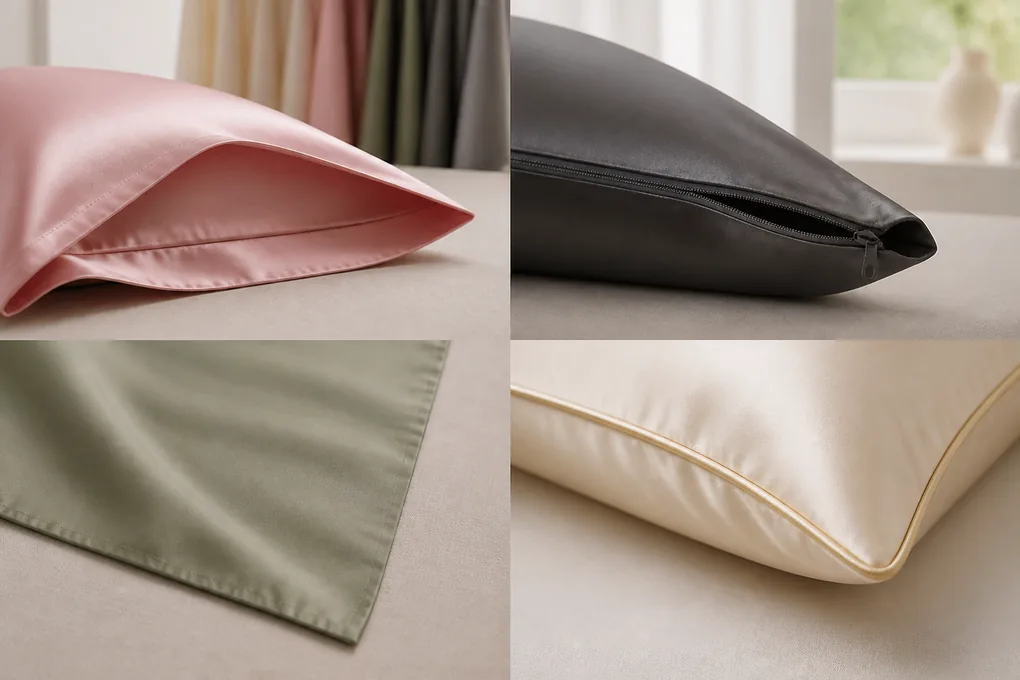
Printed silk pillowcases succeed when artwork survives scale, fabric behavior, cutting, sewing and care without losing the intended composition. A marketplace image can inspire direction, but it cannot establish ownership, repeat, color target or acceptable placement. We request project artwork and translate it into a print brief tied to the exact pillowcase dimensions and closure. Approval moves from file to strike-off to finished sample.
Prepare Artwork with Ownership, Scale and Repeat Defined
Vector or high-resolution files need project instructions
Motif intent is stated before color work begins
The buyer confirms the right to use all graphics, fonts and licensed elements. Files include color separations or named color targets where relevant, plus the intended physical scale. Repeat type—straight, half-drop, engineered placement or another arrangement—is specified rather than inferred. Directional motifs receive a top and bottom reference. If multiple pillow sizes share artwork, the buyer decides whether motif scale remains constant or composition changes by size.
Bleed and seam allowance are planned around the finished case. Important faces, text or borders stay away from cutting and sewing zones unless intentional. An envelope flap or zipper edge may hide part of the design, and flange width can change the visible field. We prepare a placement representation using the actual pattern pieces. This allows brand and product teams to approve what the customer will see, not just a rectangular artboard detached from construction.
Artwork changes after strike-off approval are classified by impact. Correcting a spelling error outside the print field differs from changing motif scale, background color or the number of repeat elements. Identify whether the strike-off, placement sample, pack proof or all three need renewal. This avoids unnecessary resampling for unrelated edits while preventing a substantial visual change from slipping through as a “small file update.” The current filename, revision and checksum or controlled identifier travel with approvals and project files. Archived versions remain separated from released files.
Approve Color and Detail on Silk, Not Only on Paper
Luster and ink or dye behavior change appearance
A strike-off answers material-level questions
The print trial uses the nominated silk reference and process direction because color and sharpness depend on the substrate and finishing. Compare the strike-off with approved targets under agreed light and examine fine lines, gradients, registration, penetration, hand and unwanted marking. Large dark grounds, saturated colors and delicate pale artwork may require different attention. A paper proof remains useful for content and position but cannot approve the textile result.
Each approved strike-off is identified by artwork version, scale, colorway, fabric and date. Comments specify measurable or visible changes rather than asking for an undefined improvement. If a colorway changes, only the affected elements reopen, provided process and material remain controlled. This record prevents an old digital file from reappearing after a newer textile color decision and gives bulk comparison a reliable reference.
Print scale is checked on every ordered size because the same repeat can create a different visual balance on a larger king case than on a smaller format. Buyers may accept natural motif cropping for an all-over pattern, but a centered emblem or border requires defined position. The artwork brief states whether size variants share one scale, receive scaled compositions or use separate files. Yield and approval consequences are reviewed before quotation. This avoids discovering after sampling that the desired king composition cannot be produced by simply enlarging the standard artwork.
Place the Print on the Finished Case and Inspect Repeats
Cutting and sewing complete the visual design
Motif relationships are checked across product sizes
The prototype shows front, back, opening, flange or piping and the packed fold. We examine whether a hero motif is centered as intended, whether directional elements face consistently, and whether the repeat produces awkward seams or obvious discontinuities. Random-placement prints need an agreed acceptance approach because every unit will not display identical motif locations. Engineered placements instead require tighter positional checks and may change cutting yield.
Bulk inspection samples colorways, sizes and print lots. Checks cover artwork version, orientation, repeat scale, visible flaws, registration, color relationship and absence of transfer or contamination. Packaging is assessed for fold marks that conceal the main design or place hard components against printed silk. The result is a print program that can be described honestly and reproduced within stated acceptance rules, rather than a one-time photograph with no product-development definition.
Build a Reversible Silk Pillowcase That Works from Both Faces
Reversible construction requires two complete user experiences. Both orientations must look intentional, feel appropriate and operate with the same insert. The seam, opening, label and edge cannot reveal one side as an unfinished reverse. We identify the principal display side and its counterpart separately, then solve the points where they meet. The buyer approves the product turned both ways and understands any added material, operation, pack or care dependency.
Give Each Reversible Pillowcase Side a Clear Selling Role
Color, print and material choices need a relationship
Two faces should create a reason to reverse
A buyer may pair two solids, a print with a solid, or two coordinated prints. The brief names the primary and secondary presentation, the intended contact surfaces and any differences in material or finish. Colors are assessed together because contrast can show through at seams or change the perceived tone of a pale face. Printed faces need independent orientation and scale decisions. We also confirm whether both sides carry the same fiber claim or require separate descriptions.
The reversible benefit should be clear to the customer: seasonal color change, styling flexibility or another honest use. It should not rest on claims that one untested side performs differently. If buyers want distinct functional messages, the attributes and check scope for each face must be defined. This keeps merchandising creativity connected to verifiable construction and prevents the second face from becoming unsupported promotional copy.
Turning instructions can be included when the reversible method is unfamiliar, but they should be brief and product-specific. The customer should understand how to access the opening and which label or closure detail identifies each orientation without reading a technical manual. Pack photography may show both faces and clarify that one pillowcase is reversible rather than two cases being included. Accurate contents language is especially important in online channels, where two color views can otherwise be interpreted as a pair.
Resolve Seams, Closure and Label Placement for Two Directions
Internal details cannot migrate onto a display face
Turning must preserve fit and smoothness
Seam architecture is selected so allowances, overlocking, zipper tape and flap finishing remain concealed or deliberately finished when the case reverses. A closure must work from both orientations without creating an exposed puller or inaccessible opening. Flange and piping need equal visual quality on both faces, including corners and joins. Thread color may require compromise or a construction that hides it. The filled case is handled from both sides to find pressure points and twisting.
Labels are a frequent reversible-design conflict. A conventional side-seam label can become conspicuous when turned. Options may include a carefully positioned low-profile label, removable presentation label or another compliant arrangement, subject to destination requirements. Do not omit mandatory information merely to create a clean photograph. Instead, the buyer reviews legal and branding needs while we identify a placement that protects both usability and appearance.
Bulk planning for reversible cases keeps paired face materials synchronized. If face A and face B arrive from different lots or processes, cutting and assembly allocations must preserve the approved combination. Substitution on one face can alter shade relationship, hand, shrinkage and edge behavior even when the replacement seems similar alone. Therefore, review the pair as the unit of control. Carton and SKU identity also indicate the approved combination so replenishment does not accidentally mix a new secondary face with an old primary reference.
Control Differential Behavior between the Two Faces
Paired materials must respond together
Care and dimensional change are evaluated as one product
Different colors, prints or fabric treatments can react differently during processing or care. If one face changes dimension, hand or color more than the other, the case may twist, bubble or lose edge alignment. Compare nominated fabrics before assembly and evaluate the finished sample after the agreed care simulation. Seam length, grain direction and pressing are controlled to keep the faces balanced. Any accepted natural variation is described rather than hidden.
Bulk checks view both faces, not a sample folded permanently to the primary side. Inspection includes shade or print, stains, seam show-through, edge roll, closure access, measurements and filled appearance in both orientations. Pack instructions identify which face is outward and ensure turning guidance is understandable. A reversible claim is released only when the secondary face receives the same deliberate review expected for the primary display face.
Place Brand, Size and Care Information without Damaging Comfort
Labels and printed information are small in area but large in customer impact. A stiff tag at the cheek, an exposed label on a reversible face or conflicting fiber and care statements can undermine an otherwise strong pillowcase. We coordinate brand identity, size, fiber content, care, origin and traceability with the product construction and destination review. Every physical and printed element must identify the same style and variant.
Separate Required Information from Brand Presentation
Compliance content and storytelling serve different jobs
Destination review determines mandatory elements
The buyer provides target countries, selling channels and proposed label copy. Their qualified adviser confirms applicable fiber, care, origin, language and business-identification obligations. We reserve space and select a construction that can carry the approved information. Marketing claims remain separate from required declarations and need their own substantiation. Do not copy a competitor label or assume that one market’s format is acceptable in another.
Brand presentation may include woven marks, printed labels, hangtags, inserts and package graphics. Each element receives a purpose, size, material, color, position and artwork version. Repeating the same fiber or care statement across several pieces can create inconsistency when one file changes, so the approval set lists which source controls each field. Barcode and SKU identifiers are checked against the actual size, color, closure, fabric-weight reference and pack count.
Choose Label Position by Contact and Construction
Comfort and visibility depend on the finished case
Placement is tested with the pillow inserted
Side seam, opening area and inner flap positions each carry tradeoffs. A side label may touch the sleeper or interrupt piping; an inner label may be concealed but harder to access; a reversible product can expose either location. The label edge, fold and attachment should not create scratching or a hard knot. We pin or temporarily place components on the filled sample before final sewing so product and brand teams can evaluate use rather than relying on a flat drawing.
Label stitching must not distort the silk or weaken a critical seam. Thread and backing are selected to limit puckering and show-through, especially on pale shades. If a removable label is considered, mandatory information still needs a compliant durable location where required. Decorative metal plates, charms or heat transfers receive additional review for contact, care, adhesion and staining risk. Premium appearance never overrides wearer safety or truthful information.
Maintain Artwork and SKU Parity across the Selling Unit
One approved identity follows product, pack and carton
Version control prevents mixed messages
The pillowcase style name, size, color, closure and pack quantity are reconciled across sewn label, insert, retail pack, barcode data and outer carton. A “pair” package must contain two matching cases and use a unit identifier distinct from a single. Printed variants carry the correct artwork or colorway code. Reversible cases name both faces consistently. Use approval proofs and pack samples to find discrepancies before bulk packaging begins.
Bulk line checks compare the physical product with the released artwork set. Obsolete files and superseded labels are removed from the active work area. If the buyer revises a claim or care symbol, affected stock and timing are identified before implementation. Traceable version control lets purchasing know exactly which orders carry the change and helps customer service investigate a reported mismatch by SKU and lot.
Care statements are tested against the complete construction. Silk fabric, dye or print, zipper, piping, labels and any decorative application must tolerate the released process together. If the buyer proposes machine washing, hand washing, specialist cleaning, drying or ironing language, the method and symbols are reviewed for the destination and supported by appropriate evaluation. We avoid inserting generic care language solely because it appears on competing products. The selected instruction should protect the item customers will actually own and remain consistent across sewn label, insert and online listing.
Translation is handled as controlled artwork, not as an informal text replacement. The buyer supplies approved language or assigns qualified review for destination copy. Text length can change line breaks, symbol spacing and minimum size, so each version is proofed on the actual label or package area. SKU, material and care data remain consistent across languages. If online copy uses a shorter marketing phrase, it must not contradict the durable label. This protects international programs from a visually polished translation that changes the underlying product statement.
Design the Selling-Unit Fold and Packaging around Silk
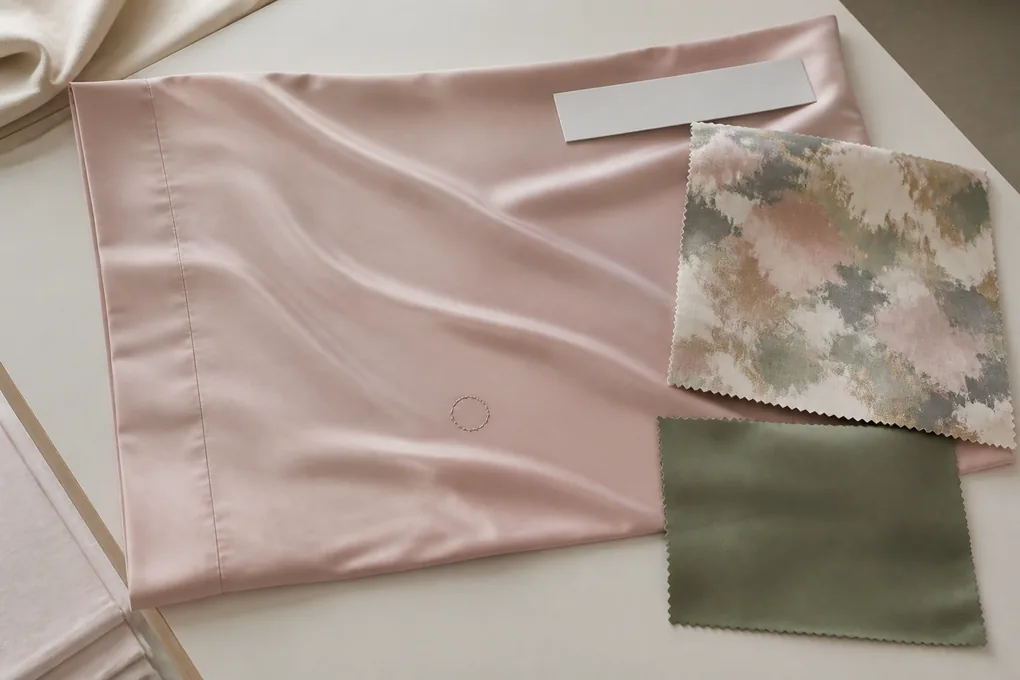
Silk pillowcase packaging must protect a smooth, lustrous surface while communicating the exact product inside. Hard edges, excessive pressure, color-transfer materials and uncontrolled folding can leave marks before the customer opens the pack. We begin with the selling unit—single, pair, set component or gift combination—then define fold, protection, label, insert, barcode and outer-carton relationships. Packaging is sampled with the finished case, not approved as an isolated graphic.
Define the Selling Unit before Choosing the Package
Piece count controls identity, volume and inspection
Singles, pairs and sets need different reconciliation
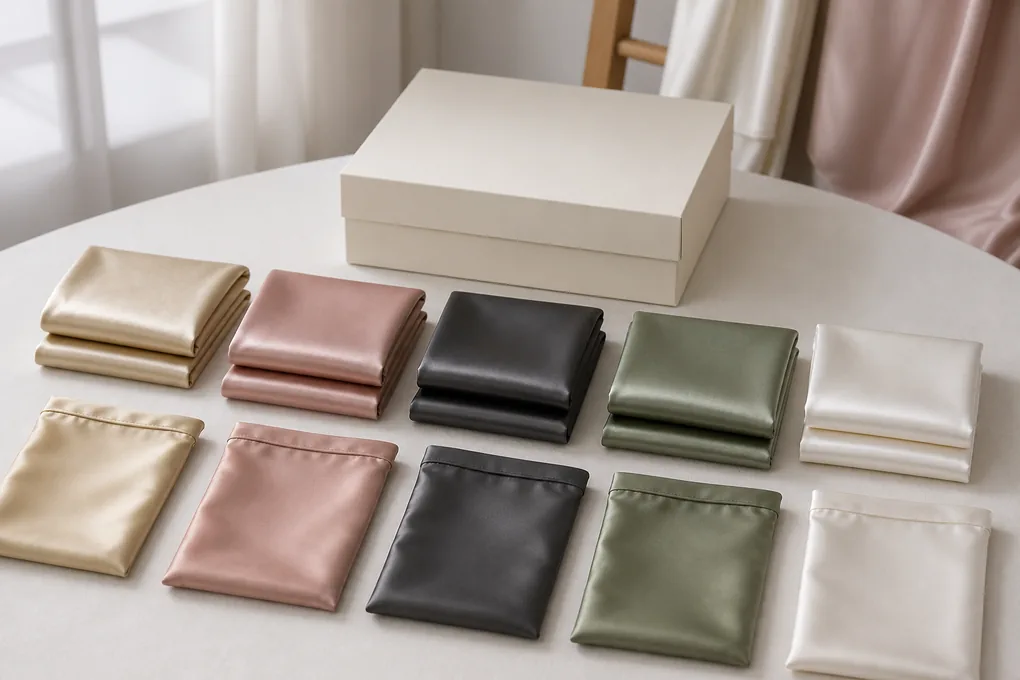
A single pillowcase can use a compact fold and one size-color identity. A pair needs shade grouping, count verification and a fold that presents both pieces without confusion. When pillowcases join a bedding set, component dimensions and labels remain traceable even though the consumer buys one set. Gift editions may add a care card, presentation wrap or reusable storage piece, with each included item named precisely. The pack list records every component and quantity.
The selling unit drives barcode assignment, insert copy, retail dimensions, weight estimates and carton planning. We distinguish individual pieces from sellable packs in the RFQ because quoting 1,000 pieces can mean 1,000 singles or 500 pairs. Inner packs and master cartons state their conversion. This arithmetic is checked against purchase order quantities and packing results so an attractive package does not conceal an allocation error.
Unboxing sequence should respect both product protection and inspection practicality. A package that requires cutting close to silk creates snag risk; a tightly sealed sleeve may make repacking impossible for warehouse checks; loose tissue can shift and expose hardware. We open pilot packs using ordinary customer actions and record any contact with scissors, adhesive, staples or sharp card edges. The preferred sequence lets the case emerge cleanly, shows the correct face and preserves inserts or care information without asking customers to dismantle unnecessary layers. Warehouse teams can then reseal checked units without disguising damage or losing components.
Fold and Protect the Contact Surface
Presentation should not create permanent pressure marks
Closure hardware and labels stay away from exposed silk
The fold places the clean contact face outward or inward according to the presentation and protection strategy. Zipper pullers, label edges, piping joins and rigid inserts should not press directly into visible silk during storage. Tissue, sleeves, bags, cartons or molded supports are reviewed for surface compatibility and destination needs. We avoid promising that every crease will disappear; instead, packing density and fold sequence are evaluated on retained samples after representative storage.
Pale colors need protection from dust, ink transfer and mixed-color contact. Dark printed packaging can be isolated from the silk where transfer risk exists. Moisture protection, ventilation and desiccant decisions consider route and packaging materials rather than following one formula. The buyer also confirms sustainability, recycling or material claims before they appear on the pack. A lower-material format should still protect the premium product throughout handling.
Carton planning uses the finished selling-unit dimensions and weight after pack approval. We define units per inner and master carton, carton marks, variant segregation and any pallet or shipping constraints provided by the buyer. Excessive compression can mark silk, while loose packing can allow movement and crushed retail packs. A trial pack-out shows how units are arranged and how counts are checked. Shipping estimates remain provisional until the approved package and actual assortment quantities establish the physical basis.
Approve Artwork on the Physical Pack
Color, barcode and legal copy share limited space
A packed sample tests appearance and usability
Package artwork identifies product, size, color or colorway, material scope, care reference, quantity and business information as approved for the destination. Barcode quiet zones and contrast are tested on the chosen substrate. Product photography should match the packed variant and avoid implying contents not included. Window positions, if used, must reveal the intended area without exposing silk to abrasion or light beyond the agreed protection strategy.
The packed sample is opened and reclosed by people unfamiliar with development. We look for confusing orientation, difficult removal, snagging, excessive tape, loose components and instructions that contradict the sewn label. Drop, compression or transport simulations can be defined when the distribution route requires them. Bulk packing checks piece count, variant identity, artwork version, fold, cleanliness and carton marks. Packaging approval is complete only when graphics and physical protection work together.
Validate Silk Pillowcases with Filled Samples and Use-Cycle Checks
An empty pillowcase can pass a table inspection while failing the first time a customer inserts a pillow. Filled validation exposes fit, closure access, corner shape, zipper concealment, flange balance, print placement and contact comfort. Use the buyer’s nominated insert or an agreed physical equivalent and record its dimensions and loft. The sample sequence separates fabric and color decisions from construction and final packed-unit approval.
Build the Sample Sequence around Open Decisions
Lab dip, strike-off, prototype and pre-project serve different purposes
One approval cannot answer every question
Solid colors may begin with lab dips; prints may require strike-offs; unusual trim can require a component sample. A construction prototype answers dimensions, seam, closure and filled appearance. A sales sample may support photography after product decisions are stable. A pre-project sample brings together released fabric, color or artwork, labels and packaging before bulk. We state what each sample is meant to approve and avoid charging one early sample with decisions it was not built to answer.
Buyer comments identify the sample ID, observed condition, location and requested outcome. “Opening exposes 30 millimeters of insert after normal movement” is more actionable than “improve closure.” Photographs include scale and orientation where useful. Accepted areas are recorded so corrections do not reopen unrelated details. If a change affects neighboring features—for example, wider flange changing overall dimensions—the dependent checks return in the next sample.
Sample approval should include people from the functions that own later risk. Product management reviews the assortment promise, technical and quality teams review construction and measurements, brand teams approve artwork and presentation, and purchasing confirms scope and commercial assumptions. Parallel review is useful when decisions are independent, but one named release consolidates them. This prevents a photographer’s acceptance of appearance from being mistaken for technical approval or a zipper check from authorizing unreviewed packaging.
Evaluate Fit, Contact and Operation on the Insert
Loading and sleep-facing details require handling
Both normal use and foreseeable stress are observed
The case is loaded without excessive pulling, and corners seat without large empty pockets or distorted seams. Envelope retention is observed after movement; a zipper is opened and closed repeatedly while fabric clearance and puller concealment are checked. Flange and piping should remain even around the filled shape. Labels, joins and closure ends are touched from likely contact positions. Reversible cases repeat the process on both faces.
The review does not invent universal comfort outcomes. It records the specified insert, user actions and physical observations. When the target range includes different pillow lofts, representative extremes may need separate trials. A use-cycle check can include repeated insertion, removal and laundering according to the agreed care route. Findings guide dimension, component or sewing adjustments before a larger pilot makes the same problem expensive.
Approval quantity and sample source are identified. A hand-finished development piece can answer design questions, while a pre-project sample should represent intended materials, equipment and methods closely enough to reveal project risks. If an approved sample includes an exceptional manual correction that will not occur in bulk, the difference must be disclosed and resolved. Compare pilot units for consistency rather than admiring one best piece. This gives purchasing a realistic basis for release and gives project a standard that can be repeated rather than a presentation artifact. The release note records the quantity examined and any accepted limits.
Approve the Packed Product after Representative Storage
Fold recovery and component pressure become visible over time
The release sample matches the selling unit
The finished case is folded with actual labels, insert and package components, then held under a defined storage condition where appropriate. After opening, we examine transfer, abrasion, pressure marks, odor, closure indentation, fold recovery and artwork condition. The pack should identify the correct variant and allow removal without snagging. Paired cases are compared for shade and count. This confirms that the first customer impression reflects the product approved during development.
A retained approved sample supports project setup and final comparison, but it is accompanied by measurements and identified component or artwork references. Physical samples age and can be handled differently, so they should not be the only instruction. The release decision states remaining limits and which changes require renewed approval. Purchasing then receives a product that has been seen as fabric, construction, filled object and packed selling unit—not merely as a catalog image.
Turn Bulk Pillowcase Quality Requirements into an RFQ and Inspection Plan
A useful RFQ defines the pillowcase being commercially evaluated and the risks the buyer wants controlled. It separates mandatory values from preferences, quantities by orderable variant, buyer-supplied inputs from supplier discussion responsibilities, and approved claims from open questions. The resulting inspection plan follows the selected construction. Retail pricing, universal minimums, timing assurances, coverage statements, tolerances, and inspection grades should not be assumed before the actual allocation and requirements are reviewed.
Submit One Clear Row per Orderable Variant
Size, color, construction and pack count define the SKU
Headline quantity is divided into manufacturable allocations
Each line identifies classic, printed or reversible construction; finished size; intended insert; selected or requested fabric-weight reference; solid color or artwork version; envelope or zipper; flange or piping; label set; selling-unit count; and required quantity. Optional alternatives are placed on separate rows. A pair is stated as sellable units and total pieces. This lets material, cutting, sewing, printing and packaging requirements be evaluated against the real mix rather than against one misleading total.
The allocation reveals setup complexity. Ten colors across two sizes and two closures may divide a large purchase into small project lots. Printed colorways can add strike-offs and artwork controls; reversible combinations can pair distinct materials. Identify which variants drive sampling, yield, component and schedule differences. If the buyer wants simplification, a buyer can show the impact of reducing colors, consolidating closures or separating a pilot from the replenishment range without changing mandatory product needs.
Attach the Inputs That Determine Feasibility
Measurements, claims, artwork and packaging are decision files
Unknown values are named instead of guessed
The inquiry includes insert dimensions and loft, target finished measurements, destination, care direction, proposed fiber or performance claims, color target or artwork, branding files, packaging concept, barcode needs, inspection requirements and target decision dates. Buyer-supplied components and required documented scopes or check reports are identified for scope confirmation. Where data is incomplete, the buyer marks the field for our proposal. That produces a useful question instead of a silent assumption.
Reference links can show an aesthetic or feature, but the buyer states which characteristic matters. Do not copy marketplace descriptions, review quotations, medical promises or competitor artwork. A reference zipper case may illustrate hidden hardware while leaving material, dimensions and construction open. We convert the intended feature into measurable language and note exclusions. This protects originality and makes our response comparable with any other supplier’s proposal.
Inspect the Risks Created by the Selected Construction
Sampling covers lots, variants and selling units
Findings support proportionate corrective decisions
Core checks can include product identity, material reference, a specified fabric-weight target, finished measurements, shade or print, surface appearance, seam and stitch condition, opening operation, flange or piping, labels, cleanliness and pack count. Printed products add artwork version, scale, orientation and registration. Reversible products add both-side appearance and differential behavior. Zipper and envelope cases receive different functional checks. The agreed sampling basis and acceptance criteria are recorded before final inspection.
An inspection finding states what was observed, where, how many sampled units were affected and which requirement applied. Photographs support measurements and functional notes. The distribution helps distinguish isolated workmanship from a systematic lot, pattern, component or instruction issue. Purchasing can then decide correction, sorting, additional sampling or another disposition with evidence. The same specification supports repeat orders and complaint investigation because the shipped product remains traceable to its variant and approval set.
The RFQ response repeats inclusions and assumptions so offers can be compared on equal products. It identifies the nominated fabric route, construction, quantities, sample plan, buyer-supplied files, packaging basis, destination and open decisions. Commercial validity belongs to that scope. A later change to size, print, color allocation, closure, label or pack can alter consumption and operations, so we assess it transparently. This discipline helps buyers compare total program requirements rather than selecting a headline number attached to an undefined pillowcase.
Complaint handling closes the quality loop. The buyer’s service team can categorize issues by SKU, lot, size, color, closure and observed failure, retaining photographs and measurements when practical. Compare the report with released specifications, inspection findings and retained references. A confirmed pattern may call for corrective action in material, pattern, sewing, component, pressing or packing; an isolated misuse question may call for clearer care or size guidance. Structured feedback improves the next order without converting an anecdote into an unsupported claim about all units.
Buyer questions about wholesale silk pillowcase development
What separates the three pillowcase routes?
Classic focuses on opening and edge, printed adds artwork placement and approval, and two-face requires a separate definition for each visible face.
Can this page confirm a fixed size or closure?
No. The page identifies inputs needed to review the requested construction.