
P007
Silk Hair Bonnet Development for B2B Buyers
A silk hair bonnet is simple to photograph but complex to buy well. The customer judges it by whether it contains her hairstyle, feels comfortable at the hairline, stays positioned during the intended routine, and looks credible when she opens the package. A buyer also needs a product that can be described accurately: which component is silk, which closure is selected, which silhouette belongs to which customer, and which sample evidence supports the final selling message. We use this page to help B2B teams define those decisions before requesting a comparable manufacturing conversation. Start with the question delaying your program, then send the information already known; we will focus the discussion on the unresolved fit, component, artwork, packaging, or approval issue.
Published by China EverBen Silks Reviewed by Mark Liu
Keep crown, band, closure, and wearer context connected
Describe the bonnet form, hair-volume or fit reference, closure route, and pack need before quote review.
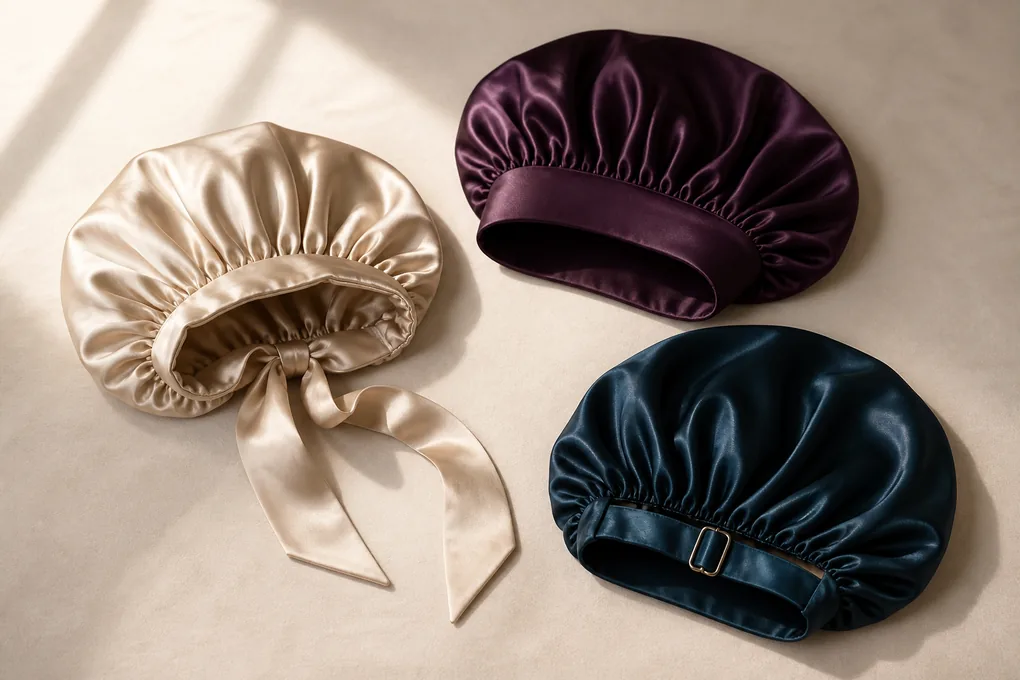
Match Silk Hair Bonnet Profiles to Real Hair and Retail Channels
We begin with the person who will wear the bonnet, not a generic one-size label. A compact overnight bonnet for short hair asks different questions from a roomier style intended for curls, braids, locs, rollers, extensions, or long hair gathered at the crown. The buying channel also changes the right commercial answer. A prestige beauty retailer may need a controlled color story and an orderly selling unit. A digital-first hair-care brand may need a clear product explanation and photographs that show the closure honestly. A gift program may need the bonnet to coordinate with a pillowcase, mask, or scrunchie while remaining a useful product on its own. We ask buyers to identify the intended hairstyle, use routine, customer preference, sales channel, companion items, and variant role before discussing construction. That work prevents a sample from becoming a vague universal item that must later be renamed, re-packed, or overclaimed. It helps merchandising explain the range, product teams select a credible silhouette, and quality reviewers know which fit scenario matters. The outcome is a bonnet assortment with a defined customer purpose rather than a collection of nearly identical colors and closures.
Define the wearer without a universal-fit promise
Hair profile, use routine, and retention preference
A range built around an identifiable customer need
We ask buyers to name the hair situations the line must serve. A person protecting a close-cropped style may value a light stable shape; a person wearing dense curls, braids, locs, or rollers may need greater usable crown space and a different entry route. Those needs cannot be resolved by a broad marketplace phrase. Record the intended hair arrangement, whether the bonnet is worn overnight or during hair care, and whether the customer is accustomed to an elastic, tie, or adjustable closure. Those inputs make a fit review useful and keep a lifestyle image from becoming accidental proof of performance.
Separate retail context from basic product function
Shelf, digital, set, and subscription requirements
A product that is easier to merchandise truthfully
We see a channel decision influence the product plan even when the silhouette is unchanged. A specialty retailer may need concise feature language and a premium opening experience; a subscription program needs variants that fulfillment can distinguish; a branded set needs a deliberate relationship between companion items. Write the actual channel, display method, intended price tier, and adjacent products into the buyer brief. This exposes whether a named feature, color cue, or package format deserves a separate sample rather than leaving a supplier to infer commercial intent from a polished reference photo.
Build variants around meaningful customer differences
Coverage, volume, and closure as a coherent range map
Fewer returns caused by a product-customer mismatch
We prefer a focused range in which every variation earns its place. A compact elastic bonnet, a larger adjustable option, and a tie style can make sense if each serves a named customer or use condition. Three nearly identical crowns with different names normally create inventory complexity without helping selection. Identify what actually changes between options: hair-volume suitability, coverage, closure behavior, artwork, or pack language. That statement supports purchasing comparisons, retail training, product photography, and customer service without implying that one style fits every wearer.
For each proposed option, we ask the buying team to record the reason it exists, the visual cue that distinguishes it, and the customer situation it is intended to address. The retail name, photography brief, product copy, carton label, and supplier reference should describe the same selected form. When those records disagree, a small variant difference can become an incorrect pack, misleading listing, or sample comparison that does not answer the right question.
Set Crown Volume for the Hair Mass Your Silk Hair Bonnet Must Hold
Crown volume is a functional decision, not a decorative measurement. A bonnet can look spacious in a flat photograph and still compress the intended hairstyle once it is filled. It can also be too loose for the customer the range claims to serve, creating an untidy shape or unstable wear. We help buyers describe the filled article: where hair sits, how it is gathered, the amount of lift needed above the scalp, the entry path, and the relationship between depth, circumference, and retention. A supplier cannot reliably infer that information from a product name such as large or extra-long. We recommend a short fit scenario for every proposed silhouette, including the intended hair arrangement and how the customer puts the bonnet on. Then a sample review can examine containment, balance, opening ease, pressure points, and dressed appearance. This approach avoids unsupported claims about universal fit and gives a buyer a concrete reason to choose a compact crown, extended crown, or separate volume option. It also makes a future quotation more comparable because the supplier responds to an identified capacity problem rather than an unmeasured picture.
Describe the filled shape, not only a flat dimension
Hair placement and vertical space
A crown selected for useful capacity
We recommend describing the bonnet when it is doing its job. Does the customer place hair loosely, gather it at the top, preserve rollers, or direct length away from the face? A flat pattern number alone cannot answer that because panels, gathering, and the opening change the filled result. Share the intended arrangement and any existing customer feedback. A sample can then show whether hair is contained naturally, whether the silhouette stays balanced, and whether the product displaces the style. We do not present an unverified dimension as suitable for every hair profile.
Review depth, circumference, and opening together
Three zones that interact during dressing
A balanced entry and finished fit
We do not solve a restrictive crown by enlarging every area automatically. More depth can create collapse if the opening and retention route remain unchanged. More circumference can redistribute gathers without creating usable space where hair needs it. A larger opening can simplify dressing yet require a different stability strategy. Review where hair sits, how the customer enters the bonnet, and how the item stays positioned after movement in one session. Record pressure, empty pockets, shifting, and hair displacement on the assembled sample so revisions address the actual cause.
Limit variants to capacity differences customers can understand
Compact, extended, and adjustable routes
A clear choice at retail and in purchasing
We add a crown variant when it solves a real customer or channel need. A compact style, extended-volume form, and adjustable option can form a sensible range when each has a visible use benefit. Avoid creating multiple names for the same physical capacity. State the intended wearer, the design distinction, and the product information that must appear on packaging or online. This lets suppliers quote against a stable configuration and helps retailers avoid explaining a range through vague size language. The goal is a silk hair bonnet that meets a defined need, not a larger assortment on paper.
A capacity choice becomes commercially useful only when the customer can recognize it before use. We encourage separate product identifiers, differentiated front-of-pack language, and deliberate photography that shows the intended silhouette without implying a result for every wearer. Before adding a new crown, compare its retail role, sample observation, and operational consequence against the existing range. That comparison keeps the assortment focused on meaningful selection rather than minor pattern changes.
Map Crown Panels and Seam Geometry Before You Approve a Silk Hair Bonnet
Panel layout influences how a bonnet fills, drapes, and looks when a customer wears it. It also determines where seams meet the head, where a print may split or gather, and how easily the inside can be finished. We treat the pattern as a buying decision because a polished flat mock-up may conceal a seam across a sensitive area, a junction that creates unwanted bulk, or a silhouette that changes when hair is inside. Buyers should be able to see the relationship among crown panels, gussets, gathered zones, band attachment, tie or elastic connection, and visible artwork. We recommend reviewing the construction flat, turned inside out, and dressed on a representative form or participant. That reveals twisting, abrupt tension, empty pockets, uneven gathering, or an artwork placement that only appears correct before the product is worn. The selected panel plan should be recorded with the approved sample and artwork reference. This gives purchasing, design, and quality teams one physical description of the bonnet instead of several loosely connected opinions about a photograph.
Compare panel routes by the filled silhouette
Crown pieces, gussets, and gathering zones
Fullness directed where hair needs it
We look beyond the number of pieces and ask where each pattern section directs space. A gathered crown may create a soft familiar form; shaping can distribute room toward the back, top, or sides. An extended panel can add useful volume without making the whole bonnet loose. The right route depends on the hair profile and desired visual character, not a rule that more panels are better. Review a sample both flat and filled. For printed styles, consider where seams and gathers move a motif before artwork is treated as approved.
Place seams with contact and appearance in mind
Sensitive zones, stress junctions, and inside surfaces
A considered product from every view
We inspect seam locations from the wearer’s view. A structurally sound seam can still be poorly placed if it interrupts an expected smooth surface, gathers heavily at the hairline, or looks unfinished when the bonnet is reversed. Junctions where the crown meets a band, tie, or elastic require separate attention because force changes there. Identify visible seams, hair-contact seams, enclosed seams, and artwork alignment points in the design record. The aim is not to declare one construction universally superior; it is to make the buyer’s chosen effect clear enough for sampling and future quality review.
Use handling to expose geometry issues early
Turning, dressing, gathering, and visual continuity
Fewer late construction changes
We ask teams to handle the full product rather than approve a drawing alone. Turn it inside out, examine junctions, dress it, and observe how panels settle after adjustment. Note twisting, uneven gathers, local tension, or a seam that becomes prominent when the crown fills. If the article has two layers, assess both orientations so they do not fight each other in use. Capture feedback as a specific product decision—move a junction, reshape a panel, retain the current route—rather than a generic request to improve quality.
Use a written observation sheet during this handling review. It should name the sample version, hair arrangement, closure condition, panel area observed, and action required. A comment such as ‘better shape’ is difficult to carry into the next sample; a note that identifies a gathered side panel or crown junction gives pattern, sewing, and quality reviewers a concrete point to revisit.
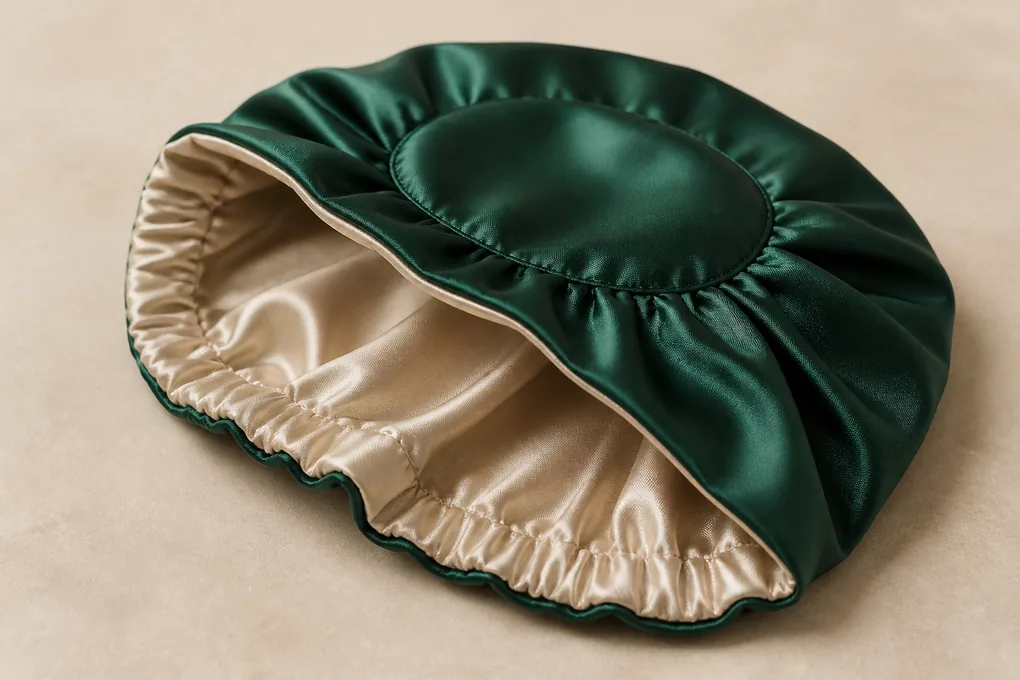
Choose Single-Layer, Dual-Layer, or Reversible Silk Hair Bonnet Components
Layer count is not a marketing adjective. It changes the product’s hand, inside appearance, edge treatment, component description, and what a buyer can accurately promise. A single-layer bonnet may be the best route when a lighter article and straightforward silhouette are central. A dual-layer or reversible concept requires a more exact map because the customer can see and touch more than one face. We help buyers decide what each layer must do: contact hair, provide outward appearance, create contrast, support opacity, or make an intentional second wearable side. Then we connect those decisions to the band, closures, labels, and selected artwork. A broad phrase such as double-layer silk should never replace a product-level component conversation. Buyers should be able to identify which surface the wording applies to, whether both faces are part of the customer story, and which elements still need confirmation. This supports credible retail copy and a quote that reflects the actual selected construction, not a category image that blends several prototypes together. It also gives retail teams a factual description for each wearable side.
Give every layer a defined customer purpose
Hair contact, outer appearance, structure, and reversibility
A component plan that supports the selling message
We begin by asking what each side must accomplish. Is there one outward face and one hair-contact face? Is the inside simply part of the construction, or is the bonnet intended to be worn either way? Map the exterior, interior, band, tie or elastic, reinforcement, and labels. This prevents a broad dual-layer description from concealing key open questions. We do not assume material weight, grade, composition, or certification. Instead, we turn the customer experience into component-specific questions a buyer can resolve during development and documentation review.
Treat reversibility as a complete product claim
Both faces, edges, labels, and closure behavior
A second side that works when the customer wears it
We test reversibility by dressing the bonnet both ways, not by photographing an inside-out sample. Check whether labels become intrusive, whether seams and edges remain intentional, whether the closure is understandable, and whether the hair-contact expectation is met in both orientations. A contrasting lining is not necessarily a reversible product. If the program only needs visual contrast, say so clearly rather than adding a claim the article has not earned. A genuine reversible plan must be judged on the assembled object, including print direction and the way the band appears from both sides.
Connect layer choice to the named quoted configuration
A bill of materials for the selected article
A comparable commercial discussion
We ask buyers to keep single-layer, lined, and reversible routes distinct in the RFQ. Identify the selected layer relationship, visible faces, retention component, needed trim, and artwork version; then mark what remains open. Similar online product names can hide very different builds, so a family description is not enough for sourcing. A product-level map keeps the quotation, sample, packaging, and copy aligned. It does not add bureaucracy for its own sake; it protects the team from approving a statement based on one prototype and applying it to another configuration.
Ask for the component relationship in a format a supplier can quote against: identify the face, its role, the trim or retention piece, and whether it changes by variant. This avoids comparing a lined article with a single-layer reference under the same shorthand name. It also gives merchandising a reliable route for describing what the finished customer receives.
Design the Hairline Contact Band for Comfort, Stability, and Brand Feel
The hairline band is often the first area a customer feels and sees. It shapes the entry experience, the apparent tension of the bonnet, the face-framing silhouette, and the way the article stays positioned. We help buyers define the band as a contact component with a purpose: gentle coverage, controlled retention, adjustable wrap behavior, a contrast design feature, or a combination of these. A generic elastic description cannot answer how the opening works with full hair, whether the band rolls after adjustment, or where the wearer notices local pressure. Buyers should review the band alongside crown volume and closure route, then record what the sample demonstrates. This creates a better foundation for product copy because the team can describe a visible construction choice without promising that every customer will have the same comfort outcome. It also makes quality review more practical: the approved sample can show the intended gathering, width, seam line, component orientation, and connection to the crown for the named variant.
Define the contact zone from the wearer’s view
Width, fold, edge, and placement at forehead and nape
Comfort considered before final sampling
We ask where the band sits during actual use. Does it cover a broad zone, gather into a narrow edge, wrap around the head, or transition into ties? Does it blend with the crown or create a deliberate visual contrast? Examine the component against hair and skin because edge treatment, seam placement, and gathering can change the experience. Separate comfort from a vague soft claim and stability from a vague tight claim. Sample comments and observations at the contact zone give a revision a real basis instead of leaving the supplier to interpret an ambiguous request.
Coordinate stability with the way customers put it on
Opening, crown capacity, and band in one use sequence
A practical entry without uncontrolled shifting
We do not assess the band alone. A comfortable band can still frustrate a customer if the entry path is too small for the intended hairstyle; a generous opening may need a more deliberate retention route after dressing. Review the sequence of gathering hair, entering the bonnet, settling the crown, adjusting the band or tie, and moving normally. Record what happens at each step. This lets a buyer address the actual issue—entry, placement, pressure, or migration—without assuming a single component can solve every fit problem.
Add the band to visible quality review
Gathers, recovery appearance, seam continuity, and alignment
A polished face-framing detail across variants
We include the band in formal appearance review. Observe gathering evenness, the line between crown and band, print or color orientation, and the appearance after ordinary adjustment. Examine transition points where ties or other retention components join because they can create local bulk. Decide which differences are acceptable before production review; do not invent a tolerance where none has been agreed. An annotated approved sample gives product, purchasing, and quality teams a common visual reference and prevents the contact component from being overlooked in a generic workmanship check.
Photograph the agreed band detail from the front, side, inside, and closure connection before the sample is signed off. Those views make it easier to distinguish an intentional gathered effect from a misaligned join or inconsistent finish. They also provide the product team with a useful visual reference when color, crown size, or closure changes later in the range. Compare those photographs with the named variant card during every subsequent approval.
Compare Elastic, Tie, and Adjustable Silk Hair Bonnet Retention Routes
A closure choice affects the customer’s daily routine and the buyer’s product story. Covered elastic may suit a quick-on style with a defined fit objective. Ties can make adjustment visible and create a wrap-inspired visual character. An adjustable mechanism may address a particular fit range, but it introduces questions about access, bulk, location, and packing. We help buyers compare these routes by the customer problem they solve, not by an assumption that one closure suits every head size or hair profile. The review should include how the product is put on, where hair is placed, what the customer touches, how the crown settles, and what the closure looks like in retail images. It should also distinguish a familiar closure from a supported universal claim. The product meeting gains focus once the buyer names whether speed, adjustment range, styling, coverage, or a visible feature carries the priority. That clarity supports a better sample and more honest product communication.
Select elastic for a simple repeatable routine
Casing, contact surface, and crown relationship
Fast use with a clear stability objective
We use an elastic route when the program values an uncomplicated wearing sequence and the silhouette is defined around a particular customer range. Identify where elastic sits, whether it is enclosed, how its casing meets the hairline surface, and how it gathers the crown. Elastic is not a replacement for fit development. During review, ask participants to dress the bonnet without assistance and observe entry, position, local pressure, and removal. These findings help the team decide whether the selected route fits the intended user rather than repeating an unsupported universal-fit phrase.
Use ties for visible adjustment and styling control
Tie placement, taper, finish, and knotting path
An adjustable article that feels intentional
We assess more than two loose ends. Where ties emerge, how they pass around the head, how they are finished, and where they sit after knotting change the experience and presentation. A tie may help serve a broader hair-volume range or provide a familiar aesthetic, but it still needs a clear use route and a design that avoids avoidable bulk. Review a full sample with ties secured as customers are likely to wear them. Note symmetry, slippage, comfort, and packaging behavior. A tie bonnet adjusts; that alone does not demonstrate suitability for every user or use case.
Question hardware or slider concepts before adding complexity
Access, hard points, visibility, and packout interaction
Adjustment chosen for a genuine buyer requirement
We introduce an adjuster only when it improves an identified customer experience. A slider, tab, or other mechanism can target a fit need yet can also introduce hard points, visual clutter, extra component questions, or a new packing issue. Ask where the customer reaches it, whether it remains accessible after hair is placed, and whether it is comfortable during the proposed use. Test a prototype before writing a strong retail promise. This allows procurement to decide whether the added component earns its place and whether the customer benefit justifies the additional specification work.
For a proposed hardware route, include a physical location drawing and an opening-and-packing check in the sample request. The review should show whether the mechanism catches, creates a sharp edge, obscures the brand treatment, or leaves an awkward profile in the selling unit. Retain it only when the demonstrated adjustment benefit is worth the added component and review burden.
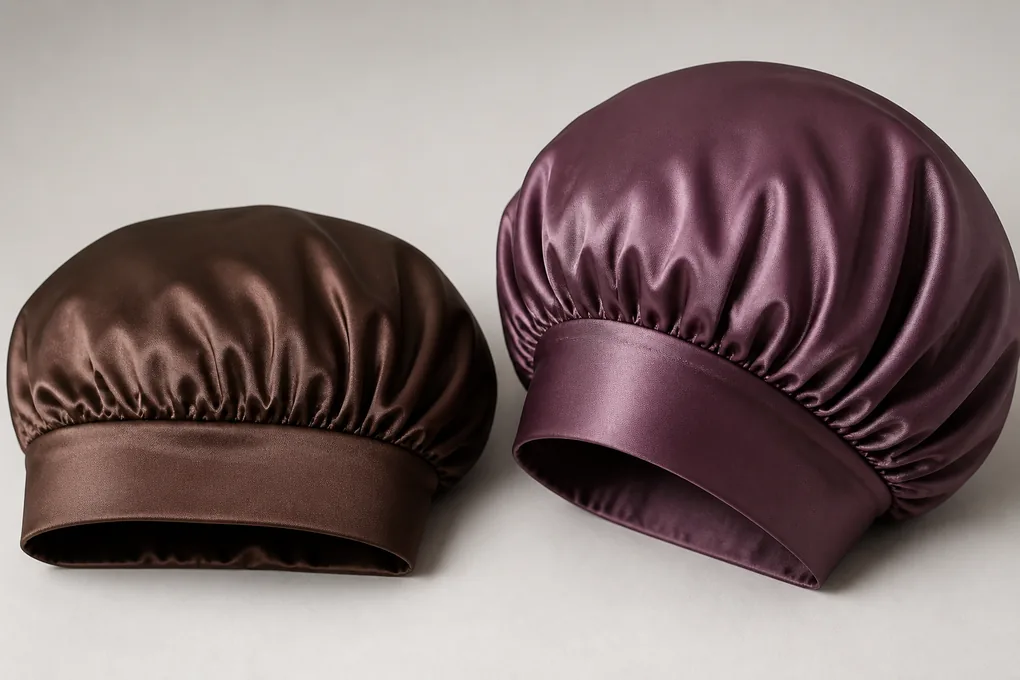
Plan Inside Finish, Label Placement, and Customer-Facing Details
The inside of a silk hair bonnet is part of the customer experience. It is visible while dressing, relevant to hair contact, and often examined when a shopper checks care or reversibility. Labels, size indicators, care instructions, brand marks, and required market content must therefore have a planned location and format. We help buyers decide what information belongs on the product, what belongs with the selling unit, and what should remain available digitally. The design should identify actual attachment zones before the sample is approved, particularly where a label could interrupt a contact surface or undermine a reversible appearance. This is not legal advice; buyers should bring their approved market requirements to the product brief. Our role is to help place the content on the selected construction in a way that is visible, practical, and consistent with the customer story. Reviewing the inside with the same care as the exterior makes the final product feel intentional rather than finished only for a catalog image. The same mapping helps each reviewer see the intended touchpoint.
Map information to suitable physical zones
Brand, size, care, and required content
A product that remains informative without needless intrusion
We separate the information a buyer must provide from the places it can live well. Brand identification, size, care language, fiber wording, and market-required content may need different locations. A label at a hair-contact area can alter the use experience; a mark on a reversible side can change the claim; an external tag can affect gift presentation. Make a placement map showing what is visible on shelf, what is accessible after purchase, and what belongs inside the package. That allows merchandising, compliance, product, and quality teams to review one proposed solution.
Inspect the inside as part of the approved build
Layer edges, seams, labels, and orientation
An interior that matches the selected product wording
We ask buyers to open the bonnet, trace crown seams, examine band connections, and locate every attachment point. If more than one layer is involved, confirm which surface contacts hair and how inner edges appear. This prevents a website image or prototype from becoming proof of a feature that belongs only to another variant. Tie the interior review to the named product record, then retain the approved sample as the visual reference. The customer should receive a product whose internal finish makes sense alongside the exterior story, not a hidden side that no one evaluated.
Put instructions where customers need them
Insert, tag, package panel, or digital guide
Less confusion at first use
We decide when the customer needs help. A tie style may benefit from a clear placement cue; an adjustable route may need a concise instruction; a deliberately reversible product may need wording that distinguishes its two intended faces. Match the message to the pack format rather than overloading every selling unit. Before approval, open the actual package and check whether the customer can tell which orientation and closure process applies to the chosen variant. Good instruction is focused, not excessive; it prevents a use question from becoming a return or customer-service issue.
Keep the instruction test practical: give the unopened selling unit to a reviewer who has not seen the development brief, then ask them to identify the opening, orientation, and first action. If the reviewer cannot do so from the intended customer-facing information, revise the insert, pack panel, or placement cue before the design moves into final artwork.
Use Accurate Silk Component Wording in Your Hair Bonnet Product Copy
Silk wording should say what applies to the product a customer is buying. It should not blur an exterior face, lining, band, tie, or selected finished configuration into a claim that cannot be checked. We help B2B teams organize the questions behind their product language: which component is being described, whether wording applies across every variant, what supporting documentation the buyer requires, and which statements must wait until the final specification is approved. Clear scope matters when a range contains multiple layer routes, contrasting components, or decorative additions. It helps procurement compare proposals, helps quality confirm the right article, and gives content teams a truthful basis for a product page or package. We do not create evidence by repeating a phrase online, and we do not add unverified fiber percentage, grade, weight, certification, testing, or performance language. Instead, we focus the buyer on component-specific wording that can move through the sample, documentation, and final commercial review without changing meaning.
Name the component before making a material statement
Crown face, interior face, band, tie, and trim
Copy that remains clear when configurations differ
We use component-specific language because one finished bonnet can contain several visible and functional areas. Ask whether a statement applies to the hair-contact face, outward crown, both layers, band, tie, or complete selected article. That question keeps a product family from collapsing into one vague claim and protects a retailer from moving copy from one variant to another without checking scope. Capture any required material statement in the buyer brief and connect it to final approved documentation. Clear language supports product comparisons and future quality review.
Keep customer benefits distinct from facts needing proof
Design intent, use message, and supported technical statement
Compelling copy without avoidable trust risk
We understand that hair-care buyers want persuasive language. The strongest message connects a visible feature to the intended routine: containing hair during sleep, protecting a hairstyle, or offering a smoother hair-contact surface according to approved materials and construction. That differs from a universal outcome, medical statement, or performance promise that has not been substantiated for the article. Maintain a working distinction between visible design features, intended customer benefits, and claims that need formal support. It helps marketing communicate confidently while allowing compliance and quality teams to validate the final message.
Review claims beside the actual approved sample
Title, feature callout, package copy, and documentation
A launch message that matches the article
We recommend placing draft selling copy beside the final sample before launch. Check whether each statement names the right component, applies to the right variant, and reflects the assembled object. If a buyer requires a material document or certificate scope, retain it in the buyer’s approval record and use it only within its stated boundary. A webpage cannot substitute for evidence. A disciplined review prevents customers from having to decode whether silk refers to an entire bonnet, a lining, or an image sample, and it gives the purchasing team a cleaner basis for sign-off.
Use the same review to compare website feature bullets, outer-pack language, and retailer product data. If a phrase applies only to the hair-contact face or one selected colorway, give that limitation a clear place in the approved record. This prevents a later launch team from applying a statement to every visible component simply because a photograph looks similar. It also makes later catalog updates traceable to the selected bonnet.
Control Color, Print Placement, and Silk Luster Across the Bonnet Range
Color and print can make a silk hair bonnet feel like a central brand accessory, but they create technical questions that a digital artwork file cannot settle alone. Silk’s surface character can change how color reads under different lighting, and crown gathering can change where a motif appears once the product is worn. We help buyers move from a creative direction to a reviewable physical reference, panel map, and variant plan. The team should decide what color reference applies, which components need to coordinate, whether a print is directional, where a focal motif may land, and how the final sample will be judged. This avoids treating a flat render as a guarantee for an assembled soft accessory. It also protects range clarity when solids, prints, crown shapes, and closures multiply. We do not promise an exact visual outcome without an agreed reference and approval process. We help buyers define the visual result they need to review on the finished article so creative, purchasing, and quality stakeholders see the same decision.
Approve color in the right physical context
Reference, lighting, neighboring components, and surface effect
A color decision that survives product development
We establish how color approval will happen before variants expand. A screen image is useful for discussion but not a physical reference when surface, lighting, and adjacent elements influence perception. Identify the selected reference, relevant component, contrast band or lining, and retail context. Deep colors, pale neutrals, and prints may show luster and shadow differently once gathered around a crown. Review them with the planned closure and pack elements where possible. This gives a buyer a controlled way to assess a visual direction without claiming that every screen or photograph will look identical.
Plan prints around panels, seams, and gathers
Direction, focal motif, border, and allowable variation
A worn bonnet that still looks intentional
We look at a print on the construction, not only as a flat repeat. A motif can split, rotate, or gather as crown panels are cut and seams join. Decide whether the pattern is non-directional, whether centered placement matters, which areas may vary, and how the finished sample will be judged. A logo-like detail or border may need its own physical plan so it does not land at the hairline or disappear into a seam. Use the artwork and panel map to create a real review point; do not assume a rendering proves a finished bulk appearance.
Keep variant identity clear as the range grows
Artwork, closure, label, and packout in one SKU map
Fewer merchandising and fulfillment errors
We make a variant map when a line combines colors, prints, crown options, or retention routes. Each selling unit needs a clear buyer identity even when consumer names stay concise. Link silhouette, component arrangement, artwork version, closure, label, and package artwork so teams do not rely on thumbnails or memory. This is especially useful when printed launch editions sit beside core solids. Quality can trace a packed unit to the right reference, and procurement can ask for a quote against a recognizable configuration. The objective is a workable control point, not paperwork detached from the product.
The map should also identify which view is needed for approval: a flat artwork proof, a sewn sample, a dressed product, or a packed unit. That distinction matters because a print can look correct as artwork but change at a gathered seam, and a closure can look correct on a sample but be mislabeled in a mixed fulfillment run. Clear identity links those reviews.
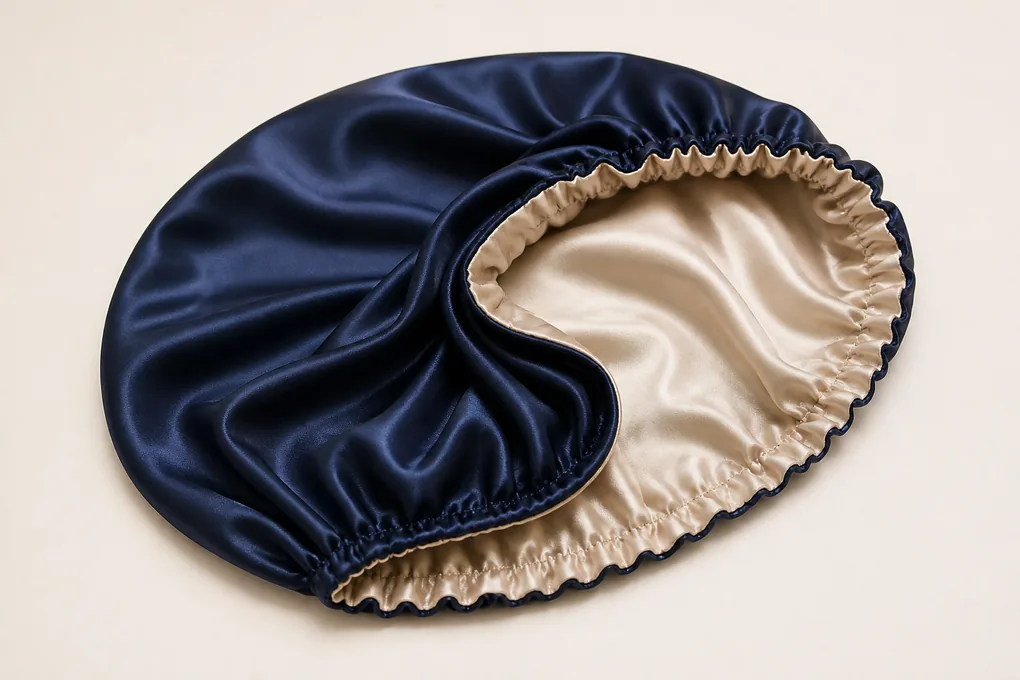
Approve Silk Hair Bonnet Samples Through Fit, Function, and Appearance Evidence
A sample matters only when a buyer has agreed what it must prove. For a silk hair bonnet, the review may need to cover capacity for the intended hair profile, comfort at the hairline, stability during the proposed routine, selected component wording, seam and inside finish, color or print appearance, and selling-unit presentation. We help teams turn comments into named decisions that can travel forward. That reduces the risk that one person approves a visual direction while another later finds that fit, closure, labels, or packaging never received a product-specific review. A useful approval process identifies the article, the customer use scenario, the reviewers, the questions, the reference materials, and the next action. It treats a sample as evidence for a selected configuration—not proof that every color, layer route, or future variant is automatically approved. This gives purchasing a transparent way to decide what must change before the next commercial stage and what can be retained with confidence.
Use fit scenarios reflecting the intended customer
Hair volume, dressing sequence, movement, and feedback
Observations that guide a real revision
We write review questions before the sample arrives. Identify the hair arrangements that matter, the expected use sequence, and the locations to observe. Ask whether hair enters comfortably, whether the crown contains it naturally, whether the bonnet stays positioned, and whether the contact band creates an unwanted sensation. Include the worn silhouette and closure behavior. The goal is not to make one individual preference universal; it is to gather relevant observations for the stated customer segment. Record what was tested, what occurred, and what action follows instead of sending a vague request to make the bonnet better.
Inspect construction and appearance on the same article
Exterior, interior, band, closure, labels, artwork, and pack
One reliable product reference
We do not approve a color strike, construction sample, and pack mock-up as unrelated projects. Place the assembled bonnet in front of the relevant reviewers and examine the complete object. Open it, inspect the inside, use the closure, compare labels and artwork to the range map, and pack it as the customer will receive it. If any part remains provisional, mark it directly in the review record. This avoids launching copy that describes a composite of features seen on several samples rather than the exact article selected for the program.
Close every review with a clear status
Accept, revise, buyer input, or excluded option
A controlled handoff to the next decision
We end a sample review by identifying what is accepted, what needs revision, what information the buyer still owes, and what is outside the present release. Connect the decision to the right artwork, color, component map, and pack direction. Small changes to a crown, closure, seam, or label can affect several parts of a bonnet, so this record protects against a fit change altering an approved print or an inside change reaching the wrong variant. A sample exists; that does not automatically make the program ready. Readiness depends on whether the relevant decisions are captured.
Assign an owner and due date to every unresolved point, even when the next action is simply a buyer decision. This prevents a sample from circulating indefinitely with comments that no one converts into a pattern, artwork, component, or packaging instruction. A final review record should tell a new colleague exactly which configuration was evaluated and what still must be confirmed before the next stage.
Build a Selling-Unit Package That Protects and Explains the Silk Hair Bonnet
A silk hair bonnet arrives as a selling unit, not only as a sewn article. The fold, protective layer, pouch, carton, insert, barcode position, variant cue, and opening experience all affect how the customer judges it. We help buyers make packaging decisions around the actual shape and intended channel so the product looks deliberate when opened and the selling unit communicates the correct variant without clutter. A fold that works for a compact elastic style may not suit a long tie or extended crown. A premium gift box may require a different internal arrangement from a subscription sleeve. Buyers should review the packed configuration as a whole: bonnet, closure, labels, protective elements, companion items, and retail information. That allows the team to see whether ties become tangled, crowns are compressed, prints transfer, or mixed variants become difficult to identify. We do not make transport or performance promises without an agreed test or real shipping context. We help buyers define the packed presentation that must be approved before the selling unit moves forward.
Select a fold and protection route for the actual silhouette
Crown support, tie management, and first-open appearance
Merchandise-ready presentation
We pack the selected configuration rather than choosing a generic beauty-accessory fold. Consider how the crown is supported, whether folds create visible creases, where ties sit, and whether an adjuster needs protection from snagging or pressure. A pouch, sleeve, card, carton, or combination can be assessed against the intended retail story and shipping path. Open a packed sample as a customer would, then review appearance, component count, accessory placement, and display readiness. This frequently reveals whether tissue, an insert, or a revised fold sequence is useful before package artwork becomes final.
Make the variant identifiable without visual clutter
Color, print, closure, fit option, barcode, and internal identity
Fewer retail and fulfillment mix-ups
We decide which facts a customer needs before opening and which details belong to retail operations. A color name, print name, closure route, or fit option may need a clear cue if close variants are sold together. Barcode and internal SKU information should remain scannable without overwhelming the presentation. Review mixed units side by side; errors appear quickly when a printed bonnet receives the wrong card or an adjustable article is packed as an elastic style. Keep product copy restrained and accurate. The same configuration name used by buying should be traceable through artwork, pack, and delivered product.
Treat a beauty set as its own configuration
Companion items, quantities, coordination, and protective arrangement
A curated set without product-scope confusion
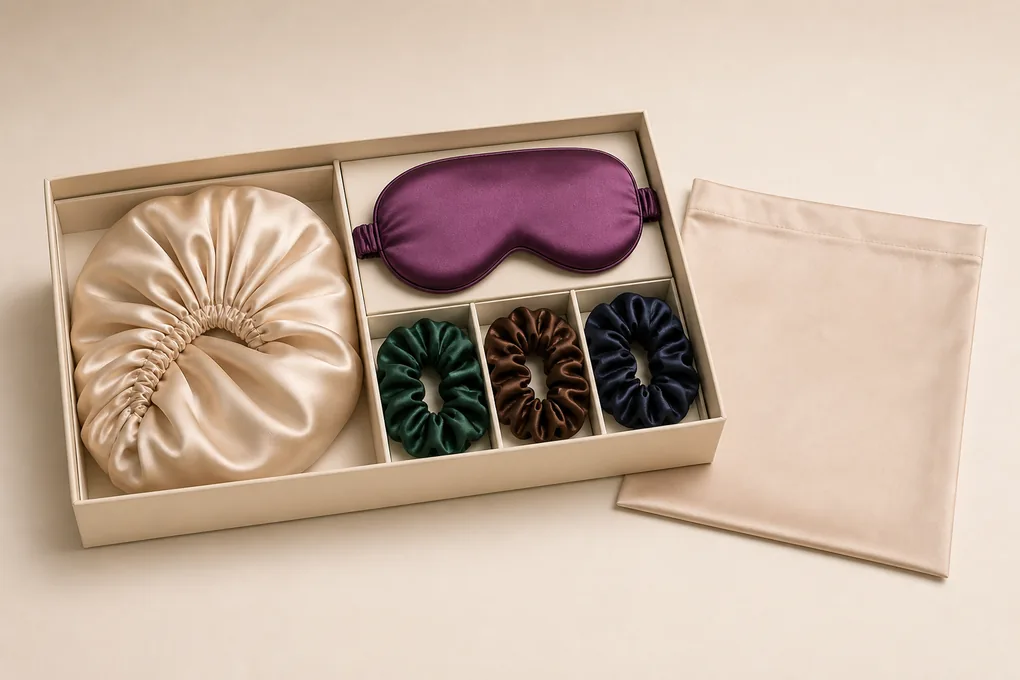
We do not assume that approved individual units automatically create an approved gift set. A bonnet paired with a sleep mask, scrunchies, or a pillowcase needs a complete quantity map, component list, color relationship, and opening presentation. Decide which item anchors the set, whether artwork must match exactly or coordinate, and how the group is protected. Pack and review the finished set, not only the separate items. This prevents an attractive collection from becoming an awkward carton where labels, dimensions, or visual hierarchy fail once the products meet.
A set review should include the actual opening order and the relative scale of each item, not merely an outer-box mock-up. Check whether the bonnet is protected without being hidden, whether companion items need separation, and whether every element can be counted easily. This lets the buyer decide whether the assembled selling unit is ready for the next packaging decision instead of treating it as a late afterthought.
Hand Off Silk Hair Bonnet Quality and Commercial Decisions Without Gaps
A good RFQ makes it clear what has been selected, what evidence is needed, and what remains open. For a silk hair bonnet, that includes the intended customer, crown and panel plan, component wording, retention route, artwork, labels, selling unit, sample findings, and quality questions relevant to the named article. We help buyers organize that handoff so the first supplier conversation is about a real product rather than an undefined request for a price. Include what is known and label unknowns honestly: commercial quantity, target market, package artwork, sample sequence, document needs, delivery window, or a design choice that still requires advice. A reference image can be valuable when it states what feature it is meant to illustrate, but it should never silently define unshown components. We do not invent MOQ, price, lead time, capacity, testing, certification scope, or customer results. Those belong to a verified commercial and documentary discussion. Our purpose is to help the buyer identify the product decisions that make that discussion comparable, efficient, and less likely to produce a mismatch later.
Assemble a quote-ready product brief
Silhouette, components, artwork, packout, quantity, and open questions
A clearer basis for supplier comparison
We ask buyers to send the intended customer and use, selected crown or closure direction, layer concept, color or print reference, label and package needs, requested variants, quantities, and decision timing. Attach drawings or photos with a note about the feature they illustrate. If you need a recommendation, ask the question directly rather than expecting a supplier to infer it. The brief should distinguish buyer requirements from open choices. This makes responses more comparable without pretending that commercial values or supporting documents are already known.
Set product-specific quality review points
Identity, visual finish, assembly, fit-related features, and packed completeness
Checks connected to what customers notice
We define what the finished bonnet must be checked against before discussing bulk quality. The approved sample and product documentation can provide the comparison reference for variant identity, visible color or print, crown shape, panel and seam appearance, layer orientation, band or closure behavior, labels, and selling-unit completeness. If measurement, test method, acceptable variation, or inspection plan is required, buyer and supplier should agree it in writing. A website description is not quality evidence. Product-specific checks help teams focus on observable features that influence customer satisfaction.
Keep commercial unknowns visible until confirmed
Pricing, timing, documents, order details, and decision owners
An honest conversation that can move forward
We believe an RFQ is stronger when it identifies what is undecided. A buyer may still be assessing order quantity, destination market, packaging content, material documentation, sample sequence, or delivery timing. Mark these as open decisions instead of hiding them under a request that suggests false certainty. Then a supplier can respond with relevant information, and the buyer can compare replies on the same basis. Start with the product issue blocking progress—crown volume, component wording, tie position, print mapping, or bundle layout—and add the remaining detail in a controlled order.
A useful handoff separates confirmed product selections from decision requests. For example, it can name an approved crown direction while asking for guidance on a closure route, or state a planned pack format while leaving the final artwork open. That clarity gives both sides a practical starting point and protects the buyer from treating an early discussion as a confirmed commercial commitment.
Silk Hair Bonnet Buying Questions
What should a B2B buyer specify for a custom silk hair bonnet?
Start with the intended wearer and hair arrangement, then state the crown route, layers, hairline band or closure, component wording, color or artwork reference, labels, selling unit, quantity context, destination, and the decision the first sample must answer.
How should we compare elastic, tie, and adjustable bonnet closures?
Compare the customer’s dressing sequence, hair-volume context, entry route, contact points, visible styling, adjustment need, and packed presentation on an assembled sample. A closure name alone does not establish fit for every wearer.
Can one silk bonnet claim apply to every component and variant?
No. Product wording should identify the component and selected configuration it describes. A crown face, lining, band, tie, trim, or different colorway may require separate confirmation before a statement is used in retail copy or packaging.