
P019
Developing Custom Silk Articles for Professional Buying Teams
At China EverBen Silks, we help turn an early silk concept into a focused B2B product conversation. Begin by identifying the launch article, then connect its material scope, visible and supporting parts, colour or print direction, artwork, selling unit, packaging, sample question, and buyer contact before asking for a commercial comparison.
Published by China EverBen Silks Reviewed by Mark Liu
Start with the buyer decision that makes development reviewable
Bring the defined article, quantity, market, and first unresolved feasibility question into the request.
Open With One Identifiable Silk Article and Its Commercial Role
We start with the article the buyer intends to sell, not a broad request for silk products.
Name the proposed sellable unit
Article identity comes before collection language
One inquiry should distinguish a single item, pair, set, or multipack
Begin by naming the precise retail unit: one or two pillowcases, a mattress-covering sheet, a top sheet, a duvet casing, a silk eye mask, a hair-tie assortment, a bonnet, a drawstring pouch, or a coordinated gifting bundle. A collection name alone can mean very different things to different teams. We need to know whether the buyer is defining one article, a repeatable variant, a bundled presentation, or a family of related pieces. Include the customer-facing role as well. An eye mask sold alone has a different product picture from the same mask paired with a travel pouch. A carded hair accessory has a different display question from a multi-piece beauty set. This opening choice shapes the rest of the brief: what needs measuring, what goes into the component list, where artwork sits, and which packaging layer reaches the customer. It also stops a buying team from comparing responses that describe unlike finished units under one category name.
Describe the customer moment
Use context gives the silk article a practical purpose
Sleep, bedding, hair care, travel, gifting, and retail display require distinct questions
Next, describe the moment in which the product is encountered. A bedding item may be judged on a made bed, an eye mask near the face during rest, a bonnet around hair overnight, or a hair tie within a beauty routine. A buyer may instead be planning a gift-opening moment, a compact e-commerce visual, or a neatly organised retail shelf. That customer moment anchors the discussion in a tangible silk article rather than a broad material category. State what must feel familiar in use, what should look deliberate in photography, and what needs to remain distinct within the range. These are product-direction inputs, not performance promises. They help us understand the intended article, its visible priorities, and the questions requiring specific technical or commercial follow-up.
Set the decision objective
A defined first question creates a useful development sequence
Choose the article, visual, construction, pack, or comparison decision that matters now
A first brief becomes useful when it contains one immediate decision. The decision could concern the silhouette of a mask, the opening of a pillowcase, the relationship between a sheet and a mattress reference, the size of an accessory assortment, a color direction, a printed area, or a gift presentation. We do not need every issue resolved at the first exchange; we need to know which issue should guide the next response. Identify what is already fixed, what is only an example, and what needs exploration. This stops a concept image from being mistaken for a final construction instruction. It also gives product, purchasing, and brand colleagues a shared point of reference. When the first decision is clear, later notes about materials, components, samples, labels, and commercial context can be added in an orderly way instead of being scattered across unrelated messages.
For a range buyer, the objective should also say what decision will change the purchase path. A bedding line may need a component count before its presentation can be compared. An accessory range may need the intended pack count before artwork becomes useful. A new sleep item may need its body-side interface clarified before the team spends time on marketing images. Naming that dependency in the opening summary keeps the discussion focused on the item that has the greatest effect on the buyer's next decision.
Build a Buyer Decision Map Before Detail Work Starts
We separate settled choices from open questions so a silk project does not quietly change direction between teams.
Separate fixed inputs from exploration points
A mature reference and an early preference must not be treated alike
Mark each item as confirmed, illustrative, or open for development
A buyer may already have a mature brand palette, selected artwork, a physical reference, or an established product family. Other fields may still be exploratory: a closure direction, a print scale, an edge treatment, a packaging level, or the number of pieces in a set. Put those items into separate lists. We use a confirmed buyer input differently from a visual mood reference or an open question. That distinction keeps an early photograph from becoming an implied specification and helps the buyer maintain control when several buyer teams contribute. It also makes later product notes easier to interpret. A clear decision map summarises what the buyer wants protected, what is being compared, and what needs a project-specific answer. It is especially useful when the same range contains bedding, sleep accessories, and hair accessories with different physical requirements.
Assign a decision owner on the buyer side
Product, procurement, brand, packaging, and quality colleagues have different authority
A named buyer contact prevents an unanswered comment from being mistaken for a decision
A development request often crosses several functions. Product may own shape and range position; a designer may hold artwork direction; packaging may control inserts and selling-unit presentation; procurement may compare commercial inputs; quality or compliance specialists may consider their own requirements. Identify who will decide each open field and who needs visibility before the next discussion. We do not replace the buyer's own decision-making, but we can keep the incoming question attached to the correct product detail. This is valuable when a new artwork file changes the visual placement, a revised package changes the selling unit, or a sample observation raises a construction question. Naming the buyer contact for each question reduces contradictory instructions and distinguishes a requested revision from an informal observation.
Choose the next product question
One product question can focus a deliberate choice, revision, or comparison
A focused question is stronger than an all-purpose request for feedback
Choose the next product question to match the stage of the article. For an early concept, the question may concern article identity and selling unit. For a more developed item, it may concern a drawing, a material-component relationship, a visible construction detail, artwork placement, packaging hierarchy, a sample observation, or the basis for a commercial comparison. State the reference that frames the question: a drawing, swatch, sample, annotated image, packaging mock-up, or buyer note. We use this information to shape a response around the chosen decision rather than assuming every topic has equal urgency. A focused question also protects the project from circular conversation. The team can describe what it considered, what remains open, and what input is needed before introducing another product question.
At the end of a discussion, state the outcome in plain product language. It may be a direction the buyer prefers, a requested change, an information gap, or a choice the buyer needs to consider later. That distinction keeps the product conversation clear without making it bureaucratic. It also prevents an early exploration from being presented later as a fixed commercial or technical term.
For cross-border procurement, include the business deadline that makes the question important, but do not mistake a target date for an agreed delivery date. This tells the buying team why the decision is being raised now and lets later project planning stay connected to the actual configuration rather than an assumption.
Define Silk-Facing Materials and Every Supporting Component
We need a component-level view of the article before a material phrase or a product photograph is allowed to carry too much meaning.
Map every visible and hidden part
Silk panels are only one part of a finished B2B article
Face, reverse, lining, elastic, closures, labels, inserts, and packaging need separate names
Break the article into parts before using broad labels such as silk bedding, silk pillowcase, silk mask, or silk accessory. A pillowcase may involve a face panel, reverse panel, opening, inner edge, label location, and pack. A bonnet may have crown panels, a gathered area, elastic or ties, seam locations, and a presentation layer. A sleep mask may include outer layers, a filling concept, a nose-area shape, a strap route, adjustment hardware, and a pouch. The buyer should identify the part that a reference is meant to describe. This gives material language a physical home and prevents an overall product name from implying that every component has the same composition or function. It also helps the buyer decide which component needs a drawing, a swatch, a photograph, a label note, or a separate question. That component map gives every later review a practical product starting point.
Use material terms with product context
A fabric word needs an identified surface, component, or visual priority
State what the material reference is intended to communicate
Add material observations to the brief for a named reason. A buyer may be exploring a smooth surface, a particular drape, a colour relationship, print character, or the way a silk-facing panel sits beside another part. We do not turn a mood board, product photo, or marketplace listing into a final technical specification. Identify the relevant article area and explain what each reference illustrates. One swatch may establish a colour family, another image may show a desired finished look, and an existing item may demonstrate component placement. Separating those purposes works better than attaching unlabelled images. It gives the development summary clearer material direction while preserving subjects that need written project confirmation. During initial review, identify the material questions most likely to change the buyer’s next product decision.
Keep non-silk parts inside the scope
Supporting components influence the customer experience and the inquiry basis
Do not let a fabric reference hide an elastic, closure, label, or pack decision
A finished silk product is shaped by more than the visible textile. Elastic affects an accessory's relationship to the wearer. A tie or adjustment route changes how a bonnet or mask is introduced. Labels, inserts, cards, pouches, closures, and outer packaging influence the selling unit and the opening experience. Buyers should identify these parts early, even when the exact selection is still open. A component list should distinguish what is known from what is being explored, and it should note whether a part is customer-visible, functional, or presentation-related. This does not create a production specification by itself. It creates a fuller product picture so that the buyer's subsequent construction, artwork, packaging, and commercial questions address the actual proposed article rather than only its most visible silk surface.
The list should also summary dependencies. A changed elastic route may alter the drawing and photo plan. A new pouch may change the selling unit, card, and outer-pack question. A label location can affect the visible product story even where no graphic appears on the silk-facing panel. When these links are stated early, the buyer can ask for a focused review instead of receiving a generic response that leaves important parts of the proposed article undefined.
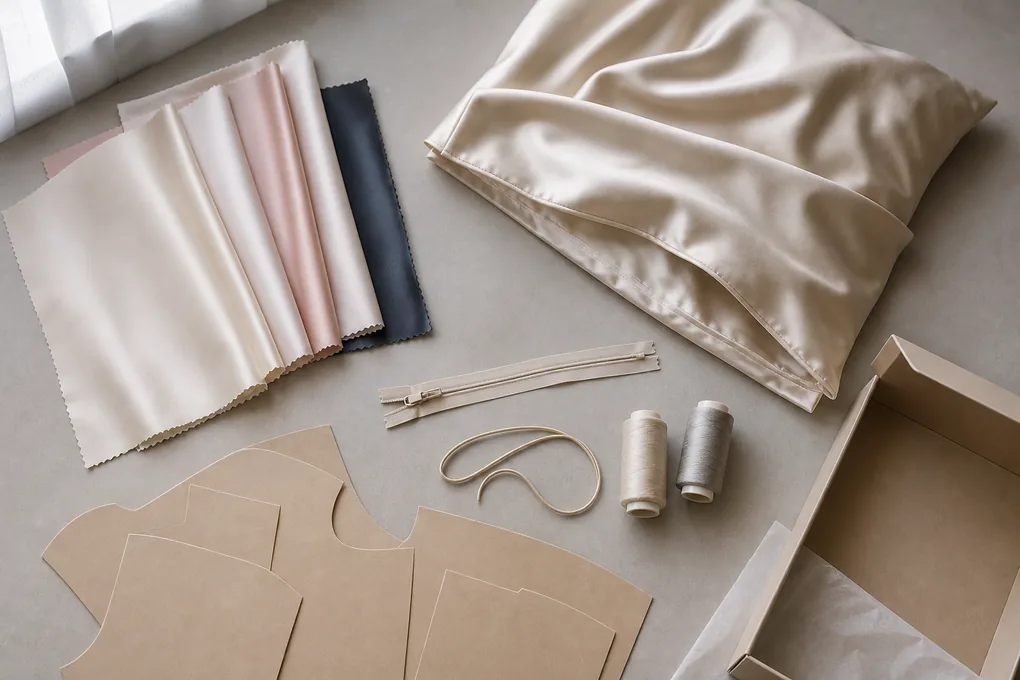
Turn Sketches and References Into a Controlled Product Definition
We use a reference only when its role is clear: it may show shape, measurement, color, placement, presentation, or a question that remains open.
Annotate what each reference contributes
A single image rarely defines the entire product
Add a short purpose note to every sketch, sample, swatch, or photograph
A reference without notes can create more uncertainty than value. A buyer may provide an image for an eye-mask outline, a photograph for a pillowcase perimeter, a sample showing bonnet gathering, a swatch for colour direction, or packaging that demonstrates the opening experience. Add a short note beside each item: which feature matters, which element is not intended for copying, and whether the reference is selected or illustrative. This preserves the buyer’s original direction while making incoming material useful. It stops a team from reading a retail photograph as a full technical instruction. Use every reference to frame one specific question, rather than suggesting that all visible and hidden details belong in the proposed article. That note also speeds a focused first response from the appropriate product colleague.
Establish a drawing and measurement basis
Dimensions need a condition, a reference point, and a named article part
A measurement becomes useful when its method is not left to assumption
Where dimensions matter, state what is being measured and under which condition. For a pillowcase, the buyer may need to identify the body, opening, visible edge, or insert relationship. For an elastic accessory, a relaxed and extended condition may be different questions. For a mask, the relevant points may be overall shape, eye-area coverage, strap path, or a specific anchor location. We do not convert a sketch into a final tolerance plan without project-specific agreement. Buyers should label the relevant points so the subsequent review stays attached to the same geometry. A versioned drawing or annotated image is far more useful than a dimension listed without context, especially when product, packaging, and commercial teams are reading the same brief.
Name the latest artwork and the questions still open
A current file needs a clear name, date, and product purpose
Clear file names stop an earlier visual from being mistaken for the latest direction
Use a simple file description from the first inquiry. Name the drawing, artwork file, product image, packaging layout, or reference board and state whether it is for comment, comparison, or a buyer decision. If a newer file replaces an older one, say so directly. The development conversation stays clearer when a buyer identifies the latest file and which markups still need discussion. This helps prevent an early render, older colour page, or abandoned pack layout from being treated as the buyer's current direction. Clear file names also let product, brand and procurement colleagues return to the point at which a decision changed, ask a precise question, and keep the product story understandable as files accumulate.
Use a file name that lets a purchasing colleague recognise the article and the decision involved without opening it. A short date and product-purpose label are normally enough. Keep an earlier item separate rather than leaving it beside the latest file without comment. This reduces the risk that the buyer's newest product direction is diluted by earlier exploration material during a cross-functional discussion.
Where several product directions are being developed together, keep a compact file list that links each drawing, package layout, or artwork revision to its product identifier and the question it relates to. This helps a buyer see whether a file applies to the same configuration as the sample or commercial question under discussion.
Review Construction as a Buyer-Owned Product Question
We focus construction review on the feature the buyer needs to understand, rather than presenting a generic silk category as a completed design.
Identify the functional interface
The relevant interface differs across bedding, masks, bonnets, pouches, and accessories
Name the interaction that the product must support
Construction questions should begin where the article meets a user, another product, or a presentation surface. A pillowcase may need an opening direction or visible edge question. A fitted bedding component may need a mattress-reference discussion. A sleep mask may require attention to the eye-area shape, strap path, or adjustment placement. A bonnet may raise a crown, band, gathered section, or tie question. An accessory may need a clear account of its loop, seam, or pack relationship. A buyer should identify the interaction that deserves review and the reference that illustrates it. This keeps the conversation specific without claiming that an early reference has already established a final construction, test result, or finished-product outcome.
Describe visible finishing priorities
Edges, seams, folds, joins, and placements should be discussed at the relevant location
A visible detail becomes reviewable when it has a defined position
A buyer often notices a particular finish because it affects how the item reads in a bed setting, a beauty routine, a gift box, or a product photograph. Name that location and the customer-facing reason it matters. The brief may refer to an edge treatment, opening, fold, seam position, gathered effect, label location, or transition between components. We separate a visual preference from a confirmed construction instruction until the buyer and project summary establish the relevant detail. That boundary makes the review more honest. It allows a product team to state what it wants to protect, while leaving room for a project-specific answer on feasibility, materials, specifications, and any further evaluation that a buyer may require.
Summarize construction questions without hidden assumptions
An open question should remain visibly open
Avoid turning a marketplace photo into an implied technical requirement
Write construction questions in direct terms. Instead of saying that a mask, bonnet, sheet, or pillowcase should be made like a reference, identify the feature to be considered: the apparent depth, the opening route, the layer relationship, the elastic position, the visible border, the corner treatment, or the insert relationship. We can then answer the actual product question rather than guess which part of the picture matters to the buyer. This discipline matters when competing references show different details or when a retail listing lacks useful technical information. It helps purchasing teams compare like with like and gives creative colleagues a way to preserve the desired product character without asking others to infer a complete design from a single image.
Where a feature affects the buyer's intended customer use or range position, say so in the question. That context may help distinguish a request for a refined visible edge from a request about a hidden assembly point, or a product-photography priority from a wearer-interface issue. The brief becomes more valuable when it ties the requested construction discussion to the actual product choice the buyer is trying to make.
If a visual reference is being used only to show the overall mood, write that plainly. We should not treat a mood reference as supporting detail for a seam, dimension, component, or material decision that the buyer has not asked us to consider. This distinction keeps the product definition honest while still giving the creative team room to communicate its intended style.
Connect Artwork, Color, and Brand Touchpoints to the Correct Surface
We keep brand expression tied to the article and the selling unit so a color or logo direction does not drift away from the product itself.
Locate every customer-facing graphic
Artwork needs a named surface, scale reference, and latest file
Product panels, labels, cards, inserts, and cartons should not be merged into one artwork question
A custom silk brief should show where each visual element belongs. Artwork may sit on a textile surface, a label, a card, an insert, a pouch, a wrap, or an outer pack. Name the surface and the relationship to the selling unit. We do not treat a general logo file as a complete placement instruction. The buyer should identify the latest artwork version, the proposed location, the intended visual hierarchy, and whether the item is a product mark, care communication, gift message, collection device, or other customer-facing element. This makes it easier to distinguish a product artwork question from a packaging question and a label question. It also gives brand and procurement colleagues a shared language when a placement, file, or pack level changes during development.
Use color direction with a reference hierarchy
A named shade, swatch, photograph, and screen render do not serve the same purpose
State which reference governs the current buyer decision
Colour direction may travel through physical swatches, digital artwork, photography, seasonal material, packaging boards, and established range pieces. The buyer should identify which reference governs the present choice and which material merely provides context. A photograph can express a room mood; a swatch can establish a colour family; a design file can show placement; an existing item can signal range continuity. Keeping those roles distinct reduces the chance that one reference answers an unrelated question. It also lets the buyer align a bed linen style, eye mask, bonnet, or hair accessory with packaging and marketing material without treating an illustrative image as an approved colour or print specification. Record the chosen hierarchy beside the current file so later comments cannot reverse its intended purpose. That prevents avoidable hierarchy confusion during the buyer review.
Protect brand-owned inputs during review
The buyer should define what is proprietary, current, or restricted
A clear boundary supports responsible use of supplied creative material
Bring buyer-owned artwork, text, layouts, and visual references into the inquiry with a stated purpose. Explain whether an item represents the current artwork direction, a scale reference, a packaging-hierarchy guide, or an example not intended for copying. We connect buyer materials to the product question they are meant to resolve. This matters when a range contains several silk formats sharing colours or presentation cues while using different surfaces. A careful discussion separates the buyer’s direction from third-party imagery and leaves room for original development. It also makes clear which items need internal team consideration before they enter the product conversation.
If an image belongs to a third party, describe the feature that informs the buyer's thinking rather than asking for a replica. If a buyer file contains an unfinished idea, identify the part the team wants to discuss and the part that remains open. This keeps creative material under the buyer's control while allowing the development exchange to focus on the original silk article the team intends to build.
For a private-label silk collection, this practice is also useful when a buyer has several visual workstreams. It separates product artwork from campaign imagery, packaging references, and prior-season material. The project team can then decide exactly what is relevant to the proposed product configuration and what should remain outside the supplier inquiry.
Plan Sample Stages Around the Decision They Must Resolve
We treat a sample request as a practical buyer decision tool, never as a replacement for a complete, article-specific product brief. It should expose the decision that the buyer needs the physical article to answer before the programme can advance.
State the purpose of the first sample
Shape, scale, material appearance, construction, print, pack, and presentation are different review purposes
One sample stage should answer a clearly defined product question
Before requesting a sample, specify the observation the buying team expects from it. The first question may concern silhouette, relative scale, a visible edge, an opening, a component relationship, a colour direction, a graphic placement, or the way a set is presented. A buyer should connect the sample purpose to the latest product description rather than requesting a generic example of a silk category. This keeps feedback meaningful. A sample used to review a mask shape should not silently settle packaging, artwork, or a different strap route. The more clearly the buyer describes the intended observation, the easier it is to summarise what was learned, what remains open, and whether the next stage needs a revised product input.
List the sample inputs that are in force
A sample discussion needs a current article reference and latest file set
Drawings, swatches, artwork, components, and pack references should have a stated standing
A sample stage works best when the buyer identifies the inputs it must follow. List the current article description, drawing or sketch, component notes, material-reference purpose, artwork version, packaging direction, and known dimensions or customer-facing priorities. We do not assume every attachment governs the same sample. The brief should distinguish a reference, an open question, and a buyer-selected input. This gives the buyer a reliable basis for comparison later and prevents a feedback meeting from reopening a choice that was never defined for review. It also simplifies cross-functional discussion because each colleague can see which product inputs applied at that particular stage.
Define the buyer review method
A sample discussion needs observers, observations, and a clear result
Written feedback is stronger when it points to the article feature under review
Plan who will consider the sample and how comments will be combined. The buyer may need input from product, brand, packaging, quality, merchandising, or procurement colleagues. Ask each person to point to a specific article feature and state whether the observation is a requested change, a question, or a note for later discussion. We recommend that the buyer combine those responses in one dated feedback summary rather than rely on separate informal messages. This does not replace the buyer's own decision rules. It gives the development conversation a reliable explanation of what the sample was intended to address and what the buyer wants to consider next. It also keeps an attractive visual response from being mistaken for a decision on construction, pack, or commercial questions that remain open.
The feedback summary should preserve disagreement as well as consensus. If packaging prefers one presentation while product wants another, state the conflict and identify the product question the team will discuss next. If a sample answers the original shape question but raises a new artwork or component question, list it separately. This gives the buyer a more useful decision summary than a simple yes-or-no label.
Where a buyer requires formal sign-off, the team should use its own method and apply the outcome only to the stated article version and sample purpose. We do not infer a buyer decision from a sample shipment, a photo, a general conversation, or a positive reaction to unrelated product details.
Use Change Control to Keep a Silk Project Comparable
We make changes visible because a new detail in a custom silk article can alter several downstream decisions.
Log what changed and why
A revised element needs a date, a product location, and a business reason
Visible change notes protect teams from relying on superseded assumptions
When a buyer changes a feature, summarise the changed article part, the earlier direction, the new direction, the reason, and the files affected. The change might involve a product shape, a visible edge, a component, a colour reference, print placement, label, insert, or packaging level. We use that summary to understand the current buyer question, not to treat a verbal preference as a completed instruction. A dated change note is especially useful when different colleagues have considered different versions of a pillowcase, bedding set, mask, bonnet, or accessory. It shows which information is still relevant and which has been replaced. That clarity helps procurement avoid comparing a response based on an older configuration with another response based on the buyer's newer product direction.
Assess the linked consequences
A product change can influence materials, components, graphics, packaging, and the selling unit
Do not close one field without checking the related article decisions
After a change, review its connections. A new opening direction may affect a pillowcase's visible edge and package description. A revised strap route may alter a mask drawing and pack imagery. A different accessory count may change the card or pouch relationship. A new textile graphic may change the artwork file, label language, and the way a collection is photographed. We keep these dependencies visible in the discussion while project-specific technical and commercial confirmation remains separate. The goal is not to add unnecessary process. It is to stop a small product edit from being isolated from the other parts of the sellable article that it may influence. A short consequence check can save a buyer from rediscovering a conflict after several teams have already acted on an earlier version.
State the Current Silk Article Direction Before the Next Discussion
Keep the article, latest files, and open choice together
A clear product summary helps every buying colleague discuss the same item
After a buyer considers a change, state the current article direction in plain product language. It may include a named article configuration, an annotated drawing, current product photographs, the latest artwork version, a packaging layout, and a short list of questions still open. This keeps the next discussion anchored to the same product picture. It does not turn unresolved fields into fixed specifications; it simply distinguishes the article the team is comparing from the choices that remain. This distinction matters in custom silk development because an open colour, material, component, or pack choice can coexist with an otherwise defined article identity. A buyer who keeps one compact product summary gives every colleague a common reference and can make later sample, product, and commercial discussions easier to compare.
A useful product summary tells a colleague what not to assume. It distinguishes a working colour direction from a selected component, the latest package layout from customer-facing wording that still needs discussion, and a current sample observation from a final acceptance criterion. That boundary lets a buyer move forward with real information without representing the project as more settled than it is.
For procurement, this short article summary prevents scope drift. Keep it beside the quantity context and destination reference so the buying team can see whether the upcoming question belongs to the same silk article, the same selling unit, and the same package direction.
Integrate Packaging, Labels, and Selling-Unit Presentation Early
We bring packaging into the development brief while it can still support the article instead of being treated as a separate last-minute task.
Define the customer-facing pack hierarchy
The product, inner presentation, insert, wrap, and outer level have different jobs
A pillowcase pair and a gift configuration should not be described as the same selling unit
Describe how the customer will receive the silk article. The selling unit may be a single accessory on a card, a pair in a fold, a mask with a pouch, a bedding component in a coordinated set, or a gift configuration with several pieces. A buyer should separate the product itself from any inner presentation, information insert, wrap, pouch, carton, or grouped pack. This allows the development conversation to connect package choices to the actual customer moment. It also prevents a product reference from being mistaken for a complete pack instruction. State what is already defined, what visual relationship the pack should support, and what part of the hierarchy still needs buyer-side direction. These details matter when a product is sold through a retailer, e-commerce channel, gift program, or a curated collection.
Connect label content to the correct component
Product labels, packaging copy, inserts, and outer-pack information need separate ownership
A text request must state where the text belongs and who will consider it
A label or pack review becomes clearer when the buyer identifies the location and job of every text element. A sewn label, hang tag, card, insert, pouch print, or carton panel may each require different buyer inputs and team review. We do not provide legal, regulatory, or certification conclusions through a general development exchange. The buyer should name the market context, the product or packaging location, the requested wording or document topic, and the colleague who will consider it. This keeps the request connected to the actual article and selling unit. It also prevents wording meant for one pack element from being read as a statement about an entire silk range. It keeps product communication legible for the buyer’s review team.
Plan presentation alongside product photography needs
The way an item opens, folds, groups, or hangs can shape a buyer's visual direction
A presentation reference should explain the selling-unit moment it is meant to support
Consider how the proposed article will be seen before a customer touches it. A bedding product may be shown in a room setting; a pillowcase pair may need a tidy folded presentation; a sleep accessory may be photographed with a pouch or card; a hair item may be grouped as a giftable assortment. Buyers should explain which presentation moment matters and to provide a reference for that specific purpose. The conversation can then distinguish a product appearance question from a package configuration question and from a marketing-image question. Keeping those roles clear helps the buyer protect a consistent range story without allowing an attractive image to stand in for a complete product, label, or packaging specification.
The presentation note should give the buyer's merchandising and product teams something concrete to review. Name whether the priority is a folded bed view, a gift reveal, a compact accessory grouping, a premium shelf presence, or a product-detail image that shows a particular feature. That precision supports better layouts and better questions without turning a proposed photograph into a claim about product availability or final packaging.
If the buyer expects a retailer, marketplace, or e-commerce editor to use the reference, distinguish that visual need from the physical pack design. The first helps explain the product's customer story; the second must still identify the actual layers, labels, and unit the buyer intends to sell.
Keep Supporting Details and Buyer Decisions Tied to the Exact Product Question
At China EverBen Silks, we keep every sample comment, information request, artwork decision, and buyer choice tied to the precise silk article and component involved. A note about a pillowcase edge, a mask strap, a print placement, a pouch, or a package panel should not quietly be extended to an entire collection. This approach helps product, quality, packaging, brand, and procurement colleagues make focused decisions without presenting an early comment as a decision on unrelated product details.
Match each summary to an article-level purpose
A request for information is meaningful only when its product context is named
Material, label, package, market, and customer questions should remain distinct
When a buyer asks for supporting information, identify the silk article, component, intended use, and reason for the request. The question may relate to a product statement, a label review, supplier onboarding, a customer inquiry, a packaging field, or a market-specific process owned by the buyer's specialists. We keep the request attached to that stated purpose. A broad request for every available document is less useful than a precise question about the specific product detail the buyer needs to review. This approach also helps avoid extending a statement about one component, product sample, or file into a claim about a whole collection. Where a project needs technical, legal, market, or third-party review, the buyer should retain the appropriate owner and seek written confirmation for the relevant scope.
Summarise buyer decisions by version and scope
A buyer decision needs a contact, a latest file, and a stated choice
A positive comment on one feature should not decide every product element
A buyer decision summary should state exactly what the team considered. For example, a buying team may choose an article silhouette while leaving material wording open; it may choose a package layout while asking for a new insert; it may agree on a colour direction while leaving product artwork for later discussion. The buyer should identify the latest file, the article or pack location, the choice made, any conditions, and the buyer contact who responded. This prevents a general email reply or meeting comment from being treated as a decision on the whole project. It also gives a clear reference point when the product moves from a concept to a sample question, an artwork update, a packaging discussion, or a comparable commercial inquiry.
Preserve unresolved items in the summary
Open questions are useful when they name a buyer contact and next discussion
A concise question list prevents a development brief from overstating certainty
Do not conceal uncertainty simply to make a development request look complete. Keep a short open-question list naming the product detail, the team comparison, buyer contact, supporting detail needed, and next choice. A question may concern a component, artwork file, packaging level, proposed statement, measurement reference, or commercial input. This shows which product matter deserves attention first. It is more dependable than a brief that silently assumes an answer. The question list also lets a buyer choose whether the next exchange concerns article definition, sample review, packaging integration, document scope, or preparation for a comparable quote.
Use a simple priority marker for questions still open. A question that changes the article's physical identity or selling unit should be discussed before the buyer treats the configuration as comparable. A preference that affects later visual refinement can remain open while earlier product definition work continues. This prioritisation helps the buying team spend time on the questions that affect the next decision rather than on every possible detail at once.
The list is also the right place to describe a decision that cannot yet be made. If the buyer is waiting for a brand file, a product colleague, a destination confirmation, or a customer-program requirement, state that dependency plainly. It keeps us from giving a misleading impression that the unfinished input has already been decided.
Prepare a Comparable Commercial Inquiry Without Inventing Terms
We make the product basis explicit before commercial discussion so an inquiry does not suggest a price, timing, minimum, availability, or commitment that has not been confirmed.
Separate each proposed configuration
Variants should not be combined under one broad silk-product label
Article, size, components, artwork, pack, and selling unit create the comparison basis
A purchasing team can compare responses only when every proposed configuration is plainly visible. Treat a two-case pillowcase offer separately from a mattress sheet, an individual eye mask separately from a multi-strap mask kit, and a hair-accessory grouping separately from a bonnet-and-pouch gift set. Apply the same rule to any variant with a different article identity or pack structure. For each line, state the selected product direction, current component scope, latest artwork or label direction, and selling unit. This avoids using broad labels such as silk bedding or silk accessory for unlike products. It also keeps an open construction or packaging question with the correct configuration rather than allowing it to blur the whole range. This line-by-line discipline lets buyers evaluate response differences without losing the commercial or product detail that produced them, while keeping later assortment decisions grounded in named articles rather than broad category shorthand.
Add commercial context that changes the project picture
Quantity outlook, destination, channel, and target window belong beside the defined article
Known inputs can be shared without representing them as fixed commercial terms
Add project context that explains the buyer’s inquiry: estimated quantity, destination market, channel, target period, launch relationship, or a team decision point. Mark an input as an estimate while it is still forming. That context explains the purchase situation; it does not become a fixed minimum, price, lead time, delivery promise, or availability statement. A buyer may also identify a new launch, range extension, gift programme, online assortment, or retail test. These inputs keep the commercial question close to the article and its customer setting. They are most useful beside the precise configuration, not supplied later as a disconnected spreadsheet note.
Ask the next commercial question directly
A buyer should state whether the immediate need is feasibility, comparison, information, or a revised scope
The requested response should match the maturity of the product definition
Close the commercial brief by writing the next question in plain language. The buyer may need to decide whether the incoming brief needs more definition, compare a named configuration, clarify a component or packaging scope, or identify information needed before a later quote request. We address the exact product question supplied, subject to project-specific confirmation. This is more useful than an undirected wholesale-pricing request because it shows whether the article, material, construction, artwork, selling unit, packaging, or buyer choice still requires discussion. A direct question gives procurement a useful next action and prevents a preliminary exchange from being described as a completed commercial agreement.
When the buyer needs a quote-ready comparison later, the inquiry should identify the configuration used for that comparison rather than relying on an assortment nickname. It should also name the unresolved point that could change the scope. This allows a commercial response to remain honestly connected to the product definition and shows procurement whether the next action is to obtain more product detail or to proceed with a more defined request.
Avoid combining price, terms, sampling, and technical questions into one unranked request. Identify which answer is needed first and which inputs are still estimates. A narrow next question gives purchasing colleagues a better basis for follow-up and avoids implying that a preliminary response settles every commercial variable in a developing silk program.
Send a Development Brief the Whole Buying Team Can Use
At China EverBen Silks, we finish a development discussion with one focused B2B inquiry: the named article, current configuration, useful references, open choices, business context, and buyer contact. This gives merchandise, creative, pack-development, quality-assurance, and purchasing colleagues a shared view before the next supplier response. It avoids describing a silk item through scattered images, separate emails, and unranked questions, while leaving unconfirmed material, commercial, and technical points for written project confirmation.
Summarise the current product direction
The brief should make the current article easy to recognise
A concise summary includes the sellable unit, use context, and controlling references
The final development brief should begin with a short product summary. Name the silk article, its selling unit, intended customer moment, range role, and current product configuration. Then list the latest references: drawing, sketch, swatch purpose, component list, artwork version, packaging layout, or sample observation. We do not need a polished narrative; we need an accurate product picture that a product manager, buyer, designer, packaging colleague, and procurement reviewer can all recognise. Mark anything that is still illustrative or open. This gives the inquiry a credible product picture and prevents the next discussion from starting with an assumption about which product image, file, or configuration is current.
Attach only materials that answer a defined question
Every attachment should have a product purpose and a clear role
Relevant supporting detail is more useful than a large unannotated file collection
Select attachments because they help answer a specific decision. Include a sketch for geometry, a swatch for colour context, a reference photo for a visible detail, an artwork file for placement, a package layout for the selling unit, or a sample note that describes a specific observation. State what each attachment is meant to show and whether it is the latest reference, illustrative, or replaced by another file. We use this context to read the buyer's material accurately. It also helps protect the buyer from having an old image or a vague reference treated as a current instruction. A carefully annotated short set of files gives a much stronger development brief than a large folder with no version labels or product explanation.
State the request, owner, and next decision
A complete inquiry asks for one meaningful response and names the responsible buyer contact
The next action should be concrete without implying an unconfirmed outcome
End with the exact response the buying team needs next. It may be a discussion of the defined article, a question about component scope, a drawing or sample-stage discussion, an artwork-placement check, a packaging-integration question, a document-scope inquiry, or a commercial comparison once the configuration is ready. Identify the responsible buyer contact, the expected order band and market destination where available, and the buyer decision that will follow the response. We then have a practical basis for a professional B2B development exchange. This brief does not promise a product, price, minimum, timing, document, or delivery result. It makes the buyer's requested next decision clear enough for project-specific written confirmation and keeps the developing silk article at the centre of every subsequent conversation.
A strong closing message is brief but complete: it identifies the article, links the latest supporting detail, names the open question, provides business context, and tells us who will evaluate the next answer. That structure gives a U.S., European, Canadian, or other high-income-market buying team a workable supplier conversation without requiring visitor-facing prices or turning an early contact into a promise that is not yet supported by the project summary.
Before sending, check that the contact is providing business information rather than sensitive personal data, that the inquiry identifies a real buying organization, and that the product reference is understandable without a separate email thread. Those small checks make it easier for the next response to address the buyer's actual silk development decision. They also help preserve a clean written summary for purchasing, product, and brand review.
Questions from B2B teams developing a custom silk article
What should a first custom silk development brief include?
Identify the article, intended selling unit, use context, reference purpose, material and component questions, artwork or packaging standing, quantity context, destination, and the one decision that needs attention first.
Can an early idea be submitted before every detail is final?
It can. Distinguish fixed inputs from illustrative material and list every unresolved choice so that the brief does not present a working preference as a confirmed specification.
What does a comparable commercial brief need?
Keep each article or configuration separate and connect it to its selling unit, visible components, latest artwork, packaging level, quantity context, destination, and remaining technical question.