
P005
Wholesale Silk Sleep Masks: Fixed and Adjustable Formats
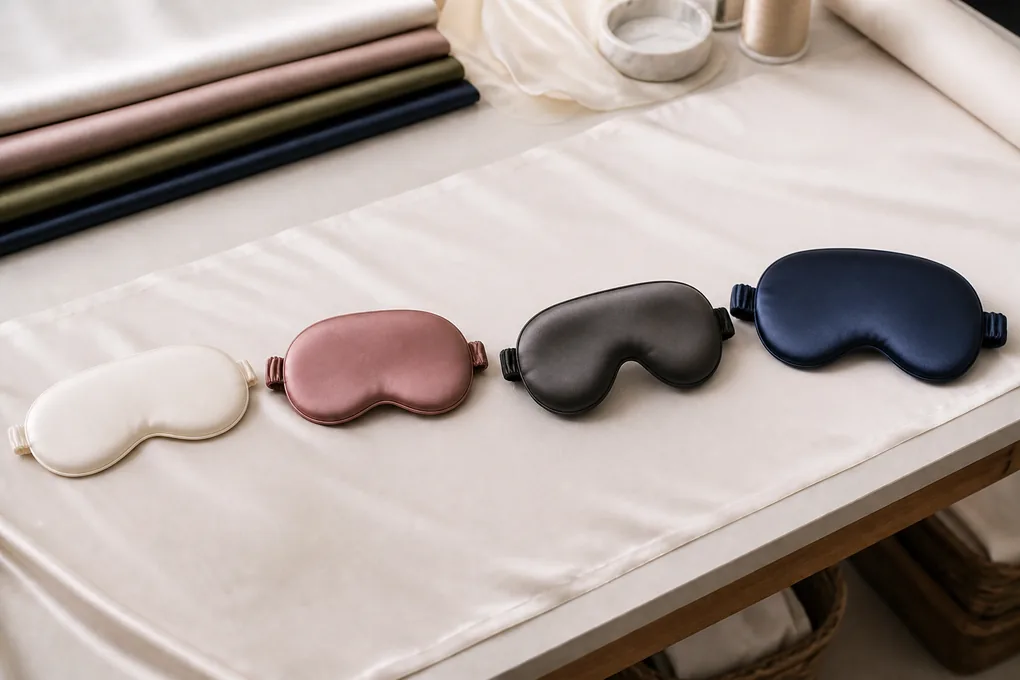
A silk sleep mask needs a specific face-coverage and strap discussion, not a generic promise about rest. We help B2B buyers define the mask body, lower-edge contour, layers, fixed or adjustable strap route, anchor position, branding, selling unit, and sample question so the finished article can be reviewed against the intended wearer context.
Published by China EverBen Silks Reviewed by Mark Liu
Separate fixed and adjustable mask risks before sampling
State the body shape, layers, strap route, coverage question, and selling-unit context.
Define the Sleep Mask Use Context before Choosing a Shape
A sleep mask used nightly in bed, during air travel, inside a hotel amenity kit or as a beauty gift does not face the same constraints. Side-sleeping profile, pack volume, user adjustment, repeated laundering, shared presentation and expected darkness all change the useful construction. We begin with the wear situation and intended audience, then shortlist a geometry and retention system that can be sampled honestly for that scope.
Describe Where and How the Mask Will Be Worn
Bed, travel and gifting create different priorities
The use scenario guides physical decisions
Nightly home use may prioritize low edge bulk, stable retention and a care routine customers can repeat. Travel programs add compact packing, intermittent use, cabin light and the need to adjust without a mirror. Hospitality amenities may need simple instructions, clear single-user presentation and efficient replenishment. Gift products can carry more branding or set presentation, but decorative features must not create a hard contact point. We ask the buyer to rank these needs instead of assuming one luxury mask suits every situation.
Sleep position matters. A wide rigid side profile can press under side sleeping; a thin mask can feel unobtrusive but may allow edge light if geometry does not follow the face. Hair volume and headwear can affect strap position. Do not infer universal comfort from a soft fabric statement. The brief identifies likely positions, wear duration, adjustment expectations and any pack constraints so the prototype can be judged against observable priorities.
Use context also determines the complaint threshold the buyer should plan for. An airline amenity may be worn briefly by many unfamiliar users, making intuitive orientation and broad but honest adjustability important. A premium nightly product may receive closer scrutiny for seam feel, long-session pressure and care recovery. A promotional gift can be opened for its visual effect but still needs accurate materials and usable fit. We ask the buyer to supply existing review themes, return reasons or internal check observations where available. Those inputs are not copied into claims. They are converted into development priorities and a complaint taxonomy that preserves the exact mask route, wearer condition and observed failure after launch.
Identify the Intended Wearer Range without Promising One-Size Perfection
Face shape and head range vary substantially
Fit claims stay within tested conditions
The buyer defines whether the product targets a broad adult range, a more specific audience or a user group that requires separate review. We collect head-circumference direction where relevant and note sensitivity to nose pressure, eyelid clearance, hair snagging or closure contact. A catalog dimension is a starting reference, not proof that every person will obtain full blackout. Representative fit trials reveal where the mask sits well and where geometry creates a gap or pressure point.
Age and safety scope are stated explicitly. Products intended for children or vulnerable users can introduce different component, warning and review obligations. Do not transfer adult assumptions to another audience. Removable parts, long ties, gel elements, magnets, scents or unfamiliar materials are assessed as new components rather than casual upgrades. If the buyer has no evidence or requirement for them, the base mask remains the clearer development route.
Channel data should preserve construction identity after launch. If reviews for classic and adjustable masks are combined, complaints about a slider can appear to describe a fixed-elastic product, while fit observations from a 3D mask can mislead buyers of a flat body. We recommend separate variant attributes and service categories for geometry, strap and pack. Returns can then be linked to the actual unit. That evidence helps revise the right feature and keeps an isolated issue from triggering a cosmetic change across the whole range.
The brief names environmental conditions that matter, such as bright cabin windows, bedroom indicator lights or frequent side sleeping, without pretending one check recreates every night. Sample evaluation can then challenge the intended risk directly. Features that do not serve that setting are removed, keeping the finished mask lighter, clearer and easier to develop.
Turn Customer Complaints into Prioritized Design Risks
Light gaps, pressure, slipping and odor have different causes
One vague comfort goal cannot resolve them
Marketplace reviews often describe light entering near the nose, a strap that loosens, hardware pressing the head, a mask sliding during sleep, eyelash contact, chemical odor or difficult care. We separate these observations by physical cause. Nose gaps relate to lower-edge contour and placement; sliding can involve strap route, surface friction and fit; pressure can come from tension or local thickness; odor may originate in filling, finish, packaging or storage.
The buyer ranks which failures are commercially most damaging. A travel mask might tolerate more bulk to gain eye clearance, while a side-sleeping range may reject prominent hardware. We convert priorities into prototype comparisons and acceptance notes. The public product description can then communicate verified construction features without promising total darkness, medical benefit or comfort for every user.
A wear instruction is kept concise: orient the nose edge, place cups where applicable, adjust evenly and discontinue use if discomfort occurs. It does not promise to solve a medical condition. The buyer confirms language and destination requirements, while the sample verifies that the described adjustment is physically possible.
Choose between Classic and Adjustable Silk Sleep Masks
Classic and adjustable masks solve retention differently. A classic covered-elastic design can offer a clean, simple form but must be sized for the intended head range. An adjustable mask gives users more control yet introduces sliders, hooks or overlapping parts that require concealment and operating checks. Compare user behavior, channel and fit range before choosing. Neither route guarantees blackout or comfort without geometry and wearer validation.
Use a Classic Mask for Simple, Repeatable Wearing
Covered elastic removes a user adjustment step
Tension and recovery become factory decisions
A classic mask suits programs that value fast use, minimal exposed hardware and a visually clean strap. The covered elastic length, width, extension and recovery are specified, as is the way gathers distribute around the head. Too little tension encourages sliding; too much can create pressure or leave marks. Review the nominated head range and check repeated donning, movement and recovery. The cover should not bunch into a hard cord or twist against hair.
Fixed sizing requires honest range language. One elastic length cannot create the same pressure on every user. A brand may offer one validated adult range, more than one size or a different construction for special needs. Sample comments identify the wearer reference and observed result instead of declaring the mask “comfortable.” This gives purchasing a repeatable basis for approval and customer teams clearer guidance.
Bulk checks distinguish presence from function. A slider attached to every unit can still fail if it creeps, jams or leaves sharp exposure. Selected masks are adjusted through their range, and findings name the component lot and location. This creates corrective evidence rather than a box-ticking count.
Use an Adjustable Mask When User-Controlled Fit Is Essential
Adjustment travel must be useful and stable
Hardware should not become the new problem
An adjustable route needs a buyer-defined starting geometry, while strap length and adjustment travel are developed for the intended wearer context. The slider or hook-and-loop zone should be reachable, maintain its setting and avoid the normal contact area. Excess strap tails, sharp edges and bulky joins are controlled. The adjustment should not loosen repeatedly during movement or pull the mask off-center as tension changes.
Hook-and-loop constructions need overlap length, orientation, edge finishing and hair-contact review. Sliders need material, dimensions, color, travel stops and concealment. We operate samples without a mirror and while lying in likely sleep positions. If a component substitution is proposed, function and contact are rechecked; a similar-looking buckle may produce a very different pressure point or slip behavior.
The adjustment decision includes customer-service complexity. A fixed mask is easy to explain but can generate size complaints if the validated range is too broad. An adjustable mask may fit more users yet generate questions about orientation, slider use or loose tails. We check whether a first-time wearer understands the mechanism from the product and short instruction. If explanation remains lengthy, the design may need simplification. The buyer can compare the likely cost of another size against the component, packaging and support burden of adjustability. That commercial tradeoff is reviewed alongside physical fit, not after tooling or artwork is approved.
Compare Both Routes with the Same Fit Evidence
User range, movement and light gaps remain visible
Preference follows results, not option count
A fair comparison uses the same face-coverage target and representative wearers. We record strap setting or extension, mask position, lower-edge gap, eye contact, side profile and movement after turning. The classic route may win on simplicity while the adjustable route may serve a broader range. The decision can differ by channel: a hotel amenity may prioritize immediate use, while a direct-to-consumer brand may value adjustability and explanatory packaging.
Commercial review uses the exact strap and body construction. Adjustable hardware, longer straps, hook-and-loop and additional sewing can affect materials, packing and inspection. Do not quote a generic mask and add “adjustable” later. The SKU row names the route, dimensions, component and quantity so the buyer compares complete products rather than feature labels.
Adjustment instructions should not compensate for an unsuitable base geometry. The customer can set tension, but cannot move eye cups, change the nose contour or relocate strap anchors. During comparison we identify which fit differences the adjustment genuinely resolves and which require another pattern. Product selectors and pack copy can then direct buyers honestly. A broad adjustable range is useful only when settings remain stable and the body follows the intended faces.
Adjustment components are shown in product photography from useful angles. Hiding the slider or overlap can make a listing look cleaner but leaves customers unable to judge the product they will receive. Accurate images, numeric travel where appropriate and concise use instructions reduce selection errors and help wholesale accounts explain why the adjustable route differs from a classic mask.
Specify the Complete Anatomy of a Silk Sleep Mask
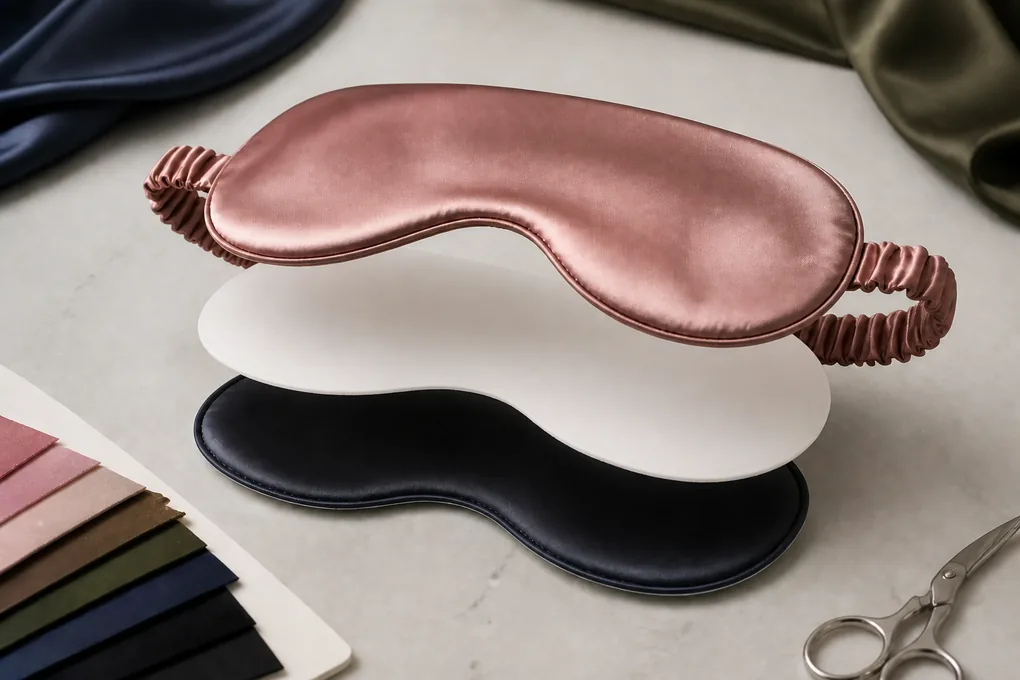
A sleep mask includes body panels, contact surface, outer face, filling or spacer, edge, strap, adjustment parts, labels and possibly shaped eye or nose features. Each layer affects thickness, heat, opacity, hand, laundering and claims. Map the entire construction and state which areas use silk. This prevents a broad material description from silently extending to filling, elastic, hardware or labels.
Map Outer, Contact and Internal Layers
Every material receives a location and function
Silk claims attach to the actual face construction
The skin-contact face and outward face may use the same silk reference or different approved materials. Printed artwork may appear only outside; a solid contact face may be chosen to protect hand and claim clarity. Filling, foam, batting, spacer fabric or interlining is identified separately. We record thickness or mass direction where relevant and avoid calling the whole mask pure silk when internal or functional components are different.
The map supports accurate labels and ecommerce copy. If both principal faces use the approved silk, the statement can name that scope. If only the contact face is silk, the wording should say so directly. Documented scope or check statements are reviewed against current documents and exact products. Do not convert fabric evidence into unsupported performance claims for blackout, cooling, skin improvement or sleep quality.
Component traceability supports odor and contact investigations. Filling lot, elastic, hardware, printed face, label and package batch can be linked to finished project without displaying internal codes to customers. If an unexpected smell or skin-contact issue is reported, samples from the affected combination can be compared. This is more useful than attributing every complaint to silk and allows corrective action to focus on the actual material, process or storage condition involved.
Construction drawings distinguish decorative topstitching from seams that close internal layers. Stitch line, margin and opening closure are defined. A repair used to close a turning gap should not create a rough patch on the contact face. These details are reviewed in pre-project units so workmanship remains consistent when internal layers are no longer visible.
Define Edge, Nose and Eye-Zone Geometry
Small shape changes alter pressure and light
Pattern points require numeric control
The body drawing shows overall width and height, bridge or nose contour, lower-edge curve, side wing, strap attachment and any cup or eye recess. A classic flat reference around 20 × 9 centimeters differs materially from a 3D direction around 21.5 × 9.5 centimeters even before internal depth is added. We nominate measuring points and symmetry rules so pattern changes can be evaluated beyond a front photograph.
Nose pieces, wire, foam bridges or removable inserts introduce new materials and pressure risks. They are not assumed necessary. If selected, their dimensions, flexibility, ends, placement and care behavior are specified. Eye cups are reviewed for eyelid and lash clearance without creating a rigid perimeter. The finished mask is worn because flat measurements cannot show how curves interact with a three-dimensional face.
Material substitutions are handled before assembly whenever possible. Similar color or thickness does not prove equal hand, odor, recovery or care behavior. Compare the attributes that support the approved function and obtain buyer acceptance when the change affects a declared or visible feature.
Treat Strap, Labels and Branding as Wearable Components
Seam positions and attachments can be felt
Every addition needs contact review
Strap width, cover, elastic or webbing, join and attachment angle affect stability. A twisted seam or bulky bartack near the ear can dominate the user experience even when the mask body feels smooth. Labels are positioned away from sensitive contact or designed with an appropriate low-profile solution subject to destination requirements. Embroidery backing, transfer film and logo stitching are likewise assessed from the skin side.
The bill of materials identifies approved colors and substitution limits. Dark strap materials should not shadow or transfer onto pale silk. Adhesives, if used, require compatibility and care assessment. Buyer-supplied hardware or labels carry version and delivery control. This full anatomy gives inspectors observable checkpoints and gives brand teams material language that matches what customers actually touch.
Layer and component declarations remain consistent through selling channels. A marketplace title might call the item a silk mask, while the detailed composition field, sewn label and package explain which faces are silk and which components serve filling or retention. Those statements must not contradict. We give the buyer a component-level fact set for its legal and merchandising review. If a product changes from silk on both faces to silk on the contact face only, the SKU, artwork and claims reopen. This control prevents old copy from following a visually similar revision and protects customers from a material scope that exists only in the title.
Set Honest Boundaries for Comfort, Blackout and Wellness Claims
Soft silk surfaces and well-developed geometry can support a pleasant wearing experience, but comfort, total darkness, cooling, anti-aging and sleep improvement are not universal outcomes. Faces, rooms and preferences differ. We describe material and construction accurately, check observable fit and light behavior under defined conditions, and reserve medical or therapeutic statements for evidence and qualified review. Strong B2B content should reduce claim risk, not copy marketplace superlatives.
Describe Construction Features before Subjective Outcomes
Smooth surface and covered components are observable
Comfort remains user-dependent
A buyer can state that a nominated face uses the approved silk fabric, that elastic is covered, that a slider is positioned away from a defined contact zone, or that a contoured cavity provides measured clearance. Those are physical facts. “Pressure-free,” “perfectly comfortable” or “fits everyone” are not. Wear trials record specific observations such as local contact, strap setting, movement and ease of adjustment across representative users.
Marketing can communicate the design intent without converting it into certainty. A low-profile side edge may be developed for side sleepers, yet actual experience depends on head, pillow and position. A broader body may be intended to increase coverage, while edge light can still vary. Review final copy with product evidence and ensure instructions explain adjustment and orientation where those actions affect results.
Evidence is also required for care-related promises. “Machine washable,” “washable without deformation” or “no fading” are testable statements whose method, number of cycles and acceptance conditions should be defined. A hand-wash instruction cannot support claims about machine cycles. We evaluate the complete mask, including logo, filling and hardware, and describe observed changes. If the product is intended for frequent travel, the buyer may prioritize quick recovery after packing, but that is different from drying performance. Precise language lets product teams emphasize a verified advantage while avoiding an absolute result that could fail under another household process.
Measure Light Control under a Defined Setup
Blackout depends on face seal and environment
A dark material alone cannot prove zero light
Light enters through material and, more commonly, through gaps at the nose, cheek or side. We evaluate coverage on representative faces under a stated light direction and intensity approach appropriate to development. Observations distinguish transmitted light from edge leakage. A cup construction may create clearance while increasing the perimeter that must follow the face. Strap setting and mask position are recorded with the result.
If the buyer wants a numeric method or claim, the method, equipment, sample and acceptance boundary are agreed before review. One wearer photograph in a dark room is not evidence for universal blackout. Copy can instead describe opaque layered construction, contoured coverage or another verified feature and invite customers to adjust the fit. This is more credible than promising complete darkness regardless of facial anatomy.
Claim review also considers comparison wording. “More breathable,” “cooler” or “better blackout” needs a named comparator, method and result. Without that basis, a physical description is safer and more informative: body dimensions, silk contact face, adjustable travel, contoured eye space or layered construction. The buyer’s legal reviewer determines destination requirements, while we provide accurate component and check information. This division keeps product development detailed without allowing marketing language to outrun evidence.
Copy approval includes translations and marketplace attribute fields. A safe description in the main text can be contradicted by an absolute “100% blackout” variant attribute or badge. The buyer reviews all occurrences of the claim, and final product data uses the same bounded material and performance language across title, bullets, label and package.
Review Health and Beauty Language with Evidence
Skin, hair and sleep claims require care
Product copy should not diagnose or treat
Marketplace listings often connect silk masks with wrinkle prevention, hydration, migraines, insomnia or guaranteed better sleep. Such statements can cross into health claims and may be unsupported. Do not reproduce them because competitors use them. The buyer supplies proposed wording, destination and substantiation for qualified review. Material facts, contact-surface design and care instructions can stand on their own without promising a clinical result.
Even apparently simple “hypoallergenic,” “antibacterial” or “chemical-free” claims need definition and evidence. A fiber name does not establish absence of every sensitizer, dye, finish or component. We maintain a component map and current check scope. Where evidence is limited, the claim is narrowed or removed. This protects the buyer from preventable enforcement and trust problems while preserving detailed product information customers can verify.
A complaint about sleeping hot may relate to room temperature, mask coverage, humidity or user preference and cannot be assigned automatically to one layer. We keep claims limited, examine material and profile, and offer design comparisons without promising a universal thermal outcome.
Use a Product Selector Based on Sleep and Travel Needs
Overall width and height are useful only when tied to named pattern points and a wearer context. A classic, adjustable, or contoured mask route creates a different coverage conversation, but a flat measurement alone cannot settle nose contour, eye spacing, side wings, or the strap relationship. State the finished shape, symmetry expectation, anchor locations, and profile question your project team needs to review.
Prioritize Low Profile for Side-Sleeping Programs
Side bulk and hardware position become key variables
Coverage must remain adequate without rigid edges
Side sleepers can feel sliders, thick cup rims or gathered joins when the head presses into a pillow. A low-profile classic construction may reduce that contact, but body contour and strap tension still need to control movement and edge gaps. We examine likely side positions, locate the strap join and feel transitions at temples and ears. The goal is a defined construction that reduces identified pressure points, not a claim that no wearer will feel the mask.
Packaging and customer guidance can explain orientation and correct placement. If adjustability remains necessary, hardware may be located toward a lower-contact zone and protected by fabric, subject to wearer review. We avoid adding a thick cushion everywhere because extra bulk can create heat and new pressure. Sample comparison isolates the variable: body shape, edge padding or adjustment component changes one at a time where practical.
Variant names use direct functional terms such as classic fixed elastic, adjustable slider, contoured eye cup or long tie. Vague names like deluxe and premium may support merchandising but cannot replace the construction field. Clear naming reduces selection and packing errors.
Choose Eye Clearance for Lash or Makeup Concerns
Contoured cavities create space but require fit control
Depth and rim geometry are inspected together
A 3D reference around 21.5 × 9.5 centimeters can begin discussion of shaped eye areas. The buyer defines why clearance matters and whether both eye zones need a particular depth or position. Cup spacing, rim softness, nose relationship and side profile are assessed on representative users. Deep cavities that miss the eyes do not deliver the intended benefit, and rigid rims can create pressure or leak light.
We define cavity shape and symmetry through patterns, sectional references or approved tooling where applicable. Filling and outer silk must follow the form without wrinkles touching the eye zone. Care review checks whether the shape recovers. Marketing should describe contoured clearance rather than guaranteeing protection for every lash style or cosmetic application. The finished sample sets the factual limit for customer language.
The selector can include a decision tree for purchasing: start with likely sleep position, decide whether eyelid clearance is required, identify the wearer range, choose fixed or user adjustment, and state the pack role. Each answer narrows physical options. Color and logo come later because they do not repair fit. This order also helps distributors train sales staff and prevents variant selectors from presenting size, 3D shape and strap type as equally cosmetic swatches. A buyer receives fewer but more defensible SKUs, deeper allocations and product descriptions tied to observable differences rather than repeated luxury adjectives.
Select Adjustable or Tie Routes for Specific Wearing Behavior
User control can improve fit but adds handling
Long parts require clear safety and pack review
An adjustable strap can serve users who expect quick tension changes. A long-tie mask offers a different visual and fit ritual, but tie length, knot position, loose ends and hair interaction require examination. Hook-and-loop provides broad overlap yet can snag hair if exposed or degrade if misaligned during care. We choose these routes when their use benefit is clear and give buyers an alternative when component complexity outweighs it.
The product selector states which features are included, which user problem they address and what remains unverified. Optional gel, aroma or removable elements are excluded unless the buyer supplies a defined need and appropriate safety review. A focused range makes variant quantities deeper, instructions clearer and quality checks more relevant. Customers can see a reason to select one mask without reading the same generic benefits under five silhouettes.
A selector should limit duplicated SKUs. If two masks share body, strap, material and pack and differ only by a marketing name, they create inventory and content complexity without a functional choice. We consolidate them or give the variant a real distinction such as size, geometry, artwork or selling unit. The result is a range that customers can compare, purchasing can allocate and inspectors can identify without relying on subtle naming.
A range comparison table can state use context, geometry, strap type, body reference, layer direction and included pack without assigning a universal comfort ranking. Customers choose from physical differences. Purchasing can map feedback to the chosen configuration, and future development can alter one route without rewriting every mask in the assortment.
Define Finished Dimensions and Face-Coverage Geometry
Overall width and height are useful only when tied to named pattern points and a wearer context. A classic, adjustable, or contoured mask route creates a different coverage conversation, but a flat measurement alone cannot settle nose contour, eye spacing, side wings, or the strap relationship. State the finished shape, symmetry expectation, anchor locations, and profile question your project team needs to review.
Measure the Mask Body at Repeatable Points
Curves need a drawing, not one bounding box
Centerline and landmark dimensions control shape
The drawing identifies maximum width and height, center-front height, nose-notch depth and width, eye-zone position, side-wing height, strap-anchor separation and relevant radii or curve templates. Quilting, piping or binding references are included where used. Measurements state whether they follow a straight chord or a curved edge. This prevents two masks with the same headline dimensions from passing even though their coverage and nose relationship are visibly different.
Silk and filling can shift during sewing, so symmetry is checked after finishing under a stated laying method. Do not stretch elastic or flatten shaped cups to force a reading. Tolerances reflect feature scale and functional risk. Nose contour or eye position may need tighter control than total strap length. Pilot data confirms whether the pattern and operation can hold the proposed limits.
Pattern grading follows facial landmarks rather than uniform enlargement. Increasing total width can shift strap anchors and eye zones while leaving nose contour unsuitable. A larger size may need a different lower curve, side height or cup spacing. We define which points move and which remain stable, then check representative users. This preserves the design intent across sizes and prevents a “large” mask from becoming only a stretched silhouette.
Pattern measurement and fit review remain linked but separate. Numeric inspection protects project consistency; wear trials determine whether the pattern serves the intended faces. Passing one does not imply passing the other. Both references appear in the release set so later dimensional drift can be distinguished from the original design limitation.
Relate Coverage to Representative Facial Landmarks
Nose, cheekbone and temple relationships influence gaps
Review records the wearer reference
Fit trials observe where the lower edge meets the nose and cheeks, whether the side reaches the intended temple zone and whether the upper edge conflicts with brows. For 3D masks, cavity centers are compared with eye position and lash clearance. Use representative users or fit forms suited to the target scope, documenting relevant dimensions. One face cannot validate a broad audience, so conclusions remain limited to the examined range.
Coverage is assessed while the wearer changes position, because a mask can look sealed when upright and shift on a pillow. Strap tension and adjustment setting are noted. Edge gaps, transmitted light, local pressure and slippage are recorded separately. These observations guide pattern changes without claiming that a larger body automatically solves all light leakage.
Finished dimensions are sampled across project, not inferred from one pattern. Results identify body and strap states separately. A body within tolerance with an incorrect strap remains a failure, as does correct total width with misplaced eye zones.
Keep Size Naming Secondary to Numeric Fit Data
Regular, large and one size require definitions
Customer guidance should identify actual ranges
If the buyer offers regular and large, each size receives its own body and strap specification plus the wearer range it is intended to serve. “One size” is used only with carefully validated scope and honest limitations. Numeric product dimensions can be shown to customers, accompanied by adjustment guidance where relevant. We avoid converting a catalog reference into a universal head-size promise.
Packaging, barcode and SKU data carry the same size identity. Samples and inspection reports name the exact version. When geometry changes after wear trials, artwork and photography are checked so customers do not see an obsolete silhouette. This parity helps prevent size-selection complaints and supports replenishment without relying on an informal visual comparison.
Geometry changes are reviewed against pattern balance and material grain. Enlarging one side wing or deepening a nose notch can shift the visual center, change strap pull and create asymmetric sewing behavior. The approved pattern includes alignment marks and left-right checkpoints. Where contoured components are paired, their position and depth are compared before and after assembly. Bulk templates or digital patterns are revision controlled. An inspector should be able to distinguish a genuine geometry deviation from normal soft-fabric drape, while project should not rely on pulling the mask into shape during pressing.
Engineer Strap Tension, Adjustment Travel and Hardware Placement
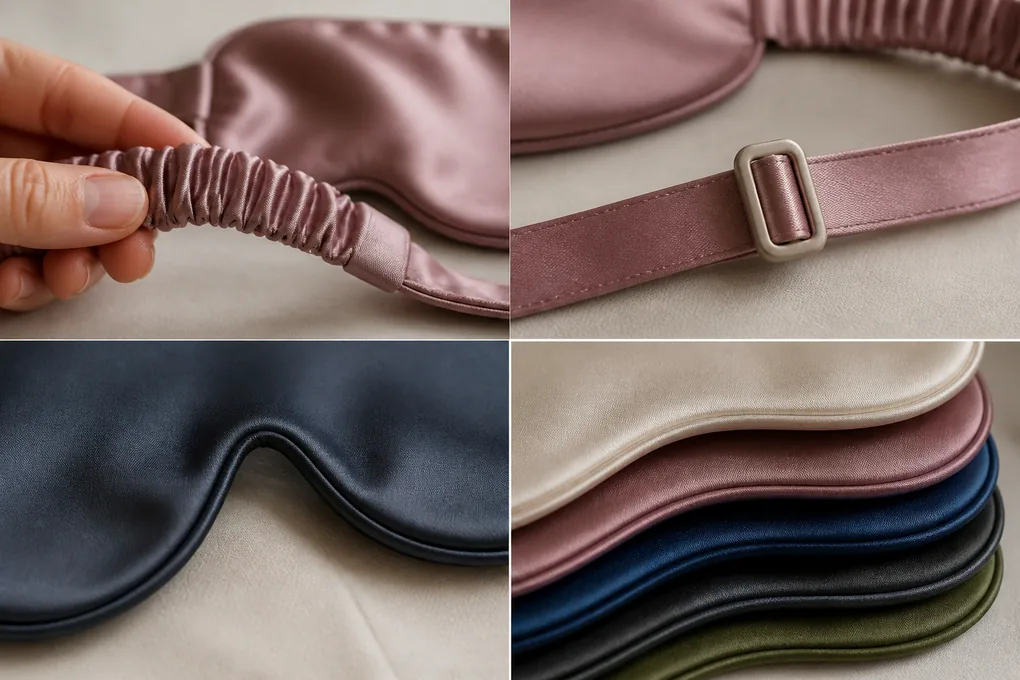
A mask can have an excellent body and still fail because the strap slips, pulls hair, loses recovery or places hardware under the head. We define the retention system as carefully as the silk face. Fixed elastic needs extension and recovery targets; adjustable routes need useful travel, holding behavior and end control; tie and hook-and-loop routes require safe length and contact review. Finished wear trials connect component measurements to real stability.
Specify Fixed Elastic by Behavior, Not Only Length
Extension, recovery and cover distribution affect pressure
Tension is checked across the intended range
The bill of materials identifies elastic type, width and reference behavior. Finished loop length, stretch under stated load and recovery after cycling can be specified where appropriate. The silk cover has enough fullness to extend without limiting the elastic or forming hard bunches. Strap joins and anchor angles distribute force across the mask body. Inspect for twisting and exposed elastic after repeated movement.
Wear trials record head reference, initial fit, movement, pressure observations and strap recovery. A loose mask is not corrected automatically by shortening the elastic; that can increase nose or temple pressure while leaving geometry unchanged. We determine whether slippage originates in tension, anchor location, surface interaction or body shape. Corrective action targets the observed cause.
Recovery requirements are tied to duration and load rather than described as “strong elastic.” A buyer can cycle the strap through a stated extension, allow a defined recovery time and compare retained length or holding behavior. Wear and laundering trials complement that component result because covers, seams and hardware can limit travel. The buyer decides which change would be unacceptable in use. If repeat use is central to the program, an early component screening can prevent full mask samples from being made with elastic that loses tension quickly or creates an unstable adjustment range.
Design Adjustable Straps with Useful, Stable Travel
The setting must hold without sharp exposure
Excess length and stops require control
The adjustable range is stated between defined settings, with the slider, buckle or overlap able to maintain position under representative movement. Hardware dimensions, material, edges, color and orientation are approved. Fabric tunnels or protective tabs can reduce contact, but they should not jam the adjustment. Strap tails are contained without creating a lump. We check operation with one hand and without a mirror.
Users should be able to identify the correct adjustment direction from the construction or concise instructions. If the setting creeps during sleep, we measure the change and examine hardware compatibility. A substitute component is revalidated for holding force and comfort. Do not claim broad fit merely because a slider exists; body geometry and adjustment travel must work together on the intended range.
Strap materials are reviewed with hair as well as skin. Rough joins, exposed hook surfaces and certain hardware positions can catch hair during removal. We observe donning and doffing, not only stationary wear. A silk cover can reduce direct elastic contact, but its seam and gather distribution still matter. If the brand makes a reduced-snag claim, that wording requires evidence from the nominated construction and intended comparison.
Component suppliers should identify the exact approved hardware and elastic reference. Color alone is insufficient. Surface finish, edge radius, holding behavior and recovery affect use. Incoming checks verify the attributes important to the mask, and unauthorized look-alike components are not accepted merely because they fit the same strap width.
Control Hook-and-Loop and Long-Tie Variants
Broad adjustment introduces hair and loose-end risks
Closure surfaces stay away from skin and silk
Hook-and-loop length, hook direction, edge finishing and overlap are specified. Exposed hooks can catch hair or abrade silk, while a narrow overlap may open under movement. Long ties need finished length, width, seam, knot position and loose-end evaluation. The buyer defines the aesthetic and wearing method, and pack instructions demonstrate it without implying suitability for every user.
Care trials observe lint collection, closure damage and tangling. Hook-and-loop may need to be closed before washing; ties may require a laundry bag or another verified instruction. Any warning or age-scope question is reviewed for destination. Bulk checks operate selected units and inspect attachment security, rather than counting the component as present and assuming it works.
Hardware position is checked while the wearer rests on a representative pillow. A location that feels unobtrusive when standing may become prominent under side pressure. This simple change in check condition often explains marketplace disagreement about adjustable-mask comfort.
Place Logos without Creating Eye, Skin or Light-Control Problems
Branding on a sleep mask sits close to eyes, skin and flexible curves. Embroidery, heat transfer, print, woven labels and decorative plates each change hand, opacity, care and appearance. We choose placement and method after defining the contact face and body geometry. A prominent logo cannot justify a stiff backing, rough thread, ink odor or pinhole light path where the wearer expects softness and coverage.
Choose the Brand Method for the Intended Face
Outer decoration and contact-face branding have different limits
Backing and adhesive remain part of the product
Embroidery can create a premium tactile mark outside, but stitch density, backing and knots may be felt through a thin construction. Printing can preserve a flatter hand if the process suits the nominated silk, yet color, cure and odor require evaluation. Heat transfers add film and edge feel. A woven label creates a seam or loose edge. Review every method from both sides and state all supporting materials.
The skin-contact face is kept clean unless the buyer has a strong reason and an approved low-impact method. Even an outer logo can alter stiffness over the eye zone. We request final artwork, dimensions and color rather than sampling a placeholder mark whose density is unrelated. Material and brand claims on packaging remain consistent with the decorated construction.
Decorative approval includes artwork ownership. Do not reproduce competitor logos, licensed characters or marketplace imagery without buyer-provided rights. Original files and approved revisions travel with the SKU so project does not rely on a screenshot.
Position Artwork around Curves, Seams and Cups
A flat logo can distort on a shaped mask
Visual center and functional center may differ
The placement drawing references centerline, finished edges, nose contour and eye zones. A logo that appears centered in the pattern may curve or tilt when worn. On 3D masks, artwork should avoid cup seams or compression unless that effect is intentional. Strap branding must not create a hard join near the ear. We assess the worn appearance as well as the flat presentation used in packaging.
Print and embroidery tolerances reflect scale and visibility. Fine text may become unreadable on lustrous moving fabric, while large marks can dominate the limited surface. We define acceptable placement and orientation for each mask size. If artwork changes, the sample or strike-off stage affected by size, density or color reopens. Photography uses the approved version so ecommerce images do not promise a different mark.
Logo sampling should include the smallest and largest ordered artwork, not only the most forgiving middle size. A compact mark may fill with thread or lose fine detail; a large transfer can stiffen the body and affect folding. Colorways with high contrast can reveal placement and edge defects differently. We approve actual combinations or a reasoned representative set and state which variants it covers. If a licensed design requires exact colors or minimum clear space, those requirements enter the artwork specification without implying that ownership came from a marketplace reference.
Check Branding through Care and Packed Storage
Adhesion, transfer and odor need time to appear
The unboxed mask should remain ready to wear
Decorated samples follow the agreed care route. We examine cracking, peeling, thread change, puckering, color transfer and edge lift. Printed or adhesive methods receive odor and skin-contact review appropriate to the program. Dark logos on pale silk are stored in the planned fold to reveal migration or pressure marking. Packaging materials are included because they can trap volatile odor or press a raised mark into another area.
Bulk inspection verifies artwork version, method, color, position, appearance, attachment and clean contact face. A visually small defect can affect every unit if it comes from the project file or setup, so early line checks are useful. The buyer approves limits for natural embroidery or print variation without accepting unreadable, detached or misplaced branding.
Brand color is compared on the chosen method and silk ground. Thread, ink and transfer colors can appear different from a screen value, especially against lustrous fabric. We approve a physical sample and define whether exact matching or coordinated contrast is required. Raised logos are checked under packed pressure because they can emboss another area. Fine typography is examined after care for legibility and edge integrity.
Branding placement is checked after strap tension curves the mask around the face. A logo approved on a flat sample may wrinkle or shift visually when worn. The buyer sees both states and decides the priority. This avoids moving the mark during bulk setup to “correct” a behavior that was never discussed.
Select Filling and Layer Construction for Coverage and Hand
Filling changes opacity, thickness, heat, drape, eye clearance, edge seal, care and odor. More padding is not automatically more comfortable, and an unexplained internal layer weakens material claims. Identify every layer, its purpose and its response inside the selected body geometry. The buyer can compare flat, lightly padded or shaped constructions through finished samples instead of relying on a plush photograph.
Choose the Minimum Layering Needed for the Job
Opacity and cushioning come with bulk and heat
Layer purpose is documented before sampling
A mask may use silk faces with a defined internal layer for opacity, body or cushioning. We nominate thickness, mass or material reference where relevant and state whether the layer covers the full body or selected zones. Side-sleeping products may favor lower profile; 3D eye areas may use structured elements while keeping the rim soft. We avoid filling the mask heavily merely to imply luxury.
Layer combinations are checked for show-through, shifting and differential shrinkage. Pale silk can reveal a dark or uneven filling. A loose layer can bunch after care and create pressure. Quilting or tack points can stabilize it but may introduce visible depressions or light paths. The prototype shows the compromise, allowing product teams to select based on the actual use priority.
Layer specifications distinguish nominal thickness from compressed or finished profile. Foam and batting can recover differently after sewing and storage, so a raw sheet measurement does not establish worn thickness. We record the relevant state and observe project samples. If cup structure uses molded or cut components, orientation and pair symmetry are controlled. This gives buyers a repeatable construction rather than an internal material described only as “soft padding.”
Layer cleanliness is protected during cutting and assembly. Light-colored silk can reveal trapped fibers, and eye-adjacent products demand careful handling. Work surfaces, component storage and in-process inspection are defined for the program. Any retained opening is closed by the approved method and checked for loose material.
Control Odor through Material, Process and Packaging
Smell can originate before or after sewing
A fragrance is not used to hide a material problem
Marketplace complaints about chemical or musty odor may relate to filling, printing, adhesive, finish, storage moisture or sealed packaging. We keep component and lot identity, use clean storage and evaluate finished packed samples after a defined closure period. Findings describe odor character, intensity approach and conditions rather than declaring every person will perceive it identically. Suspect sources are isolated through comparison.
The buyer should not add scent unless it is an intentional, reviewed product feature with ingredient, safety, labeling and destination considerations. Airing instructions are not a substitute for investigating unexpected odor. Pack materials and inks are included in trials because a mask can leave project acceptable and acquire odor in a sealed gift box. Corrective action follows the identified source.
Unexpected particles, fibers or residue inside the mask are investigated before release. Layer cutting, sewing and closure processes should not leave material that can migrate toward eyes. Workmanship and cleanliness checks include the internal construction where feasible.
Validate Layer Recovery and Care Compatibility
Shape should remain consistent after handling
All materials follow one released instruction
The mask is compressed, packed, worn and cared for according to the proposed route. We observe wrinkling, delamination, filling migration, cup collapse, edge roll and strap interaction. A removable insert needs secure containment, unambiguous contents and customer instructions. Gel or special inserts require additional safety and temperature review and are excluded unless specifically defined.
Dimensional and appearance checks occur before and after care using the same measuring references. If one layer shrinks or stiffens disproportionately, the mask can lose fit even though the silk face remains intact. The customer care label must reflect the complete construction, not generic guidance copied from an unrelated silk item. Bulk controls verify that the approved layer and placement are used.
Internal layer cutting and placement receive their own tolerances. A filling piece that is too small can leave thin light-transmitting margins; one that is oversized can buckle at the edge. Cup inserts need matched pairs and correct orientation. Adhesive or thermal bonding, when used, must not create brittle zones, odor or visible strike-through. Inspect representative work before closing the body because hidden defects become difficult to diagnose later. Finished opacity and feel remain the customer-facing result, while component controls give project a practical way to reproduce it.
Design a Travel or Gift Selling Unit around the Mask
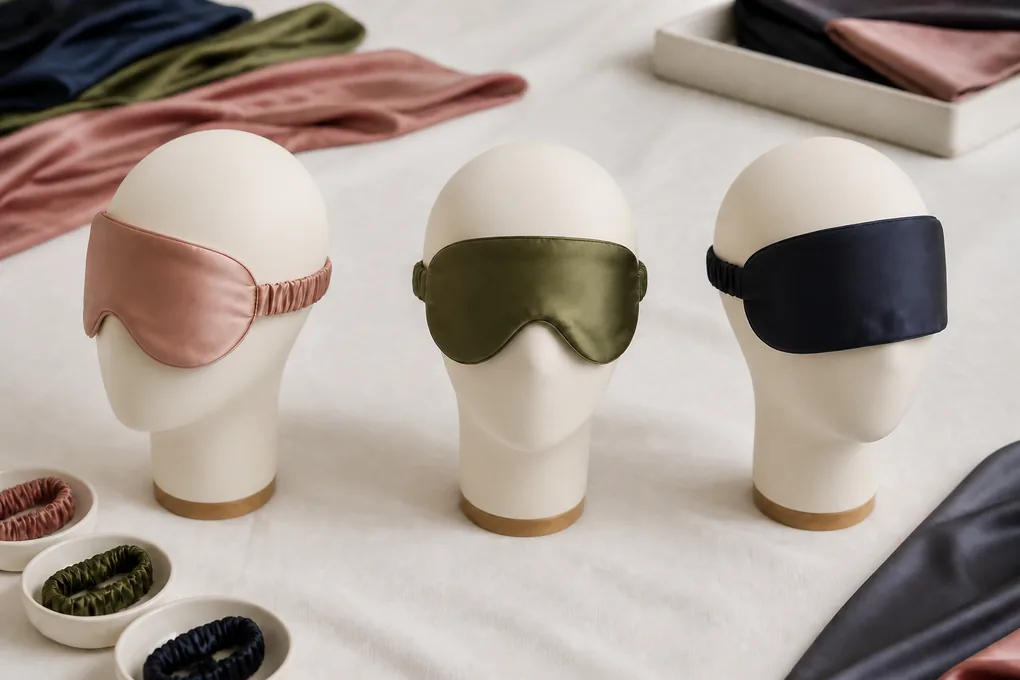
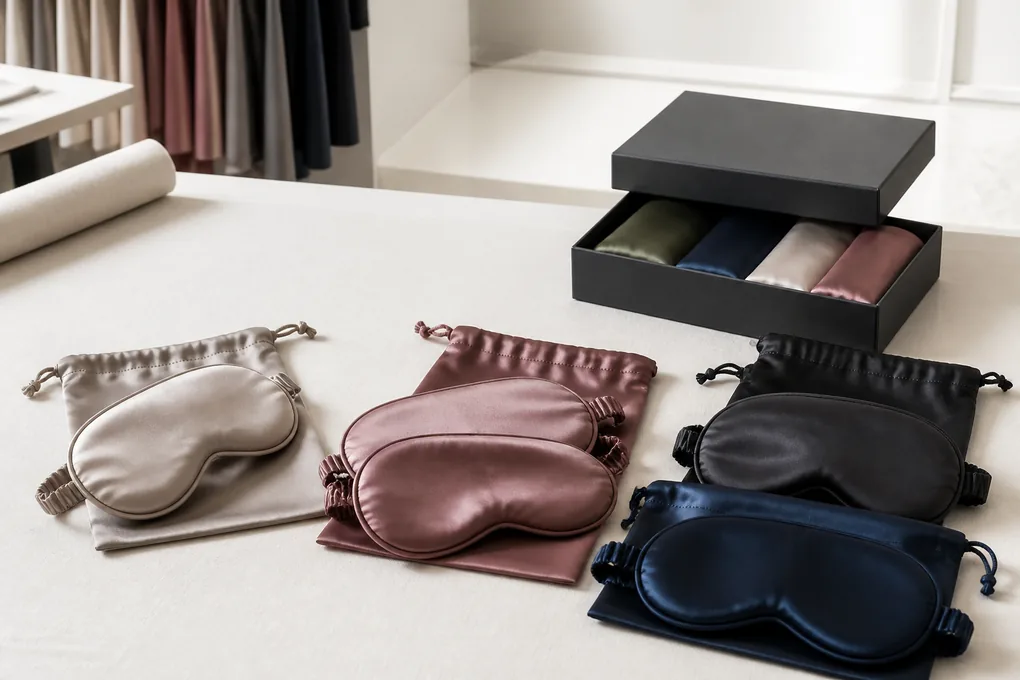
A silk sleep mask can be sold alone, with a storage pouch, inside a travel kit or as part of a gift presentation. The selling unit must state exactly what is included, protect the silk and adjustment parts, and avoid trapping odor or leaving pressure marks. We define fold, pouch, insert, barcode and outer packaging from the actual finished mask. Retail imagery and count language follow that physical unit.
State Every Included Piece and Its Material Scope
Mask, pouch and inserts remain distinct components
One photograph should not imply extra contents
A mask-only pack identifies one mask. If a storage pouch, care card, earplugs or another accessory is included, the bill of set names its quantity and material. Optional styling props do not appear as contents. Fiber claims distinguish the mask face from the pouch and functional components. The buyer confirms any age, safety or destination questions introduced by added pieces before the kit is released.
SKU and barcode data identify colour, shape, strap route, and pack configuration. A gift-box mask with pouch cannot share the same sellable code as a loose mask unless the buyer’s system handles that relationship explicitly. State loose-mask pieces and customer-unit counts as distinct figures in the RFQ and carton plan. This avoids a familiar shortage in which purchasing orders masks while the package supplier prepares fewer complete kits.
Travel and gift logistics include humidity and storage time appropriate to the route. A mask sealed immediately after processing may retain odor or moisture; a breathable pouch may reduce that risk but offer less contamination protection. We evaluate the chosen combination rather than assuming that a fully sealed pack is always more premium. Inserts and rigid cards use rounded or protected edges. If a kit includes several dark and pale textiles, separation prevents transfer. Carton compression is adjusted to preserve cups and retail boxes without leaving so much movement that contents abrade during transport.
Fold and Restrain the Mask without Permanent Marks
Cups, sliders and silk surfaces need protection
Pack volume follows approved geometry
A flat classic mask may lie differently from a 3D cup construction. Crushing the cups can compromise shape; placing a slider against silk can leave an indentation; folding long ties can tangle or create a hard knot. We develop a repeatable arrangement using tissue, pouch, sleeve, card or insert as needed. Restraint should not be so tight that it distorts edges or so loose that hardware abrades the face in transit.
Packed samples are held and reopened after representative storage. We examine shape recovery, fold marks, odor, transfer, loose fibers, component migration and ease of removal. Travel formats should fit the intended luggage context without making false claims about exact space savings. Gift formats should open cleanly and show the correct face, color and logo immediately.
Travel packs should be tested inside the intended kit geometry where one exists. A mask may fit its own pouch but become crushed beside a bottle, adaptor or rigid insert in a larger amenity set. Review component order and movement in that final context. Gift sets likewise reconcile every item and label. The mask remains protected without implying that props or optional accessories are part of the purchased unit.
Pack instructions should not overstate care convenience. If hand washing, air drying or shape adjustment is required, the language remains readable before purchase. Customers can make an informed choice, and support teams can answer from the same approved instruction rather than from a generic silk-care script.
Approve Pack Artwork and Distribution Protection Together
Instructions, claims and barcode share one system
Cartons preserve variant identity and presentation
Artwork states product name, size or fit guidance, material scope, care, included pieces, business information and other approved destination content. Adjustment instructions use clear diagrams or concise language. Barcodes are tested on the actual substrate. Claims about blackout, comfort or wellness receive the same evidence review as online copy. The physical pack is proofed because small panels can force text below useful size.
Master cartons use approved units per carton, variant marks and protection. Excess compression can deform masks or gift boxes; excess movement can scuff packaging. Mixed-color cartons are mapped when authorized. Receiving and final inspection teams should identify a variant without opening every retail unit. This makes presentation a controlled part of the product rather than a decorative item added after mask approval.
Packaging claims about reusable, recyclable or compostable materials require supplier evidence and destination review. A storage pouch can be described by its actual material and function without unsupported environmental language. Product protection remains part of the decision.
Approve Sleep Masks through Wear, Movement and Pack Review
A flat inspection cannot reveal light gaps, eyelid contact, local pressure, slipping, adjustment creep or hardware contact. We validate the sample on representative users or defined fit forms, record geometry and strap settings, and observe likely sleep positions. Material, color or print, logo, care and packaging follow staged approvals. The release sample brings together the product customers will wear and receive.
Plan Samples around the Most Expensive Unknown
Material, print, geometry and hardware can advance separately
Each sample has a stated approval purpose
Solid color may begin with lab dips; printed masks may use strike-offs; custom hardware or elastic can be reviewed as components. A shape prototype answers face coverage, eye zone and strap anchor questions. A decorated sample confirms logo hand and placement. Pre-project combines released materials, geometry, labels and pack. We avoid treating one early handmade piece as proof of every bulk operation.
Every sample carries an ID, dimensions, material and component references. Buyer comments state wearer reference, strap setting, position and observation. “Left lower edge shows light near the nose” directs a pattern review; “not blackout enough” does not. Accepted areas remain accepted unless a linked change affects them. This controls resampling and protects the buyer from approving by vague impression.
The release summary identifies wearer range assessed, fit forms or users used, settings observed and conditions not tested. Customer teams can write accurate guidance from that scope. Silence about limits is not converted into an unlimited one-size or blackout promise.
Observe Fit through Movement and Likely Sleep Positions
Static front views miss the main failure modes
Pressure and slippage are recorded separately
Wearers put on and adjust the mask without coaching beyond intended instructions. We note ease of placement, nose and cheek gaps, eye contact, temple or ear pressure, strap stability and hardware exposure. The trial includes gentle head turning, back and side positions as relevant, and a defined wear interval. Results are observations under those conditions, not a universal comfort score.
When a problem appears, one or a small number of variables change deliberately. Shortening the strap may reduce sliding but increase pressure; enlarging the body may improve coverage while increasing side bulk; deeper cups may protect lashes but create perimeter gaps. Comparison samples reveal these tradeoffs. The buyer selects the balance that serves the stated audience and uses appropriately limited customer language.
Acceptance panels use consistent instructions. Wearers know what constitutes the front, how to adjust tension and what activities to perform, but they are not coached toward a positive answer. Observations can use structured location maps and defined rating anchors alongside open comments. The buyer decides what evidence is sufficient for its audience; we do not present a small development panel as population research. Its value is diagnostic: it reveals recurring pressure, gap or slippage patterns early enough to change the physical product before bulk and customer reviews.
Approve Care and Packaging after Wearing Works
Layer recovery and odor are judged on the finished unit
Release reflects project-intended inputs
Selected samples follow the proposed care method and are rechecked for dimensions, surface, filling migration, cup shape, strap recovery, hardware function, logo and color. The completed mask is then packed using intended components and opened after representative storage. Unexpected odor, transfer, crushing, pressure marks and tangled ties are recorded. A pack pass cannot compensate for a mask that fails fit, and fit approval does not authorize untested packaging.
The release identifies accepted samples, open limits and any temporary materials. A presentation sample containing a hand correction or substitute component is not silently used as the bulk standard. Drawings, bills of materials, artwork and acceptance notes accompany retained samples. This gives project a reproducible target and gives purchasing clear knowledge of what was actually validated.
Fit panels should include normal variation rather than only selecting people who suit the first prototype. We record enough relevant dimensions to understand why a sample works or fails without collecting unnecessary personal data. Results are anonymized for product decisions. A failure at an edge of the intended range can prompt another size, altered adjustment or narrower compatibility wording. It is not hidden behind an average score.
Wear results are reviewed for patterns, not averaged into silence. If several users report pressure at the same temple, the issue remains visible even when most scores are positive. Inspect anchor, hardware and edge construction at that location. A design decision then responds to the physical pattern.
Submit a Quote-Ready Custom Silk Sleep Mask RFQ
A useful mask RFQ identifies the wearer context, use setting, body geometry, material layers, strap or adjustment system, branding, packaging, and quantities. It separates confirmed choices from options that still need discussion. This is a bulk business route, so the final commercial conversation follows the actual color, size, construction, sample, and review scope rather than a public single-unit value.
Create One Row per Orderable Mask Variant
Geometry, strap, color and pack define the SKU
Options do not share one ambiguous quantity
Each line states classic, adjustable, 3D, tie or another selected route; finished dimensions or catalog reference; intended wearer range; silk face scope; filling or layers; strap and hardware; solid color or artwork; logo; labels; included pieces; selling-unit pack; and quantity. Colorways or sizes have separate allocations. A mask with pouch is distinguished from mask-only units. Alternatives remain clearly optional.
The matrix reveals setup and component complexity. A large total divided across many colors, logo versions and strap systems may create small project cells. Identify which choices affect material, printing or embroidery, cutting, sewing, component procurement and packing. Buyers can simplify lower-value variation while retaining mandatory fit and branding needs. Our quotation then applies to a defined product, not to the word “custom.”
The inquiry identifies whether the desired response is feasibility guidance, sample development, a budgetary option or a formal quotation. Early concepts may receive alternatives and missing-input questions; released briefs can receive scope-based terms. Stating the stage prevents a provisional component or assumption from being treated as final. It also lets the buyer schedule artwork, fit review and packaging decisions in an order that protects the intended launch.
Quote comparison identifies taxes, freight, tooling, sampling or buyer-supplied elements according to the agreed commercial format, without publishing a retail unit commercial value. What matters here is scope parity: every offer should refer to the same body, layers, strap, logo, pack and allocation before purchasing compares totals.
Attach Fit, Artwork, Claims and Packaging Inputs
The biggest assumptions should arrive as files or questions
References are annotated rather than copied
Useful inputs include the intended wearer and setting, head or face-fit direction, a dimensional drawing, preferred catalogue sample, material and filling needs, a colour target or print file, logo artwork, planned claims, required tests or documents, label copy, pack design, barcode, destination, and decision dates. Buyer-supplied components are identified. Missing values are marked for our recommendation rather than filled with guesses.
Marketplace links can illustrate a contour, strap, or pack style, but they do not prove fiber, filling, blackout, or comfort. The buyer names the visible feature it wants and the features it does not want. We convert that request into checkable construction language while avoiding copied competitor wording, review statistics, artwork, or wellness promises. This protects originality and lets final inspection examine the same characteristic that purchasing requested.
Real quantities are stated by color, construction and selling unit. A thousand pieces divided among ten colorways and two logo versions is materially different from one repeated style. The commercial response reflects that allocation and names assumptions.
Confirm Scope before Accepting the Commercial Response
Inclusions, assumptions and open decisions remain visible
Changes reopen affected samples and timing
Our response repeats the selected route, dimensions, material and layer scope, component, quantities, logo, packaging, sample plan, destination and buyer-supplied inputs. Proposed alternatives are separated from the base. Timing depends on approval and file readiness. Purchasing can compare complete offers because the products share the same stated assumptions rather than selecting the lowest number attached to different mask constructions.
If geometry, strap, filling, artwork, claim, colour allocation, or pack changes, we review affected consumption, components, samples, and schedule. The revision is identified and approved. The agreed values then guide the project and its inspection plan. This turns a broad private-label mask idea into a project-ready inquiry whose fit, material claims, and selling unit can be checked.
The RFQ also states inspection responsibility and release authority. The buyer identifies whether it will inspect, appoint a third party or request a supplier proposal, plus any required sampling standard and defect classification. We align the checklist to the selected mask: geometry, materials, strap, adjustment, logo, cleanliness, odor observation, operation and pack count. A final inspector cannot recreate an undefined comfort check for every unit, so wearable approval is completed during development and bulk inspection verifies measurable construction and sampled function against released references.
Buyer questions about wholesale silk sleep mask development
Does this page promise blackout or sleep performance?
No. Those outcomes need a defined product, sample, and evidence basis.
Why separate fixed and adjustable masks?
The strap path, mechanism, anchor, and sample checks are different.