
P021
Silk Packaging and Labeling for B2B Buying Programs
At China EverBen Silks, we organise dispersed packaging notes into a focused B2B discussion about the silk article, customer-facing selling unit, buyer-owned information, and next decision. Begin with the finished item and its handling conditions, then connect folds, pack layers, artwork, identifiers, counts, destination questions, and the responsible buyer before comparing packout direction.
Published by China EverBen Silks Reviewed by Mark Liu
Keep product protection and label controls in one packaging request
State the selling unit, inner pack, carton, handling concern, label need, and destination context.
Define the Sellable Silk Unit Before Choosing Any Pack
At China EverBen Silks, we start with the object the customer will receive. A box, pouch, card, wrap, or shipping carton cannot be considered sensibly until the buying team has named the finished silk article, its variant, and the exact unit offered to the account or end customer. That product definition keeps presentation choices linked to real customer value.
Name the article, variant, and customer-facing count
One sellable unit needs one recognizable product identity
Separate a single item, pair, set, multipack, and gift configuration
Start with the specific article rather than a catchall product category. A two-case pillow offer, a mattress sheet, an upper sheet, a duvet casing set, a fixed-strap eye mask, an adjustable eye mask, a hair wrap, a carded gathered tie, or a gifting assortment each creates a different packaging conversation. Name the buyer reference, visible variant, size or colour where relevant, and the number of pieces making up one customer-facing unit. If a set contains unlike items, list each one separately. If one style is sold in several counts, treat each count as its own proposed configuration. We use this starting point to keep design, purchasing, and operations discussion tied to the same item. It also protects a buyer from comparing a response about a single article with one about a pair, bundle, or assortment that looks similar in a photograph but is commercially and physically different.
Describe the moment when the unit is opened or received
Customer, retailer, hospitality, and warehouse contexts create different priorities
State whether the immediate concern is shelf presentation, gifting, e-commerce, storage, or receiving
Next, tell us where the unit will be seen and handled first. A silk pillowcase sold through an online store may need a compact customer-ready presentation. A sheet or cover supplied as part of a selected assortment may need a clear way to distinguish size or contents. A sleep accessory offered as a gift may need an opening sequence that presents the item deliberately. A program delivered to a hotel, spa, or corporate recipient may make count reconciliation and handling more important than consumer display. We do not need a marketing story; we need the physical and commercial moment that guides the pack decision. Explain what should be visible immediately, what should remain protected, which component is expected to be handled first, and whether the unit will be picked, shelved, mailed, gifted, or distributed in bulk. This stops a reference photograph becoming an assumed full pack specification without an explicit use context.
Keep the selling unit separate from every later pack level
The article is not automatically the pouch, insert, inner pack, or master carton
A clear hierarchy avoids count and responsibility errors before quotation
The customer-facing unit is only the first layer of the packout. It may sit beside a card, inside a pouch, within an inner group, or inside an outer shipping carton, but those are not interchangeable descriptions. Write a short hierarchy: finished silk article; customer-facing unit; any grouping used for handling; and proposed master-carton level. At each level, say what is inside and which count is currently proposed. Do not assume that a supplier, retailer, or warehouse will infer arithmetic from a product name. We use the hierarchy to understand the buyer's current direction, not as an unstated promise about a finished solution. For an unresolved item, name the team question and the decision that remains pending. This modest discipline makes product photography, label copy, carton marks, range planning, receiving, and later commercial comparison easier to keep connected to the correct silk configuration.
Translate Silk Handling Risks Into Buyer-Provided Conditions
At China EverBen Silks, we start with the handling concern before discussing a protective direction. That keeps the discussion focused on the actual silk article, its fold, trim, hardware, printed area, or presentation requirement rather than a vague request for premium packaging. Tell us whether the concern belongs to a customer opening moment, a retailer handling step, a buyer-controlled warehouse, a gift assembly process, or receiving. This gives product, procurement, and packaging colleagues a shared reason to consider the condition while leaving material selection and performance conclusions for a defined project review.
Identify the surface, edge, trim, or shape that needs attention
Protection begins with a visible product-specific risk
Point to the area that could rub, catch, compress, crease, shift, or transfer color
Describe the part of the item that creates the concern. For a silk pillowcase, that might be a smooth face panel, an opening edge, a contrasting piping line, a print area, or the way the folded piece sits against another surface. For a mask, bonnet, or scrunchie, the issue might involve a strap, tie, elastic route, gathered construction, seam, hardware, decorative edge, or a compact folded shape. State what the buyer has observed or wants to preserve without claiming that a particular material or format will solve it. A useful note says where contact is expected, what kind of handling or presentation creates the question, and whether the concern belongs to the customer-facing unit, an inner group, or the shipping level. We use that information to discuss a relevant packout question rather than treating every silk product as if it faces the same conditions.
Separate handling needs from visual presentation goals
A fold, wrap, sleeve, card, or insert can have more than one job
Make the intended product story visible without confusing it with transport assurance
A buyer often needs packaging to do two different things: protect the proposed article during normal handling and present the article coherently to a customer or account. Keep those objectives in separate lines. A carefully folded pillowcase may support a calm retail presentation while a separate layer is being considered to reduce contact with another surface. A sleep mask may need a visible presentation shape while the strap and face-side construction need their own handling question. A set may need its components to remain together without losing the order in which the customer discovers them. Tell us which feature needs to be seen, which feature should be kept from direct contact, and whether the desired result concerns a shelf, e-commerce image, gift reveal, or receiving process. We do not turn those inputs into a performance representation. We use them to ask better project-specific questions about the proposed selling unit.
Describe route and receiving conditions without assuming a result
Distribution questions belong to the buyer's defined product and destination context
Flag handling, stacking, parcel, storage, or receiving conditions that change the discussion
Where delivery and receiving conditions matter, explain the condition that changes the packout question. The relevant information might include whether cartons will move through a retailer distribution center, a fulfillment operation, a hospitality program, a direct-to-consumer parcel route, a gift assembly process, or a buyer-controlled warehouse. Mention any known handling limitation, stack concern, storage constraint, or customer presentation requirement, but do not treat a general carton photograph as proof of performance on that route. We do not make transport, test, or logistics promises in a general discussion. A clearly stated condition keeps the physical product and business context together. The buyer can retain the appropriate owners for delivery, retailer, and operational review while asking us a focused question about the silk article and its proposed packaging hierarchy.
Make Folded Silk Geometry Visible Before Pack Dimensions Are Discussed
A flat product image rarely explains the actual folded or assembled volume. We need the buying team to show how the intended article sits at the point where it enters the customer-facing unit, especially when the same silk style is offered in several sizes, counts, or presentations. A simple marked photograph, buyer drawing, or physical reference is enough when it identifies the product side, component order, and current fold. It is much more useful than treating an idealized merchandising image as a hidden dimensional instruction.
Use an honest fold or assembly reference
The reference should show the proposed product condition, not an idealized silhouette
A sketch, marked photo, or physical reference can explain the starting geometry
Provide a reference that explains how the item is expected to be folded, rolled, gathered, laid, or assembled when it reaches its packaging. A product photo taken on a bed or on a model is useful for merchandising but may say little about the shape that needs to fit inside a unit pack. For a sheet, indicate whether the buyer expects a compact fold, a coordinated set, or a particular component order. For a pillowcase, show whether one or two pieces are included and how the opening is positioned. For an accessory, show whether the item is flat, looped, tied, carded, nested in a pouch, or grouped with another article. Include the purpose of the reference: geometry, visible orientation, component order, or presentation intent. We can then keep the discussion grounded in what the buyer actually wants to put into the sellable unit rather than extrapolating from a generic image.
Use dimensions as working product inputs, not hidden assumptions
Length, width, height, thickness, and component count affect the proposed pack picture
Mark a measurement as chosen, illustrative, or still open for the relevant decision
If the buyer has a current folded measurement, drawing, sample, or range reference, attach it to the article and identify whether it is a working direction, an illustrative concept, or a buyer-supplied input. A working size can help a packout discussion, but it should not be mistaken for a confirmed production or carton specification merely because it appears in an email. Separate the finished product dimensions from folded or assembled dimensions, and identify anything that changes with size, component count, or presentation choice. The same bedding style can create a different package picture when sold as a pair, a single sheet, or a multi-piece set. The same hair accessory can occupy a different visual and physical space when sold individually or as an assortment. We use the buyer's current reference to organize the question; written project confirmation remains necessary before a measurement, material, packaging format, or commercial term is treated as final.
Protect the intended orientation through the hierarchy
A good pack note tells reviewers what should face up, stay together, or remain uncompressed
Orientation instructions must follow the product rather than replace a pack specification
State which visual or physical relationship should be preserved when the product is packed. A buyer might want a printed face visible at the opening moment, a matching pair kept aligned, a mask strap placed away from the face-side panel, or a multi-piece gift set shown in a defined order. That instruction should be attached to the product and selling unit, not buried in an artwork file or left to a verbal recollection. Where orientation is only a preference, call it a preference. Where it is tied to a visible branded feature or an assembly order, identify the exact element. We do not infer a final protective method from an orientation request. The purpose is to make the buyer's desired presentation legible to everyone reviewing the same configuration, from product and packaging colleagues through purchasing and the receiving team.
Build a Clear Inner Pack, Card, Pouch, and Carton Hierarchy
We do not use the word packaging as if it names one object. A useful B2B silk brief identifies the job of every layer, from the finished article through any card, pouch, wrap, insert, inner grouping, and master-carton level. This prevents an important operational detail from being buried inside a decorative presentation request. It also lets the buying team distinguish a customer-visible component from a warehouse grouping, an information carrier, or a shipping layer before one description is copied into multiple project files. The resulting pack hierarchy helps every contributor raise a defined question rather than add another detached packaging preference. It keeps a silk product discussion readable across product and purchasing teams.
Give each proposed layer one defined role
Presentation, containment, information, grouping, and shipment are different jobs
Name the layer before deciding what belongs on it
List every proposed layer in the order it meets the product. The article may be paired with a tissue layer, sleeve, pouch, card, insert, wrap, or box before it reaches a grouped inner pack and outer carton. For each layer, state its intended role: to present the article, carry buyer-supplied information, keep a set together, separate variants, support a customer opening moment, or organize units for receiving. Avoid calling every layer a box or an insert. That shorthand makes it hard to know where the customer-facing message belongs, which part controls the product count, and which item is being discussed when a change is requested. We use the hierarchy to keep a visual idea, a component list, and a shipping question connected without pretending that any proposed material or configuration is already available or confirmed.
Show where the product ends and presentation begins
Product components and pack components require separate ownership and review
A pouch, card, or insert should not silently become part of the article definition
A silk article can be fully recognizable before the buyer adds a pouch, gift card, printed sleeve, or outer presentation. Keep that boundary visible. List product components separately from packaging components, then describe the relationship the buyer wants between them. A pouch may be intended as a customer keepsake, a card may organise an accessory set, an insert may carry buyer-owned copy, and a sleeve may hold a folded bedding item in a specified orientation. Those are meaningful commercial decisions, but they do not automatically establish the material, specification, performance, or availability of the pack component. We use the buyer's description to define the conversation. This permits merchandising and product colleagues to assess customer presentation while purchasing and fulfilment colleagues can still see which choices alter the sellable unit, product count, or later commercial inquiry.
Make count relationships readable at every level
Unit-to-inner-to-carton arithmetic should be visible before a receiving question appears
Mark every unconfirmed quantity as a proposed input rather than a settled fact
Create a simple line for the proposed count at each level. One selling unit might contain one mask, a pair of pillowcases, a four-piece bedding configuration, or a mixed accessory set. An inner group could contain several units for handling, and a carton could contain several inner groups. Write the relationship in plain terms and keep variants separate. If the buyer has not chosen a count, say that it remains open rather than inserting a convenient number. This helps avoid an expensive kind of confusion: a product team describes a set, a warehouse expects individual units, and a commercial comparison assumes another count entirely. The arithmetic is not a logistics guarantee; it is a buyer-controlled way to make the proposed pack hierarchy understandable before later project-specific confirmation.
Tie Product Identity, Variant, Size, and Count to the Correct Pack
At China EverBen Silks, we keep each printed or physical pack decision tied to the exact silk configuration. A general category name cannot tell a warehouse, retailer, merchandising team, or quote reviewer whether the unit contains the correct size, color, design, count, or coordinated component. The buyer reference should travel with the fold reference, artwork, label draft, and count table. That lets a product team discuss a coherent presentation while purchasing can still recognize the configuration under consideration. It also prevents a generic product family label from covering two different contents, counts, or buyer decisions. This is particularly useful when one visual range contains multiple customer-facing units. It also prevents a similar product image from blurring genuinely different sellable units.
Use a buyer-controlled identifier for the actual configuration
A product family name is not enough when variants share a packaging direction
Connect the article reference with size, color, print, component mix, and count
Give every proposed sellable configuration a clear buyer reference. It can be a style name, buyer code, provisional SKU, range reference, or another identifier that the buyer controls. Add the elements that distinguish the configuration: product type, size, color, print, component mix, and customer-facing count. A classic silk pillowcase in one color is not the same configuration as a printed pillowcase pair or a bedding set that includes several sizes. A scrunchie assortment is not the same as a single accessory on a card. When the pack discussion uses the same identifier, the product brief, artwork, label draft, count table, and buyer inquiry are less likely to drift apart. We do not allocate barcodes or validate product data in this general guidance; we ask the buyer to supply a coherent identity for the configuration being discussed.
Keep variant presentation from obscuring the actual contents
Color, print, size, and count need a buyer-visible relationship to the package
A pretty outer design must still let the intended unit be distinguished
Consider how a purchaser, retailer, receiver, or customer will distinguish one proposed configuration from another. The question may involve a color name, a visible print reference, a size line, a count statement, an insert, a customer-facing card, or a buyer-owned field on an outer layer. We do not prescribe the wording or assert market suitability. Instead, ask where the buyer expects the distinction to appear and who owns the active information. If an assortment contains several variants, list the logic that separates them. If a boxed set includes components that are sold individually elsewhere, explain how the set identity differs from the individual item. This keeps a product photograph, a design file, and a packaging note from silently describing different configurations under the same broad silk product label.
Keep the configuration recognizable through receiving and replenishment
The chosen product identity should survive beyond the customer-facing surface
Buyer data and count fields should help the intended operations team reconcile the unit
The configuration should remain recognizable through the buyer's receiving and replenishment process as well as at the first customer view. Identify which reference, code, variant term, count, purchase-order field, or destination indicator the buyer needs to see at the appropriate pack level. Keep this operational information separate from customer-facing copy. A retailer may need one field, a warehouse another, and a consumer unit another; the buyer should retain ownership of what each audience requires. We do not claim that a particular identifier format, barcode, or carton field will satisfy a market or channel. The value of this step is clarity. Everyone involved in the inquiry can see which product configuration, unit count, and business context must remain aligned as the proposed packout moves to the next decision.
Keep Label Fields and Their Product Scope Clear
At China EverBen Silks, we treat every printed field as buyer-supplied information with a stated location, version, and review contact. A general packaging discussion cannot confirm legal wording, certification language, fiber statements, country information, care content, retailer requirements, or destination-specific obligations. We can keep buyer-supplied text tied to the proposed product and pack layer, while the team responsible for the market, brand, customer program, legal review, or operating data considers whether that text is ready to use. Clear product scope makes draft wording easier to review and safer to revise. It also prevents a field intended for one product component or destination from being casually reused across a silk range. That boundary keeps an early artwork discussion from being mistaken for finished language. It gives every printed element a defined place in the finished customer unit. This is essential when one range serves several channels or variants. It also supports clean review of every proposed print location.
Map each text item to a physical location and business purpose
Text can appear on a textile label, retail tag, display card, information sheet, branded pouch, or carton surface
Name where the buyer wants each field to appear before copy is reviewed
Set out the label and copy details for the configuration under discussion. List the physical location, intended reader, purpose of the text, supplied wording or artwork, and the team contact for the decision. A sewn label may concern the article itself; a card may introduce an accessory set; an insert may support the opening experience; an outer layer may help distinguish a size or count; a carton mark may help the buyer receive the goods. Keep each purpose separate. We do not infer that wording intended for a card belongs on a textile label, or that a customer-facing statement should be repeated on a carton. This approach helps product, brand, purchasing, and operations teams discuss the same item without treating provisional wording as a statement for every product or pack level.
Retain market, legal, retailer, and brand review with the responsible buyer
Ownership matters when a field concerns product, destination, or customer communication
A supplier conversation does not settle legal or market-facing wording
When copy touches fiber, care, origin, safety, claims, barcodes, retailer data, or any market-facing statement, identify the team that needs to review it. That team may sit in product, legal, compliance, quality, brand, marketplace, retail, or operations. We can discuss where buyer-supplied text is proposed to appear in the pack hierarchy, but general website guidance does not deliver legal advice, regulatory certification, retailer clearance, or blanket market-compliance decisions. Mark wording under discussion clearly and state what changes when product, market, customer programme, or distribution-channel requirements differ. This helps a buyer avoid treating an early text request as final language for every version of the silk article.
Set the scope of each label or pack decision and keep open items visible
Label wording needs a named product scope, contact, and remaining question
A visual choice does not automatically settle every field or pack level
After a useful review, state the configuration, exact artwork or wording version, physical location, reviewing person or team, and decision reached. If review concerns only a layout, colour direction, or placement, say so. If it leaves fiber wording, an identifier, a destination rule, or a carton field open, name that point clearly. We do not treat silence, an old reference image, or a general meeting comment as final instruction. A defined decision scope protects the buyer from applying one choice to another size, colour, count, product, or pack level. It also gives a later reviewer a direct route to the current direction without reconstructing it from several email chains.
Review Artwork Placement on the Proposed Pack, Not Only on a Flat File
We connect artwork to the actual article and pack layer that will carry it. A logo, pattern, color panel, insert, or text block can look correct on a flat layout yet create a different question once a silk item is folded, assembled, counted, or presented to a customer. The buyer should describe what the reference is supposed to show: placement, visible orientation, variant distinction, customer opening sequence, or an operational field. That keeps graphic conversation from displacing the physical product decision it is meant to support. A named visual question also reduces avoidable rounds of feedback across brand, product, packaging, and purchasing teams. It turns a visual preference into a specific buyer decision. This preserves the connection between a brand asset and the sellable silk unit.
Identify the active artwork and the layer it is meant to control
A file name alone does not show whether the graphic belongs to the product, card, pouch, insert, or carton
State version, location, orientation, and the purpose of the artwork reference
Attach each artwork file to a named part of the pack hierarchy. The buyer might be working with a product print, a card design, a pouch mark, an insert layout, a sleeve panel, or a carton field. Tell us which configuration the file represents, which side or panel it concerns, what visual outcome the buyer is seeking, and whether the file is current or merely illustrative. We do not copy or validate third-party artwork rights through a general website discussion. The goal here is a clean physical map: this file is intended for this item, on this layer, for this customer-facing or operational purpose. That clarity helps prevent a beautiful brand direction from being applied to the wrong silk variant, count, location, or packaging component.
Use placement references that account for folds, openings, and visible sides
The buyer should show what a customer will see after the item is packed
A placement discussion needs orientation as well as a graphic file
A useful placement reference answers practical questions. Which side faces outward? Does a fold obscure part of the design? Is the product meant to open toward a card or insert? Does a set need its pieces aligned in a certain order? Is an outer mark intended to be seen on a shelf, in a product-detail image, or only at receiving? We invite buyers to annotate a photo, sketch, or layout rather than rely on an unmarked inspiration image. The annotation can be simple: face side, back side, fold line, opening edge, text area, item order, or protected surface. We do not treat this as a finished specification, but it gives the next project conversation a physical product basis that an artwork file alone cannot provide.
Set a proof-review question that one responsible team can answer
The review should resolve a named issue rather than seek an unbounded decision
Ask whether the concern is location, readability, hierarchy, variant distinction, or product presentation
Frame a proof review around the decision that matters most. A buyer might need to decide whether a wordmark appears on the correct surface, whether a size or count can be distinguished, whether an insert belongs with a proposed set, whether the product opens in the intended direction, or whether a visible graphic is connected to the right variant. State the question, active version, configuration, and reviewer. Keep other unresolved matters open rather than folding them into a vague instruction to approve packaging. We use the buyer's defined question to keep the review focused on the silk product and its proposed selling unit. A project-specific written response can then address what is actually under review without creating a misleading impression that every material, label, carton, commercial, or market issue has been settled.
Separate Buyer Identifiers and Market-Review Questions
At China EverBen Silks, we keep identification fields tied to the buyer's configuration and destination context. A barcode, customer code, market term, or retailer field should be supplied by the team that uses it and reviewed through the buyer's established process rather than assumed from a product category. Where a field is absent, we prefer a visible open item to a convenient placeholder. That approach keeps product, brand, retailer, and operations data from being mixed together in ways that are hard to review. It also tells us precisely which buyer-controlled input is needed before the packout question moves to the next discussion. Clear product identification prevents the wrong configuration from inheriting another product's data and keeps the required buyer input visible. It reduces avoidable relabeling and prevents similar silk variants from being confused.
Distinguish buyer identifiers from customer-facing product language
A provisional SKU, barcode, retailer code, and product name can serve different audiences
Name the field, team contact, intended location, and current direction for each one
List any identifier that the buyer wants associated with the proposed article: a buyer reference, provisional SKU, barcode data, retailer code, purchase-order field, variant term, or carton reference. State who supplied it and where the buyer expects it to appear. A customer-facing product title may be different from a receiving code, and a carton mark may have a different purpose than a card or insert. We do not allocate identifiers, verify barcode standards, or decide what a market requires. We ask for a clear buyer-owned input so the same configuration can be recognized across the product brief, packaging proof, count table, and inquiry. This is particularly important when an assortment, color, print, size, or count creates several closely related silk variants that should not be confused during presentation or receipt.
Attach destination context to the question instead of assuming a universal rule
A market or channel mention should explain why the buyer needs the field reviewed
Retail, marketplace, hospitality, and direct-to-consumer programs can require different buyer processes
When a buyer raises a market or channel requirement, explain the project context and keep the responsible reviewer visible. A retailer onboarding program, an online marketplace listing, a hospitality distribution process, or a direct-to-consumer range may each create a different reason to include a field. Put that reason in the project brief with the destination and the buyer-supplied request. We do not make legal, regulatory, retailer, or market-compliance assertions in this general discussion. The purpose is to prevent a generic identifier note from being copied across products and destinations without scrutiny. Clear context lets the relevant buyer team decide whether the product statement, identifier, or operational field is ready for its own market review.
Keep missing data visible until the relevant team supplies it
An open field is safer than an invented value or an outdated file
Show supplied, awaiting review, revised, or missing data clearly
Do not fill an unknown barcode, claim, market term, or retailer field with a guess just to complete a layout. Mark the field as awaiting buyer input and name the person or team expected to provide it. If a new file replaces an earlier one, tie the change to the exact configuration and pack layer. We can then discuss the buyer's live packaging question without confusing a missing field with a finished instruction. This approach also keeps the inquiry professional: product and procurement colleagues can see that the packout is otherwise defined while a market, brand, legal, or operations detail remains outside the current scope. A visible open item is more useful than an untraceable placeholder that later appears as though it were finished language.
Raise Carton and Shipping-Mark Questions While the Product Configuration Is Still Clear
At China EverBen Silks, we bring outer-carton questions into the packout discussion before product identity disappears behind a generic shipment description. Show how the proposed silk selling unit, any inner grouping, count logic, destination, and receiving needs connect to the carton question. A carton discussion is more useful when the team can see exactly which variant it contains, how that quantity relates to the customer-facing unit, what buyer-supplied fields are proposed, and which operational issue needs review. This page cannot guarantee freight, storage, testing, or distribution performance. It helps identify when a change to the sellable unit requires the receiving arrangement to be reconsidered and gives the buyer a clear basis for the next operational decision. It also makes receiving discussions more specific and less prone to mix up variants. The buyer can therefore separate a carton question from a product, retail, or delivery promise before asking for a commercial discussion. It makes the operational conversation specific, comparable, and commercially useful for the relevant silk variant. This route keeps the receiving sequence clear for each variant.
Separate carton information from the customer-facing pack
The outer carton has an operational role that should not be confused with retail presentation
List proposed shipping fields independently from customer copy and branding
A master carton is usually an operational level, not a substitute for the customer-facing selling unit. List the buyer-supplied information that the receiving or distribution process needs to associate with the proposed carton: configuration reference, count, destination, purchase-order field, handling note, or other buyer-supplied data. Keep these fields separate from the product label, card, pouch, or insert. We do not decide which marks are required for a market, carrier, or retailer, and we do not promise shipping performance in a general discussion. State the purpose of each proposed carton field and identify the team that will review it. That keeps the outer-pack discussion connected to the exact silk configuration without implying a universal carton rule.
Make carton count logic easy for receiving teams to follow
Every proposed outer quantity should trace back to a defined sellable unit
Show unit count, inner count, carton count, and any variant split in plain language
Write the proposed arithmetic as a small, readable sequence. For example, start with the customer-facing unit, state any grouping used for handling, then state the outer-carton relationship. Keep mixed variants visible rather than treating them as an unspoken assortment. If the buyer plans several sizes, colors, prints, or component counts, say whether a carton is intended to contain one configuration or a defined mix. We do not calculate final logistics requirements or accept a count as a confirmed commercial term based on a website inquiry. The count map is a decision tool. It gives purchasing, product, and operations colleagues the same basis for reviewing a packout, asking a question, or preparing a more comparable project-specific request.
Identify the unresolved shipping question before it becomes a late exception
Destination, receiving, storage, or customer-program conditions should be named early
State one specific operational issue before asking for a carton direction
End the carton discussion with the specific issue that requires attention. The buyer might need to clarify a receiving mark, a configuration split, a destination field, a storage constraint, a customer-program requirement, or the relationship between a presentation pack and an outer shipment level. State what is known, which reference is current, and who owns the decision. We do not convert that note into a commitment about transportation, packing performance, availability, or delivery. It prevents a design discussion from ending with no shared understanding of how the defined silk units should be organized for the buyer's next operational review.
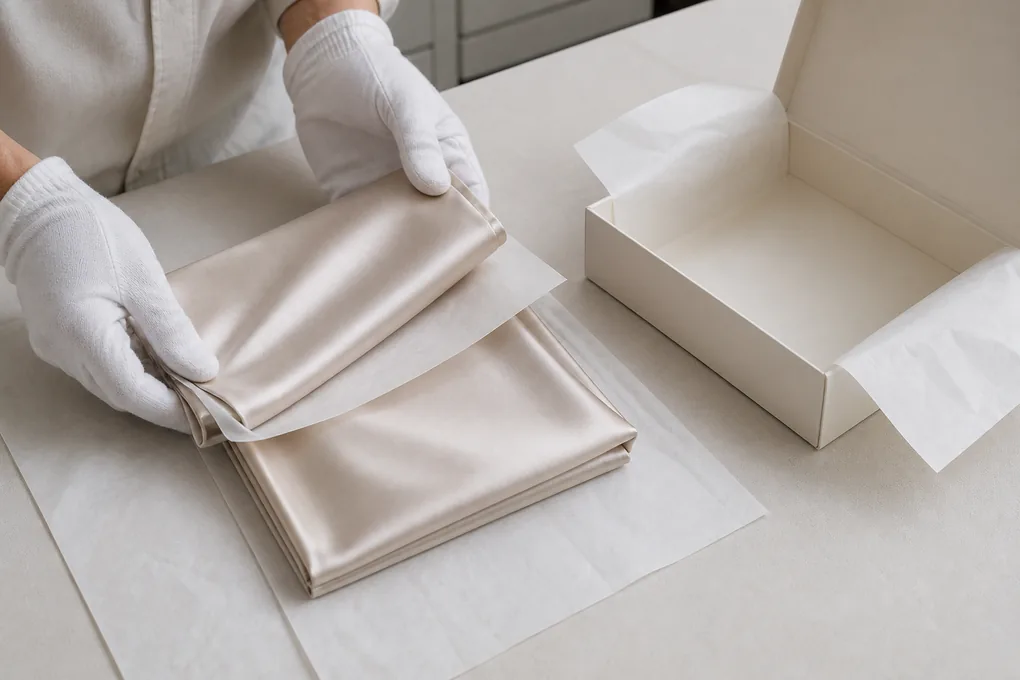
Use a Pack Sample or Receiving Review to Answer a Specific Question
At China EverBen Silks, we encourage a physical or visual review that answers a specific question. A pack reference, mock-up, assembled sample, or receiving check is most useful when tied to an identified product configuration and a short list of questions rather than an unbounded request to select everything. State the configuration, pack level, sample or artwork version being compared, reviewer, and next action. With that context, a product observation can reach the team handling the next decision without silently changing an unrelated material, label, delivery, or commercial question. This gives the wider buying team a clear answer to the practical question under review and separates a presentation observation from a conclusion about delivery or commercial terms. It also keeps feedback centered on the precise customer-facing silk unit.
Choose the review object that matches the decision
A flat layout, folded article, assembled unit, and outer carton answer different questions
Select a reference because it makes the relevant packout issue observable
Decide what the review needs to show. A flat artwork layout can help a buyer discuss copy placement or visual hierarchy. A folded silk item can help explain geometry, orientation, and a presentation goal. An assembled unit can show the relationship between article, card, pouch, insert, or wrap. An outer carton reference can help a buyer discuss count and operational fields. Do not expect one photo or mock-up to prove every point. State which configuration is being reviewed, which pack level it represents, and what the buyer wants the reviewer to observe. We do not treat any reference as a general performance, compliance, capability, or production commitment. We use it to make the buyer's next question concrete enough for an accountable project discussion.
Write observations as product-and-pack facts, not broad impressions
A useful review note identifies what was seen, where it appeared, and what decision follows
Describe the article, pack layer, orientation, version, and specific question together
When a buyer reviews a sample or receiving reference, describe observations with precision. Instead of saying that packaging feels wrong, identify the configuration, visible item or layer, orientation or count involved, and concern to be resolved. For instance, the question could concern how a folded pair sits beside an insert, whether a customer can distinguish the selected size, whether the intended product face is visible at opening, or whether a count field belongs to the correct outer level. Keep personal preference distinct from what was actually observed. A buyer can say that a presentation does not match the intended customer moment without suggesting that a product or pack has failed an unstated requirement. This lets the responsible team decide whether the next action is a revised drawing, a new artwork version, a count clarification, or another project-specific review.
Send receiving feedback to the team handling the affected decision
A receiving issue can belong to product, packaging, brand, data, or operations
Name the next action and retain unresolved information instead of reopening the entire brief
A receiving observation should lead to one next decision. If an item count is unclear, send it to the team responsible for the pack hierarchy. If a visible presentation is wrong, send it to the brand or product team. If a field is missing, send it to the team that supplies that buyer-controlled data. If an operational condition changes, attach it to the destination or channel context. We do not attach claims beyond what was observed. A short, focused follow-up prevents a single comment from becoming a vague rejection of the whole silk program. It also gives procurement a better basis for asking what must be corrected before the configuration is ready for a more defined commercial conversation.
Keep Packaging Revisions Aligned With the Product Offer
At China EverBen Silks, we keep a simple change summary because a new insert, count, label placement, fold, pouch, card, or carton question can affect more than artwork. The buyer needs a clear way to see what changed, which product configuration it affects, and what needs review again. This protects purchasing from comparing against an earlier description and helps product or brand colleagues avoid selecting one variant while an old attachment still describes another. A useful change summary can be brief: it names the prior version, the new version, and the team question created by each unresolved consequence. It is a practical guard against product-scope drift and makes the current buyer direction easy to find without hiding open decisions. It is especially useful when a silk range uses close-looking articles with different pack contents.
Identify the current product version before comparing a new version
A clear starting point combines the product, pack hierarchy, current files, and known open items
The baseline should identify what is current without falsely closing unresolved decisions
Before a change is discussed, identify the current baseline. It can include the sellable article, variant, fold or assembly reference, proposed pack layers, active artwork or copy files, unit and carton count assumptions, destination context, and list of open decisions. This does not turn a developing concept into a finished specification. It simply gives every reviewer the same starting point. When a new file, product reference, or pack idea appears, the buyer can compare it with an identifiable configuration instead of relying on memory. We use the baseline to understand which question is current and which materials have been replaced or remain illustrative. It is especially valuable when a silk range includes closely related colors, sizes, prints, or gift variations that might otherwise be described with the same loose product name.
Check the connected effects of a proposed change
A small pack edit can alter product identity, count, visual direction, data, and receiving
Review the links before an artwork change is treated as a complete solution
Ask what else changes when the buyer revises a package element. A new card can change the customer-facing selling unit. A different count can change the product identifier and outer-carton arithmetic. A revised fold can change what is visible in an e-commerce image or a gift opening. A new pouch or insert can affect the pack hierarchy and the buyer-owned wording that needs review. A changed label location can raise an article-level question as well as a graphic one. We do not predict final technical or commercial consequences without project-specific confirmation. The purpose of this check is to make dependencies visible to the people who own them, so a limited revision is not later mistaken for a complete product, pack, or operational decision.
Retire old references clearly and keep open items alive
Superseded files should not compete with the buyer's current direction
A short change note protects the inquiry from outdated attachments and silent assumptions
When a buyer replaces a reference, note what has changed and which earlier material should no longer guide the discussion. Keep a short comparison history if needed, but identify the current version unmistakably. Keep each unresolved question beside the new version: label wording awaiting review, variant count still open, destination field pending, artwork placement still under discussion, or carton logic needing buyer input. We do not bury those gaps in a broad assurance that the project is moving forward. An honest configuration summary lets a buying team manage a live silk program without overstating certainty. It also gives us a more reliable basis for responding to the current inquiry rather than to a mixture of earlier images, old count tables, and informal email requests.
Send a Defined Silk Packout Inquiry With the Right B2B Context
At China EverBen Silks, we close with one focused inquiry that tells us what is being sold, how it is proposed to be presented and grouped, what information the buyer needs to supply, what is still open, and which decision should be addressed next. This is more useful than attaching several pack images without a product basis. A concise brief enables a response to the defined project question without inferring product terms, market requirements, or a completed commercial scope from incomplete materials. It also gives the buyer an organised basis for purchasing, product, brand, and operations review. The strongest brief keeps the current configuration, business context, and the team responsible for the next decision together, creating a clear starting point for a useful follow-up rather than another broad request for packaging ideas. It gives each silk article a purposeful route into the B2B discussion.
Summarize the current sellable configuration in a short opening note
The inquiry should let a new reviewer recognize the article and proposed unit immediately
Name the item, variant, count, product reference, and customer-facing presentation
Open the inquiry with a concise description of the exact silk configuration. Name the article, variant, size or color when relevant, customer-facing count, and selling-unit presentation currently under consideration. Add the buyer reference that connects the product to its drawing, photo, fold reference, or current pack layout. This lets product, purchasing, brand, and operations colleagues recognize that they are discussing the same item. Do not rely on a range nickname alone, especially when multiple pillowcase, bedding, mask, bonnet, or accessory styles are in play. We use the summary to understand the buyer's product picture; it does not establish product availability, pack materials, technical specifications, quantity terms, pricing, minimums, or timing.
Attach references only when each one answers a stated packout question
Use a compact annotated reference set instead of an oversized unlabelled collection
Explain whether a file shows fold geometry, artwork placement, label copy, count logic, or destination context
Choose attachments because they help a reviewer answer a named question. A product image may explain the article or surface that needs attention. A sketch can clarify fold geometry or component order. An artwork file can show a proposed placement. A label draft can identify buyer-owned wording awaiting its appropriate review. A count table can show proposed unit, inner, and carton arithmetic. A destination note can explain why a receiving or market field has been raised. Identify each reference as active, illustrative, replaced, or awaiting buyer input. We do not need a polished presentation deck. We need a coherent file set that keeps the product and pack discussion focused on the same configuration without implying that every attachment is a final instruction.
State the next decision, responsible buyer, and commercial context
A quote-ready question is clear about what needs review before terms are compared
Add quantity and destination context when known, but do not present them as settled terms
Finish by naming the response your team needs next. You might need a project-specific discussion about the proposed selling unit, a packaging hierarchy question, artwork placement, buyer-owned label fields, count logic, carton information, or an information gap that must be closed before a commercial comparison. Include anticipated quantity, destination, channel, and target decision window when known, clearly marking estimates as estimates. Name the buyer contact who owns the next response and any colleague who must approve the open point. We use that information to understand the business context of a B2B inquiry. It is not a price, minimum, delivery, production, compliance, or availability commitment. It gives the silk packaging discussion a direct next action while preserving the conditions that need project-specific written confirmation.
Questions B2B Buyers Ask About Silk Packaging and Labeling
What should a buyer define before discussing packaging for a silk product?
Define the sellable article, its variant, what one customer receives, the fold or handling condition that matters, the intended pack levels, the printed fields, the buyer-side approver, and the destination question.
Can a packaging discussion confirm legal label wording or retailer acceptance?
No. Market, legal, retailer, and product-data approvals remain with the buyer and the appropriate qualified advisers. We can discuss where buyer-supplied information belongs within a defined silk unit.
What makes a packaging inquiry comparable for a B2B silk program?
Keep the article, variant, selling-unit count, fold reference, pack layers, active artwork, buyer-owned text, quantity context, destination, and open question attached to the same configuration.