
P026
Silk Bedding and Spa Textile Planning for Hospitality Buyers
Hospitality and spa buyers need more than a beautiful silk textile concept. We help turn a room, treatment, suite, amenity, retail, or gifting idea into defined questions about the finished article, visible surfaces, closures, colour, labels, set hierarchy, samples and the internal owner who must make each decision.
Published by China EverBen Silks Reviewed by Mark Liu
Translate hospitality use into article-specific buying inputs
Identify the product, guest context, care or replacement question, pack, and decision owner.
Define the Guest, Suite, Treatment, or Retail Moment
We begin a hospitality silk discussion with the moment a guest, therapist, or retail customer will actually encounter the article. A guestroom pillowcase, a suite gift, a treatment-room eye mask, and a boutique silk accessory may all belong to one brand world, yet they ask different questions about product shape, visible finish, selling unit, and presentation. Naming that moment early gives a purchasing team a practical way to choose the right silk article instead of requesting a vague collection that cannot be compared or priced meaningfully.
Start With the Guest Interaction, Not a Broad Amenity Label
Describe when the article is seen, handled, or taken away
A defined moment gives the silk article a job
We ask whether the silk item belongs at bedtime, beside a treatment table, inside a welcome arrangement, in a premium suite, or on a retail shelf. That simple distinction changes the brief. A bedtime article may start with pillow dimensions and closure direction. A treatment-room item may start with the mask shape, strap placement, and the portion of the face it covers. A retail article needs a clear product identity, a visible presentation face, and a defined customer unit. A suite gift needs the contents of the gift rather than only a mood photograph. We use the buyer’s own programme description as the starting point and keep separate articles separate.
A useful hospitality brief states who receives the item, when it is opened or used, and whether it remains in the room, travels home with the guest, or is sold. It also distinguishes a decorative bed accent from a pillowcase intended for an existing insert, a sleep mask from a pouch, and a coordinated set from unrelated add-ons. These are not minor merchandising details. They determine the article family, the visible silk surface, the components that need a decision, and the images a product team needs to review. We can then discuss a real pillowcase, bedding set, mask, bonnet, scrunchie, or gift configuration instead of an undefined “silk amenity.”
Match the Article to the Room, Treatment, Gifting, or Retail Context
Keep guest-facing choices tied to the product category
One visual concept can contain several different silk articles
For a guestroom, we talk through the relationship between the chosen pillowcase and the buyer’s pillow insert dimensions, then decide whether matching sheets, a duvet cover, or a decorative cushion cover belong in the same visual set. For a spa or treatment setting, we focus on the article’s profile: a flat eye mask, a shaped mask, a bonnet, or a small silk accessory has a different silhouette and trim route from bedding. For a gift or boutique programme, we define the featured item first and make the pouch, sleeve, card, or pair presentation serve that item rather than compete with it.
This approach also prevents a hotel buyer from applying a single image to many unrelated components. A photograph of a glossy pillowcase can guide colour, surface character, or styling, but it does not decide the reverse fabric, closure, edge finish, label placement, or set count. A mask photograph can illustrate a shape but does not select an elastic, a tie, or a binding. We help break a broad concept into visible choices that a brand, procurement, and operations team can discuss in the same language. The result is a more coherent silk assortment and fewer surprises when individual articles are compared side by side.
Give Each Stakeholder a Specific Hospitality Product Question
Bring the first decision forward without overloading the brief
A concise question moves an assortment conversation forward
We find that a purchasing manager, a creative lead, and a property team do not need to solve every subject at once. The creative lead may need to choose between a narrow self-fabric edge and a contrasting binding. The purchasing manager may need the named article, intended unit, and a first list of requested variants. The property team may need to confirm whether the piece is a room item, a retail item, or a gift. Giving each person a focused question is more useful than circulating an unstructured silk mood board with no article names or product decisions attached.
When you contact us, start with the item you want to define and the next choice your team needs to make. For example: “We are planning a silk pillowcase pair for a suite welcome gift and need to compare an envelope closure with a concealed closure,” or “We need a sleep-mask presentation for a treatment-room retail assortment and want to choose the strap arrangement.” Include a marked image if one helps explain the look you want. We will keep the discussion anchored to the named silk article, its components, and the next product decision rather than turning a preliminary concept into a claim about a finished programme.
Build a Silk Article Matrix for Each Hospitality Touchpoint
A hospitality collection becomes easier to purchase when every touchpoint has a named silk article and a clear place in the assortment. We use an article matrix to distinguish a guestroom pillowcase package, fitted bed layer, duvet sleeve, spa eye shade, hair-care wrap, amenity hair loop, or welcome pouch. The matrix is not a catalogue of promises. It is a working product map showing what the buyer wants each item to be, which details belong to it, and whether it is sold alone, paired, packed as a set, or presented within a larger suite story.
Name Every Silk Article and Its Intended Customer Unit
Separate a single item, a pair, and a coordinated set
The selling unit should be visible before presentation is designed
We begin the matrix with plain article names: a silk pillowcase, fitted bed sheet, plain top sheet, duvet shell, contoured eye shade, satin hair turban, elastic hair loop, monogram pouch, or hospitality gift bundle. Beside each name, we ask what one guest or customer receives. One pillowcase differs from a matched pair; a bedding set differs from a loose grouping of related pieces; an eye shade offered with a pouch differs from the same item displayed inside a retail sleeve. That distinction affects product description, opening experience, needed photography, and the way an internal team compares alternatives.
A clear customer unit also helps prevent accidental omissions. If a suite gift contains two pillowcases, one mask, a pouch, and a card, the buyer can see the exact relationship between the hero textile and the supporting pieces. If a boutique assortment uses the same colour story across masks, bonnets, and scrunchies, each article can still have its own construction and label decision. We do not treat the word “set” as a complete specification. We invite you to name the pieces, state the intended quantity per unit, and identify the lead article so every team member is looking at the same collection rather than a different interpretation of the same concept.
Describe the Silk Face, Reverse, Trim, and Non-Textile Components
Keep component choices attached to the article they affect
A product name alone does not describe a finished silk article
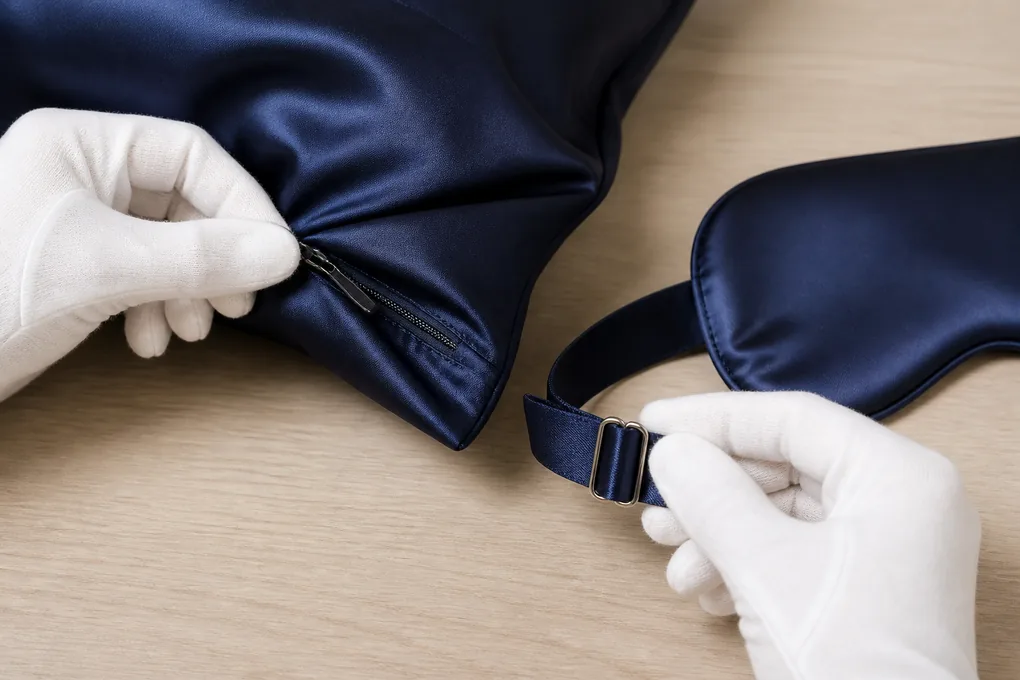
For each article, we distinguish the visible silk face from anything behind it or attached to it. A pillowcase brief may need a face colour, reverse treatment, envelope overlap or other closure route, and perimeter finish. An eye mask may need a front profile, backing layer, binding, and retention arrangement. A hair wrap may need crown shape, band treatment, tie or elastic position, and any visible label placement. These details do not have to be decided in one email, but they should not disappear behind a generic title such as “silk sleep accessory.”
The matrix also makes it easier to discuss accessories honestly. Piping, binding, elastic, tie ends, zips, snaps, paper cards, sleeves, and pouches are all separate components with a visual and physical role. A reference photo might show a colour family, but it may not show the reverse side or the closure. A buyer can mark which part of the picture matters: the sheen of the face fabric, the silhouette of a mask, the edge treatment on a pillowcase, or the fold of a pouch. We use that mark-up to keep the conversation specific and to avoid applying a single visual cue to components it does not show.
Organize Variants Without Blurring the Product Identity
Give colour, print, size, and presentation their own places
A controlled variant list makes assortment review faster
Once the core article is named, we separate its possible variants rather than describing a whole collection with one loose phrase. A pillowcase can have its own size route, colour route, print route, closure route, and packaging route. A mask can have a distinct shape, colour, binding, strap, pouch, and card route. A buyer may decide that the same silk colour is used across several articles while each article keeps its own dimensions and presentation. That is easier to evaluate than a list in which “navy,” “king,” “printed,” and “gift boxed” appear with no indication of which article they describe.
We recommend making one row for each buyer-visible configuration. The first row can be the proposed anchor product; later rows can show variants or companion pieces. Add an image, swatch, or product sketch only when it helps a person identify a feature. Then note the single choice still needed for that row: closure, edge treatment, print placement, strap style, presentation component, or set count. This gives a hospitality buyer a practical way to prepare an inquiry, compare internal feedback, and keep a multi-article silk range understandable as it develops. It also makes it clear where a preliminary concept ends and where further product discussion begins.
Specify Visible Silk Surfaces, Edges, Closures, and Trim
Silk is judged first by what a guest or customer can see and touch: the fall of the fabric, the continuity of its surface, the way an edge frames a pillowcase, and the way a closure or trim sits within the design. We make those visible decisions explicit. A hospitality image can set a sophisticated mood, but it cannot by itself tell a product team how the pillowcase opens, where a mask strap sits, whether a bonnet uses a tie or elastic, or how a pouch presents the silk face. Those decisions belong in the product conversation.
Choose the Silk Surface the Guest Will See First
Use a marked image or swatch to identify the visible face
Surface direction should be clear before trim is selected
Ask buyers to point to the surface they want a guest to notice first. On a pillowcase, that may be the face framing bed styling. On an eye mask, it may be the curved front visible in a pouch or retail display. On a hair wrap, it may be the outer crown or band appearing around the face. A swatch can identify colour and surface character; a reference image can suggest intended mood or shape. Neither needs to answer every construction question. The important step is to name the visible area of the finished article that the reference should guide.
Silk’s smooth, light-reflective appearance changes with colour, light direction, and the way a piece is folded or draped. For that reason, we encourage a buyer to distinguish the desired visual impression from a claim about an exact photograph. Describe whether the priority is a quiet tonal look, a high-contrast border, a printed focal area, or a consistent colour family across bedding and accessories. Then identify the article that carries that choice. A navy pillowcase face, a contrasting mask binding, and a small printed pouch are three separate decisions. Keeping them separate lets a hospitality collection look intentional without asking one reference image to define an entire range.
Define the Edge Finish and Closure as Part of the Design
Make openings, overlaps, bindings, and trims visible in the brief
An opening is a product detail, not an afterthought
A hotel silk pillowcase needs more than a colour name. We can discuss whether the buyer is considering an envelope overlap, another concealed opening direction, a simple open end, a self-fabric flange, a narrow contrast border, or a clean edge with no decorative trim. For a sheet or duvet-cover concept, the buyer can identify which edge will be most visible in the room and whether the design depends on a coordinated border. For an eye mask, the comparable decisions are the perimeter binding, strap position, strap adjustment concept, and the way the outer silhouette is finished. Each one affects the look a guest sees before the product is opened or used.
We keep closure questions precise because they are often hidden by product photography. A buyer can ask us to compare two clearly described routes rather than send a vague instruction to “make it like the sample.” Mark the opening on a sketch, name the preferred edge, and say whether the trim is intended to blend in or contrast with the main silk face. For a bonnet, identify whether the band should be visually quiet, tied, or elasticated, and where any tie ends should appear. For a pouch, identify which side should face outward when folded. These are tangible product choices that help a purchasing team give useful feedback to a designer and a silk supplier.
Use Trim to Connect a Collection Without Copying Every Article
Repeat a controlled visual cue where it belongs
Coherence comes from selected details, not identical construction
A collection can feel connected when a buyer repeats one deliberate cue across selected articles: a narrow border colour, a tonal binding, a print placement, or a small presentation detail. That does not mean a pillowcase, a mask, a bonnet, and a pouch should all use the same construction. Each article has its own shape and visible priorities. We help a team decide where the shared cue belongs. It may frame the pillowcase, outline the mask, appear on a pouch edge, or stay only on a gift card. This is more refined than applying the same trim everywhere without considering the role of each item.
When comparing routes, bring us the article name, the visible edge or closure, and the reference feature you want to preserve. For example, “The pillowcase should retain a quiet self-fabric edge, while the mask uses the contrast detail,” gives the discussion a clear direction. “The pouch should display the silk face when folded, but the bedding should remain understated,” is equally useful. We can then help organise the choices into a coherent product brief for the hospitality assortment. The aim is not to overstate what a concept image proves; it is to turn the buyer’s visible priorities into decisions that belong to the correct silk article.
Connect Room Context to Pillow, Mattress, and Set Decisions
Room context is useful only when it is translated into a defined bedding or accessory decision. A buyer may have a strong suite concept, a particular bed styling direction, or a target guest profile, but we still need to know which pillow, mattress, bedding, or accessory component the concept affects. We use the buyer’s stated dimensions and room priorities to organise the conversation around actual silk articles. That keeps a pillowcase, sheet, duvet cover, mask, or decorative piece from being selected by visual mood alone.
Start With the Buyer’s Pillow, Mattress, or Bed Configuration
Tie each silk bedding article to the component it is meant to cover
Dimensions belong to the buyer’s defined configuration
We begin bedding discussions with the object the silk article will meet. For pillowcases, that means the buyer’s pillow dimensions and the desired relationship between the pillowcase opening, the filled insert, and the visible bed face. For fitted sheets, it means the stated mattress width, length, and depth range the buyer wants to consider. For duvet covers, it means the stated insert dimensions and the preferred opening direction. We do not replace those buyer-side measurements with a generic “hotel size” label, because room programmes, markets, and bed specifications can differ substantially.
The product brief becomes much more useful when one article is matched to one named component. A queen or king reference in a photograph is not enough by itself; the purchasing team can state the actual dimensions they are working from, the number of pillows on the bed, and whether the intended look uses a pair of standard pillowcases, a pair of larger cases, or mixed decorative layers. That gives designers, product managers, and buyers a shared basis for deciding which silk pieces belong in the room set. It also avoids treating a styled bed image as a complete bedding specification.
Build a Bed Story Without Losing the Identity of Each Article
Coordinate sheets, pillowcases, covers, and accessories by role
A cohesive set does not require every piece to look identical
A silk room collection can be built around an anchor article rather than a single repeated treatment. A pillowcase may carry the most visible colour or border. A flat sheet may use a quieter face that supports the bed composition. A duvet cover may create the largest field of colour, while a sleep mask, bonnet, or pouch adds a compact guest-facing accent. We discuss those roles openly so that a buyer can decide which item should lead visually and which should remain understated. This is particularly valuable when a hotel, resort, spa, or boutique concept combines bedding with a small retail or gifting component.
We also separate elements that are often blended together in a room-board presentation. The sheet, pillowcase, duvet cover, decorative cushion cover, sleep mask, and gift pouch may share a palette without sharing dimensions, closures, trim, or packaging. A border that frames a pillowcase might overwhelm a fitted sheet. A print that works on a mask front may not belong across a large bedding surface. We help you use the room context to choose an appropriate role for each silk piece, then bring the individual product decisions back to the article matrix. This keeps the collection visually connected while preserving usable, article-level detail.
Use Room References as Design Direction, Not as a Hidden Specification
Mark the feature a photograph is meant to communicate
A single image can guide one decision without deciding them all
Hospitality buyers frequently start with a room photograph, rendering, interior palette, or fabric swatch. Those references are useful when they are paired with a short statement of purpose. Tell us whether the image is meant to show the desired colour family, the placement of pillowcases on the bed, the scale of a border, the way a duvet cover is styled, or the level of contrast between bedding and a gift accessory. That lets us focus on the visible feature you want to carry into a silk article without assuming that every unmarked part of the image is a product instruction.
For a productive first inquiry, combine the room reference with the named article and the next choice. You might say: “Use this room image to guide the pillowcase border tone; we are comparing two closure directions,” or “The attached styling image shows the colour relationship only; please help us organise the pillowcase pair, mask, and pouch as separate items.” We will respond to the product question that is actually in front of your team. By separating design inspiration from construction and selling-unit choices, the conversation stays useful for both a purchasing manager reviewing details and a creative team protecting the intended guest experience.
Choose the Selling Unit and Suite-Level Product Hierarchy
Before a buyer discusses a pouch, sleeve, carton, or gift card, we establish the customer unit. The unit is the item or set that one guest receives, opens, keeps, or purchases. In hospitality silk programmes, the most expensive confusion often begins when a team calls several articles “one set” without deciding whether the anchor product is a pillowcase pair, a bedding configuration, a sleep-mask gift, or a mixed accessory bundle. We help turn that broad description into a hierarchy that purchasing, creative, and property teams can all read the same way.
Identify the Anchor Article Before Adding Companion Pieces
Let the lead silk article set the hierarchy of the unit
A clear hero item makes a set easier to purchase and present
We encourage buyers to name the one article that makes the unit meaningful. It may be a pair of silk pillowcases for a suite gift, a pillowcase and sheet combination for a bedding concept, a sleep mask for a treatment-room retail display, or a bonnet for a curated beauty assortment. Once that anchor article is named, supporting pieces have a natural role. A pouch may protect or present the mask. A card may explain a brand message chosen by the buyer. A scrunchie may be an add-on rather than an unexplained second hero. The hierarchy gives each item a purpose and prevents a mixed selection from looking accidental.
This matters just as much for internal approval as it does for the guest. A procurement manager needs to know what is being counted as one customer unit. A brand team needs to know where its visual story is strongest. A property team needs to know what appears in the room and what may be offered for retail or gifting. We can help structure the collection as an anchor article, one or more companion pieces, and a defined presentation layer. That simple format makes it much easier to compare a pillowcase pair against a pillowcase-and-mask set, or a single boutique mask against a small gift configuration.
Set the Contents and Quantity of Each Guest-Facing Unit
State what one person receives before reviewing outer presentation
Count articles, not vague amenities
A customer unit should answer a straightforward question: what does one guest or retail customer receive when the silk item is presented? The answer can be as simple as one mask, one pair of pillowcases, or one bonnet. It can also be a more composed group, such as two pillowcases with a matching pouch, or one mask with a branded card selected by the buyer. We ask the team to list the pieces in the order a person sees them. That makes it easier to decide whether a companion article belongs inside the unit or should be offered separately as a different product line.
Quantity has a visual consequence as well as a commercial one. A matched pillowcase duo has a different bedside presence from one case. A set with an eye mask and drawstring pouch feels different from a set containing unrelated accessories. A buyer may want one colourway to use a simple two-piece presentation while another remains a single retail item. We do not presume a familiar marketplace bundle suits a hospitality programme. Instead, invite the buyer to name each piece, its count, and its role. That gives the whole team a dependable basis for discussing presentation, labels, images, and the next purchasing question.
Separate the Guest Unit From the Retail and Room Display Layers
Keep the finished article distinct from the way it is introduced
Presentation should support the silk product, not obscure it
A silk product can be used in a room, offered as a suite gift, displayed in a boutique, or incorporated into a seasonal brand presentation. Those are different layers around the same article. We keep the customer unit at the centre and treat the room placement, shelf display, or welcome arrangement as separate design decisions. For example, a sleep mask may be sold as one unit with a pouch, while the display tray, room card, and shop fixture remain outside the product unit. A pillowcase pair may be the gift, while a ribbon or printed sleeve is part of its selected presentation rather than a new textile article.
This separation helps avoid a common procurement problem: a concept board includes a bed, a card, a tray, a pouch, and several accessories, but no one has stated what belongs to the guest unit. We help you bring that back to the product. Identify what stays with the buyer’s room presentation, what travels with the guest, and what is intended for a retail customer. Then select the supporting pieces that serve the anchor silk article. The result is a cleaner product hierarchy that lets creative teams preserve the experience they want while giving purchasing teams a legible list of finished articles and quantities.
Describe Fold, Pouch, Card, and Presentation Components
Presentation is part of the product experience, especially when silk bedding or accessories appear in a suite, a welcome arrangement, a spa retail setting, or a premium gift. We treat the fold, pouch, sleeve, tissue, card, and visible product face as connected choices rather than decorative afterthoughts. The objective is not to make an unsupported packaging claim. It is to help a buyer describe how the defined silk article should be encountered, which piece is visible first, and how brand material sits alongside it without overpowering the textile itself.
Choose the First Visible Silk Face and Fold Direction
Make the opening moment part of the hospitality brief
A deliberate fold lets the intended textile surface lead
We ask a buyer to decide what a guest should see before the article is fully opened. A pillowcase pair may be folded to show the face colour, a narrow border, or the placement of a brand-selected label. A sleep mask may sit flat so its silhouette is immediately clear, or it may be folded into a pouch that reveals only a chosen portion of the silk face. A bonnet may be presented to show the outer crown or its band. These are small choices, but they influence the first impression of the finished item and the visual direction of product photography, room placement, or a boutique display.
A useful presentation description does not need to be elaborate. State the article, the folded or displayed position, the visible face, and any component that should remain out of sight. For example, a buyer might ask to keep a pillowcase closure inside the fold while a contrast edge remains visible, or to place a sleep mask with the front surface facing outward and the strap contained within the pouch. We use those practical directions to separate the product’s visual priorities from a general hospitality mood. That makes it easier for a creative lead to protect the desired appearance and for a purchasing manager to understand which elements belong to the selected customer unit.
Assign a Purpose to Each Pouch, Sleeve, Card, and Insert
Keep supporting paper and textile components in proportion
Every added component should serve the defined silk article
A pouch, sleeve, belly band, tissue layer, card, or insert should have a named role. A pouch may visually contain a sleep mask or bonnet. A sleeve may frame a pillowcase pair. A card may carry buyer-approved brand language, a collection name, or a guest message. Tissue may sit between folded pieces when the buyer wants a particular unboxing sequence. We do not assume that every silk article needs every component. By deciding the purpose of each element, a buyer can keep a refined presentation from becoming cluttered or from obscuring the product that the guest is meant to notice.
The product hierarchy should remain obvious after a card or pouch is added. A guest should be able to recognise whether the main item is a mask, a pillowcase pair, a bedding component, or an accessory set. The supporting component can then reinforce that article through colour, placement, or copy supplied by the buyer. We advise teams to keep an image or simple layout with each component labelled by function: textile article, protective or presentation textile, paper element, and optional add-on. This provides a practical basis for deciding what to include in the product description and helps avoid confusion between the finished silk article and the materials that surround it.
Coordinate Presentation Across a Suite Without Repeating One Formula
Use consistent cues while respecting the role of each article
A hospitality collection can feel unified without identical packs
A buyer may want a suite gift, bedding element, and retail accessory to feel related without looking like copies. One controlled cue can link them: a chosen colour family, a small contrast border, a particular card placement, or a consistent way the silk face is revealed. The pillowcase pair might appear in a slim sleeve, the sleep mask inside a pouch, and the scrunchie as a small add-on with no paper layer. The connection comes from the chosen visual language, not from forcing all three pieces into one oversized presentation. This keeps the guest experience coherent while allowing each article to remain easy to identify.
When you request a presentation discussion, tell us which silk item should lead, what one guest receives, and what must be visible at first look. Add a simple photo, sketch, or layout if it helps show the intended fold or card position. We can then help organise the product and supporting pieces into a clear hospitality brief: one named article, its companion components, its presentation surface, and the first decision still needed. This gives product, brand, and purchasing teams an intelligible way to compare options without confusing a room display or gift concept with the actual contents of the silk customer unit.
Frame Replacement and Replenishment as Buyer Planning Inputs
A hospitality buyer may need to think about future replacement, seasonal continuity, or a later phase of a programme. We keep that discussion on the buyer’s side of the planning table: identify the exact silk article, the version features that matter, and the person who will decide whether a future configuration is still the right one. We do not turn a forward-looking purchasing question into a promise of availability, service level, or identical future output. Instead, we help make the current product description sufficiently clear that a team can recognise the article it intends to revisit.
Keep a Clear Identity for Every Repeatable Silk Article
Name the details a buyer would need to compare later
Future review starts with an understandable current product
We recommend that a hospitality buyer give each intended silk article a clear identity before speaking about a later purchase. For a pillowcase, that can include the colour or print direction, the buyer’s size reference, closure concept, edge treatment, and whether the unit is one case or a pair. For a sleep mask, it can include its shape, visible face, binding or trim direction, strap concept, and pouch relationship. For a bedding set, it can include the named pieces and the way they are grouped. This is not an availability statement; it is a practical way for a team to know exactly which product it wants to compare in a future discussion.
A useful identifier is more specific than “the same silk item as before.” It points a buyer back to the visual and physical choices that make the article distinct. A collection may contain a navy pillowcase pair with a narrow tonal edge, an ivory mask with a contrast binding, and a printed pouch for a suite gift. If those differences are named, a purchasing manager can ask a focused question when the concept is reviewed again. If they are not named, colour, trim, presentation, and article count can easily be confused across internal emails and seasonal boards. We help turn the chosen details into a product description that people can recognise without relying on memory alone.
Separate the Article Decision From the Buyer’s Future Timing Assumptions
Keep purchasing schedules distinct from the silk product definition
An internal cycle is not a product feature
Property teams often have their own timing, seasonal, or internal budgeting assumptions. Those are important to the buyer, but they should not be written as if they describe the silk article itself. A pillowcase does not become a different product because a programme may be reviewed at a later date. A mask does not gain a service commitment because it appears in a planned gift cycle. We keep the current article definition on one side and the buyer’s anticipated timing discussion on the other. This allows the product team to be precise about what it wants while allowing commercial and operating decisions to remain with the appropriate buyer-side stakeholders.
The distinction also makes a later comparison more honest. If a buyer needs to revisit a concept, the first question can be product-focused: which article, colour direction, visible trim, closure, set count, or presentation component is under review? Only then should a separate team discuss its own timing, destination, commercial, or programme decisions. We do not present a preliminary timeline as a commitment from the supplier, and we do not imply that a concept image answers a future purchase question. Clear separation gives both sides a better basis for a serious B2B conversation.
Preserve Buyer-Controlled Colour, Print, and Presentation Choices
Know which decisions require a fresh comparison later
Not every feature should be treated as automatically carried forward
Some features belong to the buyer’s evolving brand direction and deserve a fresh comparison whenever the collection is reconsidered. That may include a colour reference, a print artwork, a card message, a label position, a pouch design, or a border contrast. Other features may be part of the article’s physical identity, such as the chosen pillowcase opening or the general mask silhouette. We help teams separate these choices so a future discussion does not accidentally treat a buyer-owned creative decision as a fixed feature or treat an unfinished product detail as settled merely because it appeared in an early concept.
For a concise follow-up brief, list the article first and then identify the one feature to compare. “Revisit the silk pillowcase pair; compare the previously discussed tonal border with a clean self-fabric edge,” is a much stronger starting point than “please repeat the room amenity.” “Review the sleep-mask pouch presentation; the product remains a single mask, but the card placement is changing,” gives the next discussion an equally clear boundary. We can help you use these focused questions to protect the silk article’s identity while keeping ownership of brand, presentation, and programme choices exactly where it belongs.
Use Samples to Compare One Defined Physical Question
A sample is most useful when it answers a limited physical question. We do not treat a silk swatch, a pillowcase, a mask, or a presentation mock-up as automatic proof of every product decision. Instead, we ask the buyer to name the one comparison that matters now: surface character, colour relationship, closure direction, edge detail, mask shape, strap arrangement, print placement, fold, pouch, or card position. A focused comparison gives a hospitality team something real to review and keeps unrelated decisions from being assumed rather than discussed.
Choose One Visible Silk Question for Each Sample Review
State exactly what the physical reference should help compare
A focused sample produces clearer buyer feedback
We encourage buyers to lead every sample discussion with a single sentence: “We are comparing this sample for…” That sentence might end with the visible surface of a silk pillowcase, the relationship between a border and the main face, the silhouette of an eye mask, the position of a bonnet band, the fold of a pouch, or the way a printed area appears on the named article. The sample can then be reviewed for that purpose without creating assumptions about parts it was never intended to show. This is especially valuable when several brand and property stakeholders are looking at the same physical item from different perspectives.
A swatch can be useful for a colour or surface conversation, but it cannot define a pillowcase closure or the dimensions of a finished bedding set. A pillowcase can be useful for discussing its opening and edge treatment, but it cannot by itself decide the contents of a suite gift. A mask can show its shape and binding, yet it does not automatically establish the retail card or pouch direction. We keep these distinctions clear so that a buyer receives relevant feedback rather than a broad reaction to a sample that was asked to answer too many unrelated questions.
Compare Construction and Presentation Separately When Needed
Do not force one physical item to settle every product choice
Silk article details and display details deserve their own review
Hospitality projects often combine a construction question with a presentation question. A purchasing manager may want to compare two pillowcase opening directions, while the brand lead needs to review which border is visible when the pair is folded. Those are connected but distinct decisions. We suggest reviewing the finished silk article for the construction question and using a simple layout or packed reference for the presentation question. The same principle applies to a sleep mask: its shape, binding, and strap arrangement are article details; the pouch, sleeve, card, or tissue arrangement belongs to the customer presentation layer.
Keeping these reviews separate makes comments much easier to use. Instead of “the sample feels unfinished,” a buyer can say “we prefer the self-fabric edge on the pillowcase, but want the fold to reveal the contrast border,” or “the mask silhouette is the right direction, while the pouch opening still needs a separate decision.” Those comments identify the article and the feature clearly. They also let different teams review the parts they own without turning an internal brand opinion into an unsupported statement about the product, a test, or a future programme.
Prepare Feedback That a Silk Product Team Can Act On
Connect the sample to the named article and the next choice
Specific buyer comments are more useful than general approval
The strongest feedback identifies the product, visible feature, comparison point, and decision still required. For example: “For the ivory silk pillowcase pair, compare the envelope overlap with a concealed opening; the colour reference is only for the face fabric.” Or: “For the navy eye mask, retain the shown front profile, but compare a matching pouch with a contrast-trim pouch.” These comments show what the buyer values without requiring a full technical specification at the first stage. They also preserve the distinction between a selected article feature and a brand concept still under evaluation.
When multiple people review a sample, ask each reviewer to stay within a defined area: product silhouette, visible finish, presentation, brand artwork, or suite contents. A procurement team can combine those comments into one short request naming the article and next decision. We then address the precise silk issue in a form useful to a B2B buying conversation. The point is not to create paperwork around a small physical reference. It is to let the buyer use a swatch, construction sample, or presentation layout as a precise tool for choosing the next product detail.
Separate Operating Assumptions from the Finished Silk Brief
A hospitality silk brief should distinguish the finished article from the way a buyer expects to store, handle, display, maintain, or replace it. A silk pillowcase remains a pillowcase with a defined face, edge, closure, and customer unit; it is not a guarantee about a property’s laundry operation, turnover routine, storage environment, or guest use. We make the distinction clear so a purchasing team can talk about a real product while routing operational questions to the people who own them. That protects the quality of the product conversation and avoids assumptions being read as promises.
Keep the Finished Silk Article Defined on Its Own Terms
Describe the product before discussing its future environment
Physical product details should not be hidden inside operating language
We first describe the actual silk article: a pillowcase pair with a stated opening direction and edge finish, a fitted sheet matched to the buyer’s mattress dimensions, a duvet cover with a selected closure concept, or a sleep mask with a defined front shape, trim, and strap route. That description gives everyone a common object to discuss. It is separate from questions such as where the item will be placed, how a property expects to handle it, how it will be stored, or how a team may decide on future use. Combining those subjects too early makes it difficult to see which part of a request belongs to the product and which part belongs to the buyer’s own operating plan.
This distinction helps a hospitality buyer write clearer requests. “We are reviewing an ivory silk pillowcase pair with a self-fabric edge and an envelope closure” identifies a product. “Our operations team has a separate handling question” identifies a different conversation. Both can matter, but neither should be presented as proving or guaranteeing the other. We can examine the silk article at the level needed for an informed B2B buying inquiry, while the buyer retains ownership of property practices, storage conditions, guest programme, and internal review requirements.
Put Laundry, Storage, and Handling Questions With the Right Team
Treat operational contexts as buyer-side review topics
A silk product detail is not a substitute for an operating assessment
Laundry, storage, room turnover, handling, cleaning procedures, and guest-service expectations are not generic textile details. They are buyer-side operating topics that may differ from one property, programme, geography, or retail model to another. We do not claim that a silk product is automatically appropriate for an unspecified operating environment, and we do not infer an internal procedure from a mood board or room image. A buyer can identify the specific operational question that remains open and take it to the people responsible for that assessment, while keeping the product brief focused on the actual silk article and its visible components.
The same care applies to descriptions of suitability. A product photograph, swatch, or textile discussion can help define a colour, surface, fold, construction detail, or presentation concept. It cannot by itself establish a property’s maintenance protocol or create a claim about how an article will perform in a particular operation. When a procurement, quality, or property team has a question in that area, the most useful route is a written buyer-controlled review tied to the actual environment and article. We can keep our conversation clear about the product details under consideration without extending them into statements that the current brief does not support.
Ask a Focused Product Question Without Implying an Operating Guarantee
Separate what you want to buy from what your team must evaluate
Focused language protects the purchasing conversation
A strong inquiry states the article and decision in plain language. For instance: “We are planning a silk pillowcase duo for a suite gift and need to choose the opening direction,” or “We are comparing an eye mask and drawstring pouch and need to choose which component carries the contrast colour.” If a separate team reviews an operational subject, say so without turning it into a product claim: “Our property team is addressing its handling process separately.” This gives us a defined silk question to discuss and tells the buyer’s internal colleagues where a different decision belongs.
We can also help organise a brief when several topics arrive together. Start with the named article, then list the physical feature to compare, the visible reference if there is one, the intended customer unit, and the next buyer decision. Add a short note for any operational subject that has a different owner. That structure lets a hospitality programme develop product detail without conflating product design, brand presentation, commercial planning, and property operations. It makes the request easier to understand, easier to circulate internally, and more respectful of the boundaries between a silk supplier’s product conversation and a buyer’s own operational responsibility.
Keep Labels and Guest Information Under Buyer Control
Labels, cards, retail tags, suite inserts, and guest-facing wording belong to the buyer’s brand and programme decisions. We can discuss where a sewn label, pouch insert, card, or tag might sit in relation to a defined silk article, but this page does not create brand claims, care wording, market statements, or destination-specific copy. A clear label plan gives the buyer control over words and visual assets representing its own business while allowing the silk product conversation to remain focused on article identity, component placement, and presentation.
Distinguish a Sewn Label, Retail Tag, Card, and Pouch Insert
Give each buyer-controlled information piece a physical role
The information layer should not blur the product identity
We separate the physical information pieces around a silk article. A sewn label is part of the textile construction and needs a chosen location and orientation. A retail tag is a removable product-facing element. A suite card or pouch insert sits within the presentation rather than on the silk itself. A carton label belongs to an outer handling layer, not to the guest’s immediate experience. When these functions are separated, a buyer can decide which elements should be visible at first look, which can remain discreet, and which should not appear in guest-facing photographs at all.
This prevents a common problem in premium gifting: a product image shows a pillowcase, card, sleeve, ribbon, and pouch, but no one has stated which wording belongs where. A buyer can name the anchor silk article, then identify its label position, whether a card belongs in the same unit, and whether a pouch or sleeve carries any buyer-approved visual asset. We keep the discussion at that physical level. The buyer retains control of its brand text, legal wording, market copy, and artwork; we avoid filling those areas with assumptions merely to make a concept board look complete.
Place Information Where a Guest or Customer Can Understand the Unit
Use placement to support the first reading of the product
Good information design keeps the silk article central
We ask buyers to decide what a person needs to identify first: the pillowcase pair, the mask, the bonnet, the pouch, or the gift set. Information should help that identification rather than obscure it. A small sewn label can be placed where the buyer wants the product to retain a clean face. A card can be introduced when the product is opened. A removable tag can identify a retail article without becoming the visual focal point. These choices are particularly important for a hotel boutique or a suite gift, where the same collection may be presented in more than one setting.
A useful layout shows the product and each information element from the buyer’s chosen viewing angle. Mark whether the brand name, collection name, care text, product title, or message is intended for the silk article, the pouch, the sleeve, or the card. That helps brand and procurement teams find omissions before a presentation is treated as final. We can then discuss practical product placement without changing or approving the buyer’s own wording. The point is to create a coherent guest-facing unit in which the silk product, not an arbitrary tag or card, remains the main object of attention.
Keep Brand Text, Market Copy, and Artwork With the Buyer
Bring approved assets only when the placement decision is ready
Product discussion and brand approval are different responsibilities
We do not create buyer brand claims, collection statements, product promises, destination requirements, or legal text. Those are decisions for the buyer and its appropriate advisers. What we can discuss is the product-facing placement: where a buyer-selected woven label may appear, whether a card is inside the pouch or outside it, which side of a sleeve is visible first, and whether the guest unit contains a tag at all. This distinction gives a buyer’s brand team the control it needs while keeping product, packaging, and visual decisions understandable for the people responsible for a bulk purchase.
When an asset is ready for placement review, share the named silk article, the intended customer unit, and a simple indication of where the asset belongs. You can say, “This buyer-approved card belongs inside the pouch with the sleep mask,” or “This label placement is for the reverse corner of the pillowcase pair.” We will keep that request connected to the product and presentation decision at hand. If the content of the asset still needs legal, market, or brand approval, it should remain with the buyer’s own review process rather than being silently finalised in a supplier conversation.
Assign Approval Ownership Across Property and Brand Teams
A hospitality silk collection commonly touches brand, procurement, product, property, operations, and sometimes retail teams. We do not ask one person to approve everything. Instead, we help make the question clear enough that the person responsible for the visible product, the customer unit, the brand asset, or the property context can review the part that belongs to them. Clear ownership keeps a beautiful silk concept from stalling because a closure choice, set count, label position, or room-use assumption has been passed around without a named decision-maker.
Let Product and Procurement Own the Defined Silk Article
Keep the physical configuration with the people buying it
Article-level decisions need a named commercial owner
We normally keep the finished article with the buyer’s product and procurement owners. They can decide whether the proposal is one pillowcase or a pair, a defined sheet or duvet-cover component, a single mask or a mask-and-pouch unit, and which visible construction choice should be compared next. They can also identify the initial commercial question without publishing a retail price on the site or in a preliminary product brief. Giving them that role ensures that the silk item has a clear name, intended customer unit, and priority before broader presentation choices are added.
A purchasing decision becomes easier when the product owner can state one clear direction: “We need a pillowcase pair with this buyer-supplied size reference and are comparing these two edge treatments,” or “We are building a single-mask retail unit and need to choose the pouch relationship.” We respond to the actual article question rather than guessing which internal stakeholder has authority over it. This makes a product review more productive and helps prevent a design image from quietly becoming a commercial or technical instruction that nobody has explicitly accepted.
Let Brand and Creative Teams Own Visual Language and Buyer Assets
Keep colour, print, card, and artwork approvals with their creators
A visual direction is strongest when its owner is clear
We keep colour stories, prints, brand names, guest cards, product language, and visual assets with the buyer’s brand or creative team. Those teams can say which image is a surface reference, which colour relationship matters, whether a pillowcase border should be quiet or contrast, and where a card should appear in the guest unit. They can also decide what their artwork or message means. We do not create those claims or assume that a reference image authorises every component shown in it. The product conversation becomes clearer when a buyer tells us which visible feature is ready for discussion and which brand asset is still being developed internally.
A practical division of responsibility lets the visual work stay faithful to the buyer’s identity while giving the product team usable detail. The brand lead might select a print placement for a mask front. The product owner might decide whether that mask is a single unit or paired with a pouch. Procurement might decide which article needs a first quotation conversation. Each choice can then be brought forward with the named silk article and the next decision, rather than appearing in a generic “approved concept” email that does not reveal who approved what.
Keep Property and Operations Questions With the Appropriate Team
Separate room context and operating review from product approval
Each stakeholder can give a more useful answer within scope
A property or operations team may need to explain the intended guest moment, where an article will appear, or which internal operating question requires separate review. That information helps put the product in context, but it does not replace the product or brand owner’s decision on the actual silk article. We invite those teams to state their question plainly: is the item meant for a guestroom, a treatment setting, a suite gift, or a boutique display; what part of the experience matters; and which topic needs their internal review? The article configuration, brand assets, and operating context can then remain distinct without being treated as unrelated silos.
For an efficient request, identify the primary decision owner and copy the people who own connected questions. A product manager can own the pillowcase configuration. A brand manager can own presentation imagery and card artwork. A property representative can confirm the desired guest moment. A procurement lead can consolidate the first commercial question. We can work from that focused brief without implying that one person’s preference settles every aspect of a hospitality programme. Clear ownership respects each team’s expertise and provides a stronger launch point for discussing a credible, defined silk collection.
Send a Hospitality Silk Inquiry with a Clear Next Decision
A productive hospitality silk inquiry does not need to contain every future decision. It needs to identify the article, guest or customer moment, visual or construction detail under discussion, and next decision the buyer wants to make. We use that focused starting point to discuss a real B2B product question: a pillowcase configuration, bedding component, rest accessory, suite gift, or small retail unit. The clearer the first question, the easier it is for product, creative, and purchasing colleagues to offer useful feedback without creating assumptions about the rest of the programme.
Name the Silk Article, the Guest Moment, and the First Decision
Make the opening inquiry specific enough to be useful
A clear starting point is more valuable than a broad request
Begin with the named silk article. Say whether you are discussing a pillowcase duo, fitted bed article, upper sleeping sheet, duvet shell, contoured eye shade, satin hair turban, elastic hair loop, welcome pouch, or curated suite bundle. Then add the guest or customer moment: guestroom styling, treatment-room retail, a suite welcome gift, boutique display, or another buyer-defined use. Finally, state the first decision. It might concern visible silk face, closure, perimeter treatment, mask strap, set count, pouch relationship, card placement, or colour comparison. This gives the conversation real commercial and product context without asking you to resolve the entire collection before first contact.
For example, a buyer can write: “We are reviewing a matched silk pillowcase duo for a premium suite gift. We want to compare an envelope closure with a concealed opening, and the attached image is only a colour reference.” Another buyer may write: “We are building a single eye-mask unit for a spa boutique and need to decide whether the contrast colour belongs on the binding or pouch.” Both inquiries identify the finished article, audience moment, and next choice. They are easier to circulate internally and far more useful than a request for a generic silk hospitality amenity.
Share References That Explain One Feature Rather Than Everything
Use swatches, images, and sketches with a stated purpose
A marked reference makes product feedback more precise
A swatch, layout, product image, or room reference can make an inquiry faster when the buyer says exactly what it is intended to show. A silk swatch may guide a colour or surface comparison. A product sketch may clarify a pillowcase edge or mask silhouette. A folded presentation image may show which side of a pouch should be visible first. A room photograph may show the desired visual relationship between bedding and surrounding materials. Mark the relevant feature if possible, and state what the reference does not decide. This lets your team keep a useful visual direction without accidentally turning unrelated image details into product instructions.
Attach only the materials that help answer the next decision. If the question concerns a pillowcase closure, a close-up sketch can be more valuable than a large room board. If it concerns a colour relationship, a chosen swatch or marked colour reference may be enough. If it concerns suite-gift hierarchy, list the intended pieces and show fold or pouch position. This focused approach lets us discuss the silk article with less ambiguity and allows a purchasing manager to see what information is still required from a creative, property, or brand colleague.
Use the RFQ Form to Start a Product-Specific B2B Conversation
Give procurement, product, and brand teams a concise common brief
We can discuss the next decision without publishing a retail price
Use the Request a Quote form when you are ready to turn the first decision into a direct conversation with China EverBen Silks. Tell us your company name, contact details, the named silk article, the intended hospitality moment, the quantity context you are considering, and the exact decision you need to resolve. You may also describe a reference image, swatch, or product sketch. The form is designed for wholesale and project enquiries, not for retail checkout. It does not display retail prices, and it lets you begin with a focused product question before every collection detail is finalised.
A clear final note can be short: “We need a defined silk pillowcase pair for a suite gift, a comparison of two visible edge directions, and a separate conversation about the customer unit.” Or: “We need a silk sleep mask and pouch for a boutique concept; the immediate question is the visible face and card placement.” Include the person on your team who owns the next decision if that helps. We will keep the response connected to the product and question you supplied. This is the practical route from a hospitality concept to a credible B2B silk buying discussion: name the article, identify the visible or physical choice, and ask for the next answer your team needs.
Planning Silk Products for Hospitality and Spa Use questions
What should be defined for a guest-use proposal?
The use moment, product, handling assumptions, selling unit, destination and first physical decision.
Does a silk article need project-specific evaluation for hotel or spa use?
Yes. Suitability depends on the agreed product, the buyer's operating conditions, and its project-specific requirements.