
P014
Classic Fixed-Strap Silk Sleep Mask Development
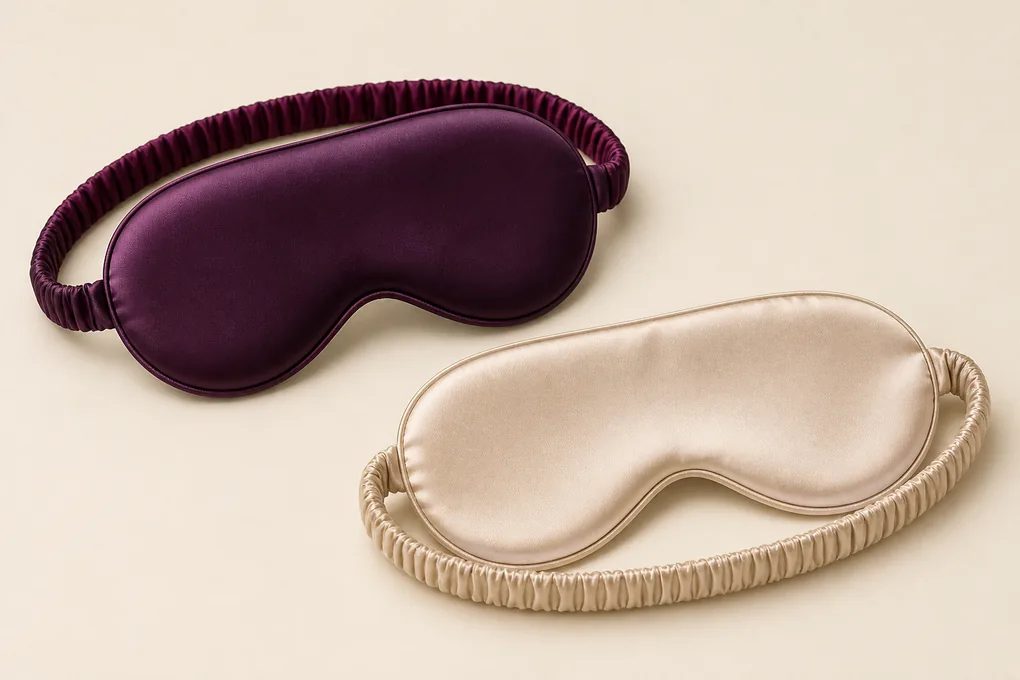
A fixed-strap silk sleep mask needs more than an appealing front image: the body shape, wearer-facing layers, strap geometry, edge treatment, colour placement, and retail fold must work as one deliberately defined item. We guide purchasing and product teams through the physical choices a first sample should show, so the next review can focus on a real mask configuration instead of a loose promise of comfort or a generic accessory reference.
Published by China EverBen Silks Reviewed by Mark Liu
Define the fixed strap before a mask fit is assumed
State the body dimensions, layer map, strap route, anchor, nose edge, and wearer coverage question.
Start With the Wear Situation for a Fixed-Strap Mask
A classic fixed-strap silk sleep mask is a small product, but it carries a concentrated set of buyer decisions: who will wear it, how the mask is expected to sit, which visual side represents the brand, and what condition the customer receives in the pack. We begin with the use situation because a fixed strap cannot later be adjusted to solve a vague fit expectation. Tell us whether the programme is intended for a beauty retailer, a bedding collection, a travel assortment, a corporate gift, or another defined B2B channel. That context helps your team set the real product brief—an elegant accessory with a particular silhouette, a coordinated item for a silk bedding range, or a branded gift component—and stops a generic sleep-mask image from standing in for a physical specification. Describe the wearer or customer group only to the level you actually use in product development; do not turn a marketing persona into a universal comfort claim. Then choose the visual orientation, visible edges, strap position, and pack form your brand wants customers to see. A fixed strap style needs a deliberate relationship between body circumference and strap length, so the intended size approach belongs in the opening brief. We do not represent an untested design as suitable for every head shape or as delivering a medical, sleep, or beauty outcome. Instead, we help buyers define the sample question that will allow their own team to evaluate the mask in its intended wearing and merchandising context. This creates a better procurement starting point: a named product, defined sales channel, physical references, known constraints, and a clear next decision.
Start with the customer context, not an assumed universal wearer
Channel, range role, and product presentation
A fixed strap needs a defined buying purpose
State whether the mask belongs beside pillowcases, beauty accessories, travel products, or a gifting programme. The answer influences the visual language, pack information, and sample review you need. A single lifestyle photo cannot establish the same requirements. When the programme has a target size or wearer group, put that in the buyer brief as an evaluation reference, not as a promise that every customer will experience the same fit.
Choose the visible orientation before drawing the pattern
Front shape, edge line, and strap appearance
The customer sees a complete accessory
Mark the customer-facing front and reverse, including any flange, piping, print placement, or label that will remain visible. Then show how the strap emerges from the body. This gives pattern, sewing, and packaging reviewers one shared visual reference. It also reduces the risk of approving an attractive front view while leaving the back, side profile, or strap attachment unresolved.
Name the first sample decision
Wear check, silhouette review, or pack review
A defined question prevents unfocused sampling
Ask the sample to answer one or more explicit questions: does the chosen body profile match the approved visual, does the strap sit where intended, or does the folded unit present correctly in its pack? Attach the version of the reference that controls. Your team can then document observations without converting a preliminary sample into an unsupported performance claim. Before taking the programme to its next stage, ask your merchandising lead to confirm that the intended channel, range role, and product imagery describe this fixed-strap configuration rather than a different accessory in the collection. That small check keeps the visual concept and the technical brief attached to the same customer offer.
Map the Mask Body Before You Choose Decorative Details
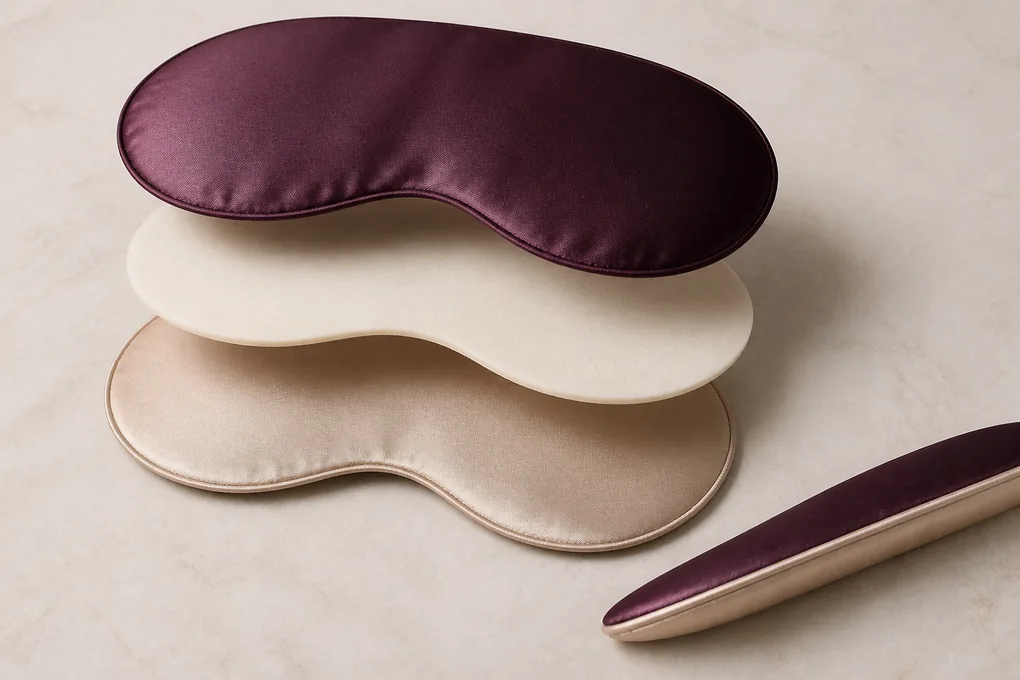
Before decorative details are discussed, the mask body needs a clear physical map. A fixed-strap sleep mask is typically composed of an outer face, a side that meets the wearer, any selected internal layer, an edge construction, and two strap attachment areas. The exact configuration is a design decision, not a default we can infer from a category term. We ask buyers to start with a front-and-back drawing or a marked reference that identifies the body outline, coverage area, nose contour, temple line, and the points where the strap joins. This sketch does not need to be an engineering drawing at the first conversation, but it must show what is visually important and what parts are still open. An oval, contoured, pleated, piped, or flat profile will each create different cutting, joining, turning, and presentation questions. If your reference includes a printed motif, embroidery, a label, or a contrast edge, show where it belongs on the finished shape rather than only on a flat artwork board. We also recommend separating a “must retain” element from inspiration taken from another product. Your product team may want the softness of one sample, the nose line of another, and the pack language of a third; those are distinct inputs, not one replicable object. A complete map enables an early review of what the customer sees, what the wearer contacts, and what must be protected during packing. It also makes it easier to compare a proposed sample against the intended mask body rather than arguing from an image after cutting has begun.
Draw the outer silhouette at the finished scale
Overall width, height, and eye-area profile
A contour should be visible in the buyer record
Use a marked front view to identify the body outline and any feature that changes its apparent scale. Note where a contour begins and ends, especially around the nose and temples. If the buyer has a preferred finished dimension, put it beside the drawing with its measurement basis. This supports a meaningful sample review without pretending that a stock form is automatically correct for your product.
Map the inside separately from the front design
Wearer-facing panel, internal layer, and seam route
The reverse deserves its own decision
The side touching the wearer may look very different from the branded front. Identify the planned layer stack, the areas where seams turn, and any internal element that affects the line of the mask. This is a practical way to avoid a front-led concept that becomes uncomfortable or bulky in assembly. It also supports accurate material and product-copy review later.
Mark the strap anchors before styling the edges
Left and right attachment locations
Attachment geometry affects the whole body
Show the point where each strap enters or meets the mask body, including whether the strap remains visible from the front. The anchor position can influence symmetry, edge finish, and how the mask sits when worn or packed. A single labelled sketch gives all reviewers a stable reference and makes an early alteration much easier to communicate. At the end of the drawing review, preserve a versioned front-and-back reference with the buyer comments. The document should distinguish a desired contour from a provisional visual idea, so the next sample has an instruction it can demonstrate rather than a collection of personal interpretations. Include the current artwork placement and any edge feature whose position depends on the cut shape.
State the Silk and Layer Stack Without Overclaiming
A customer may see one smooth silk surface; a development brief needs to describe the full layer stack without overstating what has been selected or verified. For a fixed-strap sleep mask, identify the outer textile, the wearer-facing textile, any interlining or filling under consideration, the strap material, edge treatment, label, and the materials used in the retail pack. A component-level record is better than a broad statement because it allows buyer copy, care information, and quality review to follow the actual assembly. If the visual face is silk but an internal support layer, label, or elastic strap is different, that distinction should remain available to the team writing claims. We avoid phrases such as “100% silk mask” unless the final component scope and any necessary product documentation support that exact statement. Instead, we use the confirmed material list to frame product development. Ask what hand, sheen, print response, edge definition, or pack presentation your brand needs to judge. Then ask how each layer is expected to behave when it is cut, turned, stitched, and handled. A swatch can help select a direction, but it cannot show whether an edge construction, body contour, or strap attachment works in the assembled mask. Review an actual construction sample for those questions. If there are options, keep them as separate proposed configurations with their own reference images and comments. That makes the buying conversation clear: the selected material, the alternative still under consideration, and the evidence needed before either becomes a released product description.
List materials by their actual role in the mask
Outer face, wearer-facing panel, interior, strap, and label
A layer stack protects accurate product language
Write every material role on a simple bill of materials, even if some details are still being chosen. Identify which surfaces will be visible and which will be in contact during normal use. This creates a solid foundation for later claims review. It also keeps a support component from being accidentally treated as though it shares the same composition as the silk face.
Assess material choices in the sewn sample
Sheen, edge profile, turn, and handling
The assembly reveals what a swatch cannot
Ask reviewers to look at the chosen textiles after they have been shaped and joined. Observe the front, reverse, contour, and strap junction, then record the product-specific result you need to change or approve. Avoid accepting generic descriptions such as “premium feel.” A useful comment points to a visible surface, an edge, or a wearer-facing area on the sampled mask.
Keep alternatives separate until the buyer chooses
One material route per defined sample
Options should not merge into a fictional specification
If the team is considering different internal layers or edge treatments, label each route clearly and identify what it is meant to solve. Do not combine the benefits of two unfinished alternatives into one product statement. That discipline lets your purchasing team compare configurations honestly and gives marketing colleagues a dependable handoff once a final version is approved. When the material map changes, circulate the revised component list to the colleagues responsible for product content and packaging. A truthful description becomes much easier when the team sees the outer face, inner layer, strap, and label as distinct parts of the exact mask SKU. It also avoids treating a support component as invisible simply because the front is a silk surface. The revised list should identify the sample or document that supports each selected component.
Fix Strap Length, Width, and Anchor Position Deliberately
With a fixed-strap mask, strap length, width, and anchor position are central product decisions rather than finishing details. A strap that is too short, too long, too narrow, too wide, or attached at an unsuitable point can change how the mask appears on the face, how it folds in the pack, and how your buyer team judges the sample. Start with the product size approach. Are you developing one stated size, a defined set of size options, or a style intended to be assessed against a nominated reference? Put the decision into the brief, along with the strap’s intended material, visible position, width reference, and the point on each side of the body where it joins. A fixed strap does not offer post-purchase adjustment, so the range should not be described as universally fitting unless your own documented testing and claims process supports that statement. We can instead help you build a sample review around the conditions your product managers care about: the way the strap sits in relation to the mask body, the balance between left and right anchors, the visible profile from the side, and the way the article recovers after handling. Mark whether the strap is covered, exposed, flat, gathered, or positioned to be hidden under hair; those choices affect the pattern and edge construction. If the programme includes a branded label, decide whether it sits on the strap, body, or pack and whether it can affect the wearer-facing side. By making these details early, you avoid asking a later sample review to resolve basic geometry after artwork, packing, and merchandising have already moved ahead.
Define the size proposition before assigning a strap length
Single stated size or separate pattern options
Fixed does not mean undefined
Write the intended size approach in customer-neutral, technical terms and pair it with a sample evaluation reference. If a buyer wants alternative lengths, identify them as separate options rather than relying on one phrase such as “standard.” This gives the product team a way to judge pattern changes and prevents an approval for one configuration being applied to a different strap route.
Place anchors with the body profile in view
Left/right balance, vertical position, and visible line
The connection changes the worn silhouette
Mark anchor locations on the front-and-back drawing and examine them on a body sample. The strap should be considered with the nose contour, temple line, and edge treatment, not as an isolated ribbon. A clear anchor record also helps a reviewer spot asymmetry or an unintended interruption to print placement before packaging or photography begins.
Review the strap in handling and retail-fold conditions
Worn position, relaxed condition, and pack fold
The same detail behaves differently in each state
Ask the sample review to include gentle handling and the intended folded or boxed condition. The purpose is to observe the article your customer will receive, not to claim a performance value that has not been set. Record any change request by attachment location, strap line, or material role. This produces specific development feedback rather than a vague comfort comment. Document the selected strap route with the pattern reference and sample date. This gives a later reviewer context for any observation about balance or appearance and prevents an old reference strap from being treated as the approved construction for the current design. Include the sample’s pack state because a strap can appear different after folding than when it is viewed flat.
Control Seams, Turning Points, and Edge Profile
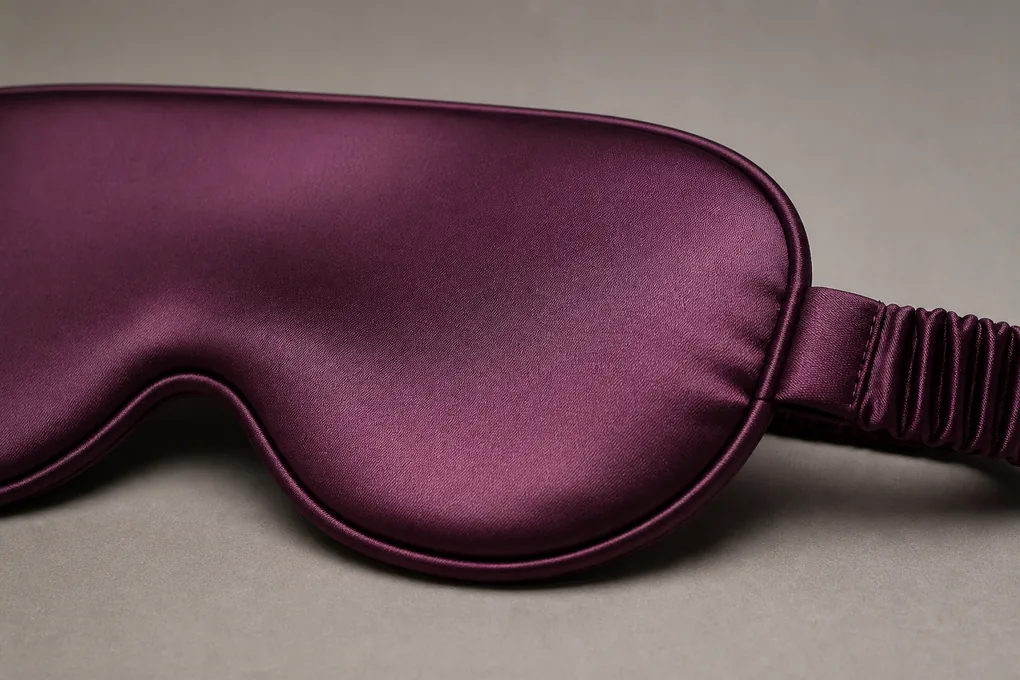
The seams and edge profile on a silk sleep mask can define whether the finished item reads as clean and refined or appears bulky, uneven, or poorly resolved. We approach these details through the real construction, not through an abstract request for “neat stitching.” First, identify the desired edge: a narrow turned edge, a piped perimeter, a visible stitched contour, a flange, or another treatment shown on a marked reference. Next, identify the locations where the body must be joined, turned, or left accessible for an internal layer and strap attachment. Those locations influence not only the visible line but also the way the mask is handled, pressed, packed, and photographed. Silk is particularly sensitive to decisions at corners, curves, and transitions. A sharp point, a narrow nose dip, or a contrast piping detail should be sampled in the finished body rather than assumed from a fabric cutting. We ask buyers to specify what must look balanced from the front, what must remain smooth on the reverse, and which points require close review. If an edge treatment is cosmetic only, say so; if it also needs to protect or conceal an assembly point, note that function. This lets the sample discussion address the genuine design constraints. It lowers the risk that a simple-looking finished mask conceals a construction choice omitted from the commercial comparison. During review, inspect the perimeter in the front, reverse, and side view; then examine the strap-anchor area and any point where the edge changes direction. Record comments against the current sample version. A usable seam and edge record gives a procurement manager tangible criteria for reviewing a private-label mask instead of relying on subjective impressions.
Name the desired edge rather than using an aesthetic adjective
Turned edge, piping, stitched contour, or flange
The construction must be visible in the brief
Use a marked image or drawing to show the perimeter style and where it changes. If the treatment has a width or contrast direction that is important to your brand, connect it to the finished view. Avoid using “luxury finish” as a substitute for an observable construction. The development team needs the visible line, not merely the intended mood.
Identify every turn, join, and transition point
Curves, nose dip, corners, and strap junctions
Sensitive locations need targeted sample review
Map the spots where the body will be turned or where the edge must pass a contour. These are the places a simple front photo may hide. Ask the sample to show both the exterior and reverse near those points. A review note should identify the location and expected visual result so a revision can be understood without translating taste into guesswork.
Check the edge after packing as well as before
Fold pressure, handling, and presentation
A fine perimeter can be affected by the selling unit
Inspect the mask after it has been placed in the proposed sleeve, pouch, or box. Look at the visible edge when the customer first opens the unit and when the mask is laid flat. If the pack changes the intended profile, make that a packaging or product decision explicitly. This is more useful than treating the issue as an unexplained final-inspection surprise. Include the edge reference in the same visual approval packet as the finished body shape. A perimeter that has been accepted only in a close-up fabric view should not be assumed to represent the full mask until the buyer has reviewed it around every relevant curve and attachment.
Review Nose and Temple Contact on an Actual Head Form
A fixed-strap mask should be reviewed on an actual head form or other buyer-approved wearing reference when the product team needs to assess coverage, nose contour, temple line, or the relation of the strap to the mask body. A flat inspection can verify some construction details, but it cannot show the same visual and physical relationship. We advise defining what the review is intended to observe before the sample is put on a head form. For example, your team may need to see whether the outer silhouette sits as designed, whether the lower edge follows the intended nose area, whether the strap emerges from the correct location, or whether the body remains visually balanced from left to right. These are product-review questions, not claims that the mask creates sleep outcomes or accommodates every wearer. Use the target form, display head, or wearer criteria your own team considers appropriate, and document that review condition with the sample comments. If the mask has an internal layer, a shaped nose line, or a decorative edge, viewing it in context can help separate an intended design feature from a construction issue. We also recommend checking the profile under the product’s usual use and then in a relaxed state, because a retail image may only show one angle. The buyer’s approval record should identify what was assessed, what needs a revision, and what remains outside the scope of the current sample. That keeps later development grounded in actual evidence rather than an unqualified comfort or performance assertion. A careful wear review can improve the clarity of a private-label brief while respecting the fact that fit and individual experience require buyer-controlled criteria.
Set the wearing review question in advance
Coverage, contour, strap position, or symmetry
A head form is a tool for observing a defined feature
Write the exact feature your team wants to examine before reviewing the sample. A shaped lower edge may be assessed for visual position; a strap anchor may be assessed for balance; the overall outline may be assessed for silhouette. This avoids a vague “try it on” exercise that produces incompatible comments. It also keeps the record clear about what was observed and what was not tested.
Use a documented review condition
Buyer-approved head form or wearer reference
The reference should travel with the comment
Identify the form or criteria used and keep a photo or note with the sample version where your process permits. The goal is not to establish universal fit. It is to make an internal buyer assessment repeatable enough for the next product decision. When a comment relates to the nose or temple line, mark the exact area on the current pattern reference.
Separate visual observations from performance claims
What the sample shows versus what requires evidence
Precise language preserves credibility
A reviewer can state that the sampled mask presents a particular contour or that the strap appears balanced on the selected reference. Those are different from claims about sleep, light blocking, skin benefits, or broad wearer suitability. Keep that distinction in the product file. It enables natural buyer conversation without putting unverified statements into customer-facing copy. If different functions comment on the same sample, have the buyer decision owner distinguish observed presentation from a formal performance requirement. That way, a natural review of silhouette or contour remains useful without being misrepresented in sales copy or a technical claim.
Use Size Options Only When the Pattern Really Changes
Size options for a fixed-strap silk sleep mask should be introduced only when the underlying pattern, strap route, or customer proposition genuinely changes. Adding labels such as small, medium, large, or one size without a controlled reference can create confusion in sampling, packaging, and ecommerce data. Begin with a practical product question: is one stated configuration sufficient for the intended collection, or is there a defined reason to develop separate pattern or strap variants? If the answer is one configuration, document the sample reference and avoid implying an unlimited or universal fit. If the answer is multiple variants, describe each variant’s physical distinction—body width, strap length, anchor location, contour, or another feature—and give it a clear SKU relationship. A different colour is not automatically a different size; a different pack sleeve does not automatically mean a different mask. We encourage buyers to view the whole unit when deciding on options: a pattern change may affect front artwork placement, the visible edge, the label location, pack dimensions, and the component count in a gift programme. It also may change what quality colleagues need to inspect. Do not create options purely to make a product page look more complete. A smaller, accurately defined line is easier to source and merchandise than a broad set of undefined labels. During sample review, compare the specific versions named in the brief and record their own observations. This keeps the next commercial request honest: each option has a stated physical configuration and a deliberate allocation, rather than a generic mask price with variants added later.
Decide whether an option represents a real pattern change
Body, strap, anchor, or contour difference
Variant names must correspond to physical instructions
A size label is useful only when the product file explains what changes with it. List the relevant dimensions or construction differences for each proposed version and tie them to a SKU map. If two masks are physically the same but packed differently, record that as a packaging difference instead. This keeps development, inventory, and buyer communication aligned.
Protect artwork and pack logic when variants are added
Print placement, label field, and sleeve dimension
One new size can affect several downstream choices
Review a proposed variant with its own front view and pack concept. A body-width change can alter the scale or location of artwork, while a different folded dimension can alter the packaging panel or insert. Do not assume the main sample automatically proves the other version. Identify which details need a separate review and carry the version name through the approval record.
Quote each configuration on its own stated basis
Allocation, sample status, and open decisions
Clear options produce useful procurement comparisons
When requesting commercial discussion, provide the quantities by defined variant and identify which one is the base direction. If a second size is still exploratory, label it accordingly. This avoids turning a preliminary idea into an accidental commitment. It also enables the buyer to compare the actual scope of each option without hiding a pattern or pack change behind a generic product name. A variant matrix should identify exactly which dimensions and artwork files belong to each version. This prevents a pack operator or content manager from joining the correct product name to an image or component combination that belongs to another proposed size route. It also clarifies when a revision is a new product configuration rather than a colour or label variation.
Place Solid Color or Artwork for the Finished Shape
Colour, print, and artwork on a silk sleep mask must be planned against the finished body shape, strap line, and folded retail unit. A beautiful repeat or logo treatment can lose clarity if it crosses a nose contour, disappears into a turned edge, lands unevenly on left and right sides, or becomes obscured in the pack. We ask buyers to provide the current artwork file or marked visual, identify its version, and explain what matters most: centred motif, continuous print, directional layout, brand mark visibility, contrast piping, or a solid colour with a particular accessory story. The design reference should show the mask’s actual front and any customer-facing reverse, not only a rectangular fabric panel. If the strap is visible, decide whether it is meant to blend with the body, offer a contrast, or remain a separate functional element. Coordinate that decision with the pack, where a folded strap might become the first thing a customer sees. When colours are selected, give the buyer-approved reference and state which component controls the visual relationship. A silk surface can present colour and shine differently across a contour and under different viewing conditions; that makes assembled sample review valuable, not a reason to promise a shade from an unreviewed digital image. Use the sample to inspect artwork placement, edge alignment, strap balance, and the appearance of the complete unit. Record whether a correction applies to the body pattern, the artwork placement, the strap, or the packaging print. This separates creative direction from a vague request to “make it look better” and gives your product manager a traceable route to an improved version.
Place art on the mask outline, not on a fabric rectangle
Centre line, nose contour, and edge allowance
The finished silhouette governs print placement
Provide a front-view template or marked sample that shows where a motif, logo, stripe, or repeat should appear. Identify any area that must remain clear of an edge or contour. This makes it possible to review the actual customer-facing shape rather than approving artwork that only works before cutting. A version name on the file prevents a past design from being mistaken for the current direction.
Coordinate strap colour with the body and retail presentation
Blend, contrast, or deliberately separate the strap
Visual intent should survive the folded pack
State whether the fixed strap is intended to disappear visually or contribute to the product’s colour story. Then view it next to the mask front, reverse, and proposed packaging. A contrast that works on a display sample may look unrelated after folding. This decision should be made with the collection, not left to a later sourcing assumption.
Review colour and placement on the complete sample
Assembled body, edge, strap, and pack
One approved visual reference serves several teams
Check the sampled mask under the conditions relevant to your product review and record the specific version approved. Note any correction by location: the motif, border, strap, or pack panel. Keep the final visual reference with the product file. It gives marketing, quality, and purchasing a common point of comparison without turning an inspiration image into an undefined specification. Keep the final artwork approval linked to the mask outline and pack mock-up. It gives a buyer a reliable way to review the motif when the product is shaped, folded, and presented, instead of relying on a flat image that no longer reflects the saleable item.
Run a Sample Review That Includes Wearing and Handling
A useful sample review for a classic fixed-strap silk sleep mask includes more than a visual approval on a desk. It should give the buyer’s product, quality, and merchandising colleagues an orderly opportunity to see the same construction in the contexts that matter to the programme. Begin by confirming that the sample represents the current version: the correct body outline, layer direction, fixed strap, edge treatment, artwork or colour, labels, and proposed pack. Then select the review sequence. A flat front-and-reverse check is valuable for appearance, edge line, and print placement. A buyer-approved wearing or head-form review can help assess silhouette, nose contour, and strap position. A pack review can show the folded condition, customer read point, and the protection provided around a silk surface. Keep these observations distinct rather than declaring a broad approval after one glance. Write comments by component and location, and have one buyer-controlled revision record collect the outcome. If a point needs a change, say whether the sample should be altered, whether a new reference is required, or whether the issue belongs to copy, packaging, or product design. If an observation has not been made, leave it open. This is more honest and much more useful than treating a preliminary sample as proof of fit, performance, or final commercial readiness. A clear sample process helps your team move from concept to a defined product version while preserving the details that made the mask worth developing.
Verify the sample version before commenting on it
Body, strap, edge, artwork, and pack must match the brief
A review cannot rescue the wrong configuration
Use the product record as a check-in list when the sample arrives. Confirm the visible front, reverse, strap type, layer direction, and any pack element that is included. If the sample differs from the current drawing, record the difference before asking colleagues for preference. This prevents comments intended for an old concept being attached to a new construction.
Use separate review moments for separate questions
Flat inspection, worn view, and packaged view
Each condition reveals different information
First inspect the mask flat for surface, seam, and artwork issues. Next, use the agreed wearing reference for silhouette and strap placement. Finally, assess the packed unit for fold, count, and customer-facing message. This structure keeps feedback specific. A reviewer can say what they saw in the appropriate condition instead of making a general statement that cannot guide a revision.
Consolidate change requests in a controlled buyer response
Confirmed revision, further question, or accepted feature
One decision owner prevents version drift
Ask internal reviewers to direct their observations to one coordinator, then issue a single revision note against the sample version. Mark which requests are approved changes and which need further evidence. This retains useful context while giving the next sample round a practical instruction set. It also protects purchasing from receiving several incompatible descriptions of the same mask. A buyer-controlled sample record should include the reason for each action, the person who owns it, and the current product version. That makes the handoff to sourcing clear while preserving any unresolved point for the next purposeful sample rather than losing it in general email traffic. It also stops a visual preference from being mistaken for a released packaging or construction instruction, where it could be applied incorrectly to a different colour or pack version.

Inspect the Fixed Strap as Part of the Complete Mask
The fixed strap should be inspected as part of the completed mask, because its appearance and construction are inseparable from the body, edge, strap anchors, labels, and pack condition. A procurement review that checks the strap only as a loose elastic or ribbon will miss the relationship your customer sees and handles. Start with the approved strap route: its visible or concealed position, material role, width reference, left and right anchor locations, and any point where a label or decorative detail meets it. On the finished sample, examine whether the attachment appears balanced, whether the strap is aligned with the intended body shape, and whether the edge treatment remains consistent around the connection. Then view the mask as it will be packed. A strap can lie neatly on a flat table but create an unwanted line or become entangled with an insert when folded. The inspection record should describe observable construction and presentation points rather than promise a durability or universal-fit result without a buyer-defined test basis. If your quality team needs a particular test or acceptance method, include that requirement in its own controlled specification. We can use the product brief to make the physical strap details clear, but we should not invent a performance value that your programme has not established. By reviewing the strap in its actual setting, buyers can catch asymmetry, an unintended twist, inappropriate label placement, or a mismatch between the mask’s visual front and rear before the development version becomes the commercial reference.
Inspect strap anchors in relation to the body
Mirrored location, alignment, and edge transition
The attachment should be reviewed from both sides
Look at the left and right anchors with the mask laid flat and then in the agreed viewing condition. Compare their height, spacing, and relation to any edge or print feature. Record the exact point when there is a correction, such as a twist, uneven position, or interruption to the perimeter. This gives the development team an actionable observation rather than a broad statement about quality.
Check the strap in the selling-unit fold
How it lies, where it appears, and what it contacts
Packaging can change the visible strap result
Fold the completed sample into the proposed pack sequence and inspect whether the strap is presented as intended. Note any point where it crosses a visible silk panel, label, or insert. A packaging choice may be the solution, not a change to the strap itself. Keep that distinction clear so the buyer team can decide the most appropriate next action.
Keep performance requirements in the buyer’s specification
Physical review and formal testing are different evidence
Do not let product language outrun the record
If a programme requires a specific strength, stretch, recovery, or other performance criterion, name the method and acceptance approach in the controlled quality brief. The product-page development record should remain focused on the finished configuration you can see and review. This preserves a credible line between a sample observation and a verified claim. If a strap detail needs further evaluation, record it as a product-specific question and include a suitable reference condition. This is a safer route than adopting an unsupported general statement about how the fixed strap will behave for every end customer or every retail market. Use the question to decide whether a new sample, a pattern change, or a buyer quality requirement is needed, and make the relevant decision owner visible to the team.
Build a Retail Pack That Does Not Distort the Mask
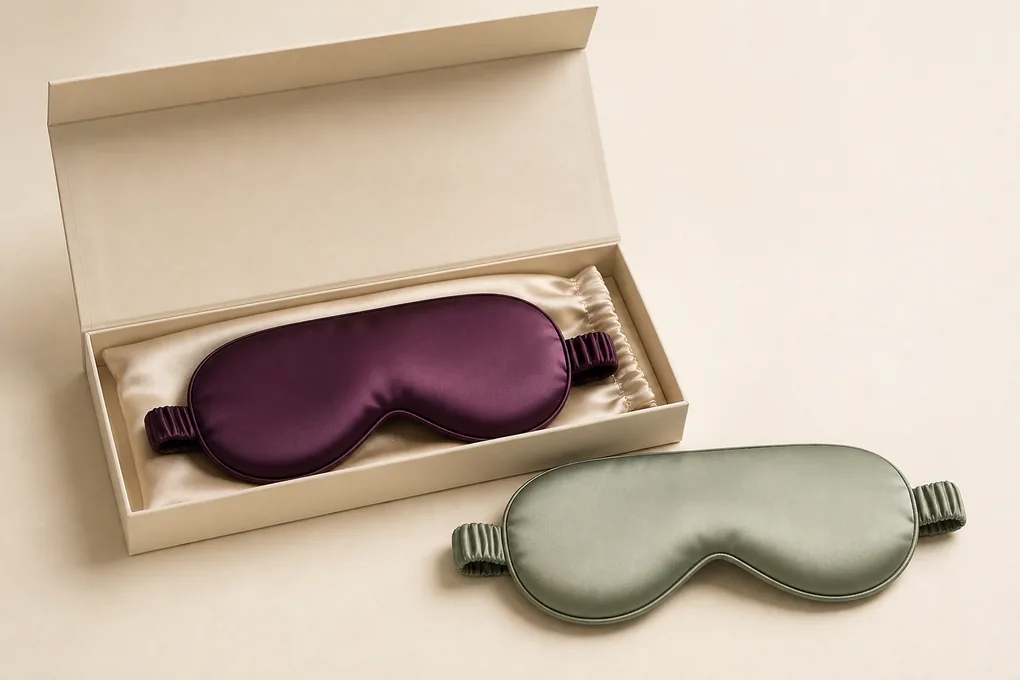
A retail pack for a classic silk sleep mask should make the product easy to understand without compressing its character into generic gift language. Start with the saleable unit: one fixed-strap mask in the named material and colour or artwork version, plus only the presentation components your programme has expressly selected. A pouch, sleeve, card, tissue, insert, or rigid box should be listed separately because each changes the customer experience, material scope, pack assembly, and outer-carton conversation. The buyer should decide how the mask is folded or displayed, what the customer sees first, where the product information is read, and which surfaces need protection. Silk can be visually sensitive to an inappropriate fold or an unplanned contact point, so review the pack with a complete sample rather than approving an empty box or a digital render alone. If the product is part of a gift set, identify the item count, any companion item, and whether the sleep mask must remain independently labelled. If it is a standalone accessory, make the unit definition clear so that a product image or price card does not imply a different bundle. Keep any legal, care, fibre, origin, or marketing copy in your buyer-controlled approval process; the pack design should reserve accurate places for that information, not manufacture claims. We can discuss product and packaging decisions tied to the stated configuration, but the final published statements must match the approved assembly and your market requirements. A well-defined pack protects the mask and gives fulfilment teams a consistent way to recognise the SKU, while allowing merchandising to present the silk item with the elegance the range deserves.
Describe the saleable unit before choosing a box or pouch
One mask, named variant, and explicit accessories
Packaging begins with accurate contents
Write exactly what the customer receives, including any pouch, insert, or card that is part of the unit. Keep optional presentation items out of the base description until approved. This prevents a product photograph from accidentally becoming a pack specification. It also gives purchasing a precise list for comparing inner-pack and outer-carton requirements.
Plan how the mask is protected and revealed
Fold route, customer read point, and visible silk surface
The first opening should support the product story
Review where the strap sits, which side of the mask faces outward, and what touches the silk surface in transit. Identify the point where the customer reads the label or product message. A pack may be minimal and still considered if the fold, protection, and information placement have been chosen deliberately. Confirm the design with a filled sample, not just a flat artwork file.
Connect the inner pack to fulfilment needs
Variant ID, item count, and distribution information
Logistics decisions need real programme inputs
Give the known destination and distribution context, then state which details are still open. If the programme has different colours or variants, define how the pack distinguishes them without relying on memory. This reduces picking errors and helps the buyer assess whether one presentation format is suitable across the assortment. Do not imply an outer-carton quantity until it is a verified programme decision. Before artwork is printed, let the buyer’s compliance and brand reviewers see the final sample and planned information locations together. This helps ensure that customer communication belongs to the actual mask and pack, not to an earlier concept board or an unrelated collection.
Prepare a Clear RFQ for a Fixed-Strap Development Run
A clear RFQ for a fixed-strap silk sleep mask starts with the product decision that your buyer team needs help resolving. It is not a blank request for “a silk mask price.” Begin by naming the exact mask version: the body outline, outer and wearer-facing material scope, any internal layer, fixed-strap direction, anchor locations, edge treatment, colour or artwork status, and the proposed retail pack. Add the intended market, quantity allocation by defined SKU, destination, and the sample or commercial question you need answered. Attach the most useful current documents—a marked drawing, measurement table, approved artwork version, reference photos, pack layout, or written revision note—and state which source controls if two inputs differ. This prevents an attractive but outdated photograph from outweighing a current buyer instruction. Tell us which elements are fixed and which remain options. For example, a buyer may have chosen a body profile and silk face but still be comparing two edge treatments or pack formats. Label those routes separately so a discussion can stay coherent. Do not invent a delivery, test, or certification requirement merely because the form contains a field. If it is important, state your defined requirement and evidence expectation; if it remains open, say who will decide it and when. Include the business contact who owns the next decision, so product, sourcing, and quality colleagues are not working from a generic inbox request. A detailed but honest brief gives us the best chance to respond to the actual buying problem and gives your team a clean record for later sample, quote, and pack reviews.
Send the product configuration as a controlled version
Body, layers, strap, edge, artwork, and pack
A supplier needs the mask you mean, not a category label
List the version-defining features in the same order your team uses internally and attach the current reference. If there are visual elements that must not change, mark them clearly. If a component is still undecided, label it as open rather than embedding it in the product name. This lets the response address the actual configuration and preserves a useful base for comparison.
Separate confirmed choices from live alternatives
Base route, option route, and the question each must answer
Honest open points improve the RFQ
A buyer can ask for a discussion of two identified edge treatments or two pack forms without pretending both are part of one final SKU. Explain which is your base direction and what you want the comparison to reveal. This provides a more practical procurement response than a broad request that leaves every material and construction point implicit.
End with a buyer decision and usable contact context
Sample need, quotation scope, destination, and review milestone
The CTA should move a real procurement issue
State whether you need a sample review, product-development discussion, configuration-specific quote, or packaging feedback. Add the destination and business context available to you, together with the date or milestone driving the decision. Your request will then be anchored to a real next step. We will keep the response tied to the fixed-strap mask version you have described. Retain the RFQ attachments and the decision requested in a shared buyer file. A later colleague can then understand which configuration was submitted, which optional routes were not chosen, and what commercial or product question the next response is intended to resolve. That continuity prevents the next conversation from restarting with an incomplete image or a generic product label.
Buyer questions about Classic fixed-strap sleep mask
Does this page promise light blocking or sleep improvement?
No. Coverage and any performance requirement need an agreed product and sample basis.
What makes this route different from adjustable masks?
The fixed strap has no adjustment mechanism; its length, path, and anchor are the core construction questions.