
P013
Four-Piece Silk Bedding Sets for Private-Label Development
A four-piece silk bedding set becomes difficult to buy when the duvet cover, sheet, pillowcase pair, measurements, and pack are described in separate documents that never form one saleable SKU. We help B2B teams turn those scattered decisions into a controlled set brief: name the exact four articles, map their size-family relationship, define component-level material and construction choices, and review the completed offer on the intended bed before you request a comparable quote.
Published by China EverBen Silks Reviewed by Mark Liu
Keep every component and count visible in a bedding-set request
Identify the fitted, flat, duvet, and pillowcase elements with their measurement and pack relationships.

Name the Four Pieces Before You Compare Set Quotes
We begin every four-piece silk bedding set conversation by listing the saleable articles, their count, and the relationship between them. A retail image can make a duvet cover, fitted sheet, and two pillowcases look like one simple offer; a purchase order cannot. The buyer needs to decide whether the fourth article is a second pillowcase, a flat sheet, a fitted sheet, or another expressly named component. That choice changes the cut plan, the pattern set, the label schedule, the carton count, and the way the final customer understands the offer. We ask for the exact component names used by your merchandising team, not a loose category label. If your range uses a duvet cover, fitted sheet, and two envelope pillowcases, write those four parts exactly. If it uses a flat sheet instead, make that substitution explicit. If a European or North American size changes the pair of pillowcases or the sheet type, show it as a separate SKU decision rather than allowing it to hide inside a colourway. We also separate the selling set from any gift sleeve, tissue, insert card, or protective bag. Those may be important parts of the final presentation, but they are not bedding components and should not make a four-piece claim ambiguous. This first record gives your product manager a clean comparison point: every supplier can be asked to quote the same articles, in the same quantities, with the same size family. It gives quality colleagues a matching inspection reference and gives the packaging team an unambiguous count to protect. When a reference sample differs from your intended assortment, tell us what the sample is useful for and what must not be copied. We can then discuss the requested configuration without pretending that an image alone settles composition, construction, or availability.
Write a bill of pieces that merchandising and production read the same way
Four named articles, count, and size family
A set name cannot replace a component schedule
Put one row in the brief for each article: duvet cover, sheet type, first pillowcase, and second pillowcase. State whether the pillowcases are matching or intentionally different, and identify the bed-size family alongside the row. This prevents a beautiful concept board from becoming two unlike quotations. We recommend giving every proposed set an internal buyer SKU or working name, then attaching marked references only to the relevant row.
Separate what is sold together from what is packed around it
Selling unit versus presentation materials
Count protection begins before carton design
A drawstring bag, belly band, insert, or tissue may improve the unboxing moment, yet it should be recorded in a packaging line rather than folded into the four components. That separation helps purchasing compare material and packing decisions independently. It also stops a last-minute branded insert from altering the perceived contents of the set or causing the carton count to be interpreted incorrectly.
Keep size-family changes visible in the assortment plan
Different markets need deliberate component mapping
One master image is not a size specification
King, queen, double, single, and continental pillow formats may require more than a scaling exercise. Note every set where a pillowcase count, fitted-sheet depth, or duvet dimension changes. We can use the map to keep artwork, care copy, labels, and pack count connected to the correct SKU. The buyer then sees where one launch programme becomes several genuinely different constructions. Before release, ask the person responsible for assortment data to confirm that the set name, item count, and regional variation use the same language in every buyer-facing record.
Measure Each Article for the Intended Bed and Insert
Measurements are not merely dimensions on a spreadsheet; they determine whether a duvet cover accepts the intended insert, whether a fitted sheet reaches the nominated mattress profile, and whether the pillowcases look proportionate on the pillows your customer owns. For a private-label silk bedding set, we ask you to identify the target bed standard first and then distinguish finished article dimensions from insert or mattress reference dimensions. A duvet cover size should not be inferred from a photograph of a made bed. Tell us the intended duvet width and length, the cover finished width and length, the orientation of the opening, and any tolerance that your own quality process requires. For fitted sheets, record the mattress width, length, stated depth, and the condition in which fit will be reviewed; a mattress label alone does not reveal topper use, edge profile, or the buyer’s expected tuck. Pillowcase details matter equally: specify the insert size, the finished case size, whether the pair is identical, and the opening or closure direction. We keep metric and imperial references together when a buying team works across markets, but we do not convert one into an unverified production tolerance. Your approved table should show the unit, the reference being measured, and who will decide a variation discovered on sample. A good schedule makes it possible to compare sample to brief rather than to personal expectation. It also protects a buyer from approving a visually attractive set that later appears undersized on the intended bed. Give us the real destination market and bed or insert references at RFQ stage, and we can focus discussion on the actual cut and construction questions instead of on assumed standards.
Distinguish the bed reference from the finished article
Duvet, mattress, and insert measurements serve different purposes
Record each reference in its own column
Use one column for the insert or mattress, another for the intended finished article, and a third for the review condition. This lets the buyer explain why a cover has chosen ease or why a fitted sheet is expected to reach beneath a particular mattress edge. It also gives a sample reviewer a disciplined way to check the right thing rather than measuring against memory.
Make pillowcase proportions a deliberate decision
Pairing, orientation, and opening direction
Pillowcases can change a set’s perceived value
State whether the cases are square, rectangular, or market-specific, then note the insert reference and visible opening treatment. A pair with an envelope opening may read differently from a pair with a hidden closure, even when the silk face looks identical. Mark whether both cases share one orientation and whether any decorative edge changes the finished size or pack fold.
Use a sample review that reflects the customer’s bed
Place the articles on nominated references
Review fit before approving presentation photography
A tabletop check is useful for sewing quality but cannot replace an assembled review where fit is central. Ask that the four articles be assessed on the size references stated in the brief, with comments tied to the relevant piece. Consolidate revisions in one controlled document. That makes later quotation and inspection much less vulnerable to competing email instructions. Where your internal system carries more than one unit, preserve the original measurement source beside the conversion so the sample reviewer knows which figure controlled the decision, the correct bed standard, and the requested finished dimension.
Define the Silk Scope and Construction of Every Piece
A silk bedding set should describe its materials at component level, because a buyer’s customer-facing claim can become misleading when it silently covers hidden parts that were never specified. We start by asking what the customer will see and touch: the duvet-cover face and reverse, the sheet body, the pillowcase face and reverse, any piping or binding, the closures, labels, and packing materials. The answer may be a uniform silk construction, or it may be a programme with different material choices for different roles. Neither approach should be guessed. For each part, identify the proposed fibre and fabric description, the appearance or hand goal, the side that will be customer-facing, and any point where a non-silk item is used. That last detail matters at openings, elasticated sheet corners, labels, and protective packing. It permits accurate merchandising copy and avoids an all-over material statement that the final assembly cannot support. We then consider construction with the textile scope: panel layout, seam placement, allowance direction, turning, edge treatment, and the relationship between a visible finish and the internal assembly. For this type of bedding, a visually attractive swatch cannot show how a duvet-cover edge or fitted-sheet corner will behave after sewing. A sample needs to show those construction decisions in the intended article form. We do not use broad claims such as “premium” or “luxury” as substitutes for a defined fabric or sewing decision. Your team should be able to tell us what is fixed, which alternative needs comparison, and what evidence is required before the product statement is released. That creates a sensible basis for development and prevents production, marketing, and purchasing from working from different versions of the same material idea. It also keeps product copy connected to the components in the finished customer set.
Identify every customer-facing silk surface
Face, reverse, and decorative edge are separate choices
Silk scope should follow the physical assembly
List the visible surfaces by article, including a reverse that becomes visible during use. If a piping, flange, or binding is part of the offer, state its material and role. This lets customer copy refer to the finished product precisely. It also gives the sample reviewer a clear list of surfaces to inspect for shade, handle, seam effect, and overall coordination.
Describe hidden components without burying them
Closures, elastic, labels, and packing affect the product record
An accurate scope is more useful than a broad claim
Where an elastic, fastening, sewn-in label, or other supporting component is used, place it in the component record. The instruction is not there to distract from the silk; it prevents an imprecise all-silk statement. Your compliance or copy reviewer can then assess the exact language that belongs with the selling unit and any care or fibre information.
Review fabric and sewing as a finished article
Panel direction and seam treatment change the visible result
Sample the real assembly, not only material cuttings
Ask for an evaluation sample that includes the edges, openings, corners, and joins that matter to your range. A flat fabric cutting will not show how a selected finish behaves around a duvet cover or fitted sheet. Mark the viewing condition—made bed, folded retail pack, or customer handling—so comments are anchored to a real product moment. Ask your product-copy owner to review the component list beside the sample, because precise material scope is easier to maintain before claims reach artwork or ecommerce systems, especially when visible silk surfaces and supporting parts differ.
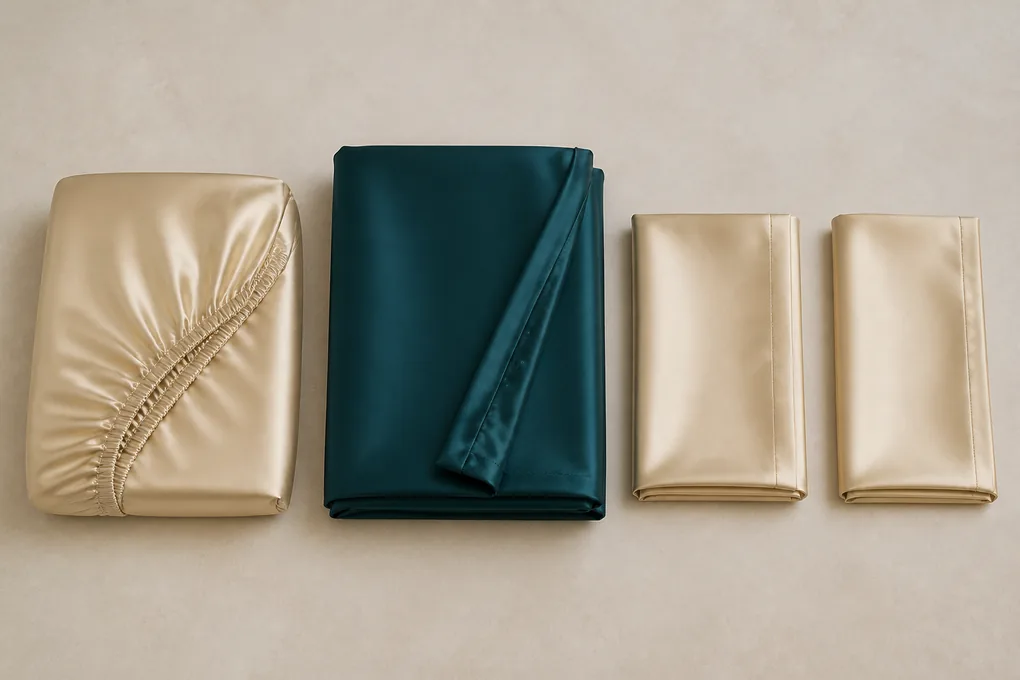
Choose Duvet Cover Openings and Edge Treatments
The duvet cover is often the most visually dominant article in a four-piece bedding set, and its opening and edge choices deserve more attention than a single line reading “standard closure.” The opening position determines how the cover is loaded, what a customer sees on the bed, how the lower edge sits, and where bulk may gather when the cover is folded for the pack. Begin with the intended opening location: foot end, side, concealed flap, or another clearly illustrated arrangement. Then describe the mechanism or overlap involved, the visible and internal faces, and any requirement for a clean exterior line. A buyer may be trying to avoid exposed hardware, reduce interruption to a print, maintain a minimalist look, or make bed-making straightforward for a hospitality programme. Those are different goals and they need different sample points. Edge treatment is equally connected to the product’s identity. A narrow turned edge, a flange, contrast piping, or a stitched border changes the visual proportion and can affect how the component is cut, joined, and packed. We ask for marked imagery or a physical reference showing the exact edge under discussion. A broad inspiration image may establish mood, but it cannot establish where an edge begins or how a closure sits beneath it. During development, assess the opening with the right insert reference and inspect the edge in both spread and folded states. Note the customer-facing view, the underside, the inside finish, and points where the chosen construction may create a change in line or bulk. A clear decision record allows the set’s pillowcases and sheet to be designed as companions rather than accidental matches. It also stops purchasing from receiving bids that use unlike closure and edge assemblies under one generic duvet-cover description.
Choose the opening for the intended use and visual line
Location, access, and exterior appearance must agree
A closure is part of the finished bedding experience
Mark the opening on a simple technical sketch and explain what the user should see when the bed is made. State whether the buyer wants an overlap, a concealed fastening, or another agreed method, without assuming a mechanism that has not been chosen. The sample should show insertion, closure, and the made-bed lower edge so the team can judge the whole interaction.
Set an edge language that works across the collection
Turned hem, flange, piping, or stitched border
Small edge choices alter proportion and pack behavior
Describe the edge style by location and width reference. If the cover has a decorative border, clarify whether pillowcases repeat it or deliberately use a simpler partner detail. Check the treatment around corners and beside the opening, where a flat photograph can hide changes in construction. A coordinated range benefits from these decisions being made together rather than article by article.
Inspect both the exterior and the internal construction
Made-bed view, fold line, and inside finish
Approval should include the opening in use
Review the cover with an insert, not as an empty shell alone. Look at the lower edge after loading, confirm that the exterior line reflects the approved reference, and examine the inside for consistent construction. Record any comment by location and version. This makes it possible to distinguish a design change from a workmanship observation during the next sample round. A marked opening sketch should travel with the brief into the next sample review, especially when the design includes a feature that cannot be judged from the front alone.
Specify Pillowcase Form, Opening, and Pairing
Pillowcases often determine how polished a silk bedding set looks at first glance, because they sit at eye level and repeat the collection’s fabric, edge, and closure decisions in a compact form. We ask buyers to set the pillowcase form deliberately instead of treating the pair as a minor accessory to the duvet cover. Begin with the intended insert shape and the finished visual style: a clean envelope form, a concealed closure, an Oxford-style border, a plain edge, or another clearly described arrangement. Each option changes the cut components, visible frame, opening position, fold line, and the way a pair is stacked or folded in its pack. Pairing also needs an explicit decision. The two cases may be identical, left and right versions, a standard pair plus a decorative variant, or a size-specific combination for different market sets. None of these should be inferred from a product photo. State the exact pairing and make sure it follows the SKU map created for the four-piece offer. If the duvet cover has a flange or trim, decide whether the pillowcases repeat it, simplify it, or use a contrasting interpretation. An unplanned mismatch can make a set look less considered even when every individual component is well sewn. We also ask how the opening should behave when the pillow is inserted and when the case is laid on the bed. The customer’s visible side, the location of any overlap, and the alignment of a print or stripe must be considered in the intended orientation. Review the sample with the nominated insert and in the pack fold proposed for sale. This gives your marketing team something real to photograph and gives quality reviewers a controlled reference for symmetry, construction, and pair consistency. It is a more useful basis for quotation than a generic request for “two silk pillowcases.”
Choose the pillowcase silhouette before styling it
Envelope, framed edge, or concealed opening has different consequences
The front view must match the construction
Define the desired outline on the pillow, not only on a flat table. An Oxford-style edge creates a frame; a plain envelope case gives a different visual economy. Specify the location where the pillow is inserted and whether the opening may be visible from the made-bed front. Use a marked reference for the exact silhouette your buyer team intends to sell.
Make the pair relationship part of the SKU design
Identical pair, orientation pair, or size-specific pairing
Two cases are not automatically interchangeable
Record whether both pillowcases are identical in dimensions, print placement, and edge treatment. If one is intentionally left-facing and one right-facing, identify that in the artwork or pattern record. Where different bed sizes use different pillow formats, connect each pair to its set SKU. This avoids a packing or label error where the correct cases are placed in the wrong selling unit.
Review surface alignment and opening behavior together
Print direction, edge line, and insert use
Pillowcase approval needs more than a front photograph
On a sample, inspect the case with the intended insert and view the front, reverse, and opening side. If there is directional artwork or a woven stripe, confirm the orientation when the pillow is placed on the bed. Then fold the pair into the proposed selling configuration. This sequence reveals whether the chosen styling and practical construction support each other. If the pair will be photographed as a key visual, agree the pillow orientation and opening concealment before sample photography so creative work does not establish the wrong product convention.
Resolve Sheet Format and Mattress-Fit Questions
The sheet in a four-piece silk bedding set should be chosen for the sleeping environment your customer will actually use, not because one sheet format is assumed to be universal. A fitted sheet and a flat sheet create different product promises, different cut and sewing requirements, and different pack messages. Start by deciding which role the sheet has in your range. A fitted sheet must relate to a stated mattress width, length, depth, and edge condition; a flat sheet must relate to the intended drape, tuck, and placement behaviour. When buyers move between the US, Canada, Europe, or different hospitality specifications, dimensions and bedding habits can shift enough that a single “queen sheet” description is not a useful instruction. We ask for the mattress or bed reference, the planned finished sheet dimensions, the size variants, and the situation in which the buyer will judge fit. If an elasticated perimeter or corners are contemplated, say where the elastic is meant to act and what part of the sheet remains visible. If the programme uses a flat sheet, show the planned top hem, side proportion, and any feature that connects it visually to the duvet cover and pillowcases. Consider the sheet as part of the complete set rather than a separate textile rectangle: its shade, hand, fold bulk, care statement, label position, and pack sequence all affect customer perception. The sample review should include the intended bed or mattress reference and should not rely solely on a nominal size label. We can then discuss real construction choices and keep unresolved points visible for your approval. That approach helps a buying team avoid the familiar frustration of receiving a sheet that technically carries the right size name but does not perform or present as the collection requires.
Select fitted or flat sheet from the customer use case
Mattress fit and tuck behavior are different briefs
The sheet type must be named per SKU
State the sheet role at the beginning of the product record. For a fitted sheet, give the target mattress measurements and review condition; for a flat sheet, describe the desired drape and tuck arrangement. Do not leave a sheet type implied by a category image. This one decision changes the pattern, sewing route, label placement, and what your retail pack must tell the customer.
Document mattress profile rather than a size label alone
Width, length, depth, topper, and edge condition
Fit needs a real reference
A mattress name does not necessarily reveal its actual profile. Provide the dimensions and any topper or edge detail that affects the intended fit. If the buyer accepts options, list them as options rather than treating one as final. A sample can then be evaluated on the stated reference, with comments about reach, corner position, and visible finish recorded consistently.
Keep the sheet aligned with the set’s visual language
Hem treatment, shade relationship, and pack fold
A companion article should not feel accidental
Decide whether the sheet repeats a border, stitch line, print, or simply the chosen silk face. Review it next to the duvet cover and pillowcases under the conditions relevant to your merchandising work. Then check how it folds in the selling unit. The complete set should communicate one coherent offer even before the customer has opened the pack. Document any mattress condition used in review, including a topper if relevant, so an informed fit observation is not later confused with a universal size promise.
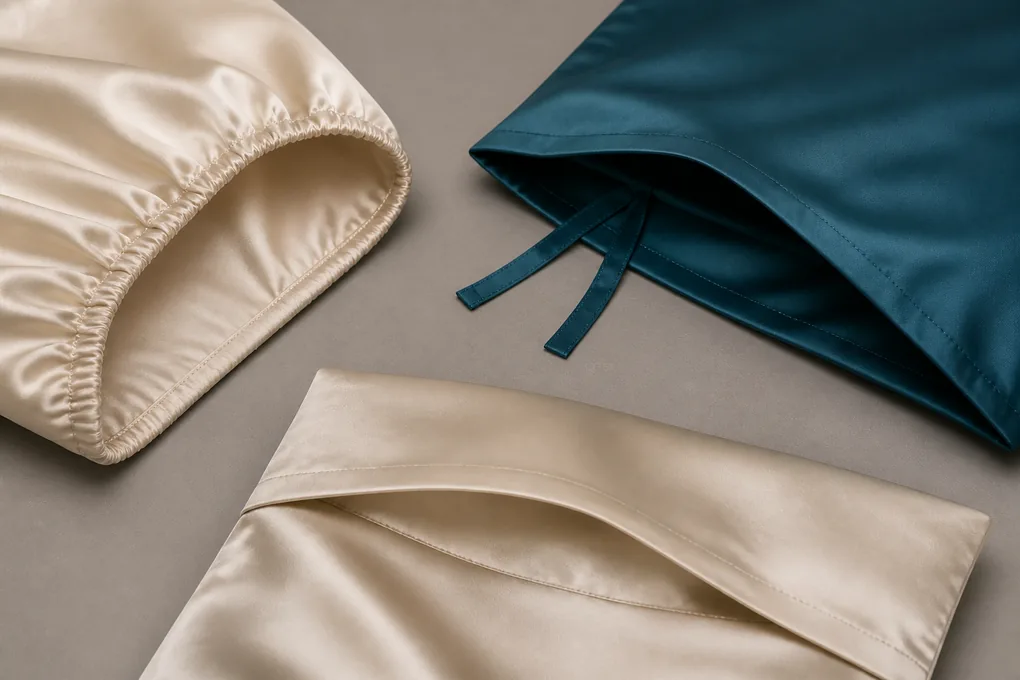
Control Coordinated Shade Across a Multi-Piece Set
A coordinated silk bedding set can lose its intended character when shade is approved article by article instead of as one assembled offer. The duvet cover has broad visual area, the fitted or flat sheet may show at the sides and turn-down, and the pillowcase pair frames the bed. Even a small apparent difference between components can become more visible when the customer sees them together under bedroom lighting. We therefore ask buyers to define the colour programme in a way that respects both the set and its variants. Begin by identifying whether every piece must match one target shade, whether the set uses a planned contrast, or whether the sheet and pillowcases are deliberately grouped differently from the duvet cover. Provide the colour reference available to your team—an approved standard, a physical reference, or a marked sample—and state which component is the controlling visual reference. Do not make a broad colour name do the work of a defined decision when the final line matters to your brand. We also look at surface orientation, print placement, trim, and folding because these can alter how a customer perceives the same colour in the selling unit. A silk face can reflect light differently at different angles; that is a sample-review subject rather than a reason to promise an exact appearance from an unreviewed description. In the review, place all four articles together where possible, include any contrasting trim or label that will be visible, and record the approved version. If your assortment contains several colours or sizes, keep the variant matrix attached to the same set record. This makes it less likely that an approved duvet-cover reference is accidentally applied to a pillowcase pair or sheet format intended for another SKU. The goal is not vague “colour consistency”; it is a documented visual relationship your product, quality, and packaging teams can inspect together.
Decide whether coordination means match or intentional contrast
One shade family can contain several controlled relationships
State the visual hierarchy before sampling
Write whether the duvet, sheet, and cases share the same target or whether one component is meant to frame, contrast, or soften another. Identify the controlling reference rather than asking reviewers to choose from memory. A planned contrast should be named just as clearly as a match, especially where a trim or border appears beside a large silk panel.
Review the full set in a common visual condition
Assembled articles reveal relationships hidden in swatches
One component cannot approve the whole range
Bring the complete four-piece sample together for a colour review. Include the made-bed view and the retail fold if it exposes multiple surfaces at once. Record the source of the approved reference and the version date. This protects the programme from scattered approvals where each article looks acceptable alone but the set lacks the intended visual harmony.
Carry colour decisions into labels and variant control
SKU matrix, artwork version, and pack allocation
The correct shade must travel with the correct set
Link each approved shade relationship to the corresponding size and component matrix. If a colour has a special print placement or contrasting edge, note that with the product version. Packaging and label owners then have a clear cue about which items belong together. This is especially valuable when sets are packed across several components before final carton closure. When colours are approved, retain the complete assembly photograph with the current version record so product, packaging, and quality teams can use one shared visual reference.
Approve a Complete Set Rather Than Isolated Swatches
A swatch can support an early silk direction, but it cannot approve the customer experience of a four-piece bedding set. The duvet cover must be loaded and viewed on a bed; the sheet must be seen in its intended role; the pillowcase pair must be checked with inserts; and the retail pack must protect the assembled offer without flattening the visual work you have chosen. For this reason, we encourage buyers to plan a complete-set review rather than allowing isolated approvals to accumulate across different samples. Start with an approval question: what must the assembled sample demonstrate before your team can release the next instruction? It may be the relationship between components, the scale of a border, the opening arrangement, the way the products fold, or the coherence of a private-label range. Assemble the relevant size and colourway, include the intended components, and use the same written version that purchasing will later reference. Examine it in the contexts that matter to your business: made bed, buyer photography review, store presentation, unboxing sequence, or quality inspection. If only part of the programme is ready, identify it honestly as a partial review and keep the remaining decision open. A carefully staged sample process is better than declaring a full set approved when the fitted sheet, pillowcase pair, or packaging has not been evaluated. Consolidate comments in one buyer-controlled response, separating changes to product design from requests for additional information. That record prevents a decorated duvet cover sample from becoming an accidental master for the entire set. It also gives the next commercial discussion a real configuration to consider: named components, specific size, material scope, construction details, colour relationship, and pack condition. We can respond most usefully when the sample question is concrete and the buyer tells us which decision needs to be reached.
Set the approval question before the sample arrives
A sample should answer a defined buyer decision
Avoid collecting attractive but disconnected evidence
Name the question in the sample request: does this assembly show the intended border scale, component relationship, pack fold, or bed presentation? Attach the current component and measurement table. That gives every reviewer the same frame and discourages comments based on a different assumed configuration. A sample is strongest when it is evaluated against a written decision rather than a general sense of preference.
Review the same configuration your customer will encounter
Make the bed, fill the cases, and fold the selling unit
The assembled condition is the product
Where fit or visual coordination matters, use the nominated insert, pillows, and mattress reference. Review the duvet cover open and closed, the sheet in place, and the pillowcase pair in its intended orientation. Then inspect the pack condition. This sequence shows whether a choice that looks good in isolation still supports the completed bedding offer.
Capture comments so the next sample has one direction
One consolidated buyer response
Version control serves the commercial decision
Ask each function to add its observations to one controlled response, then designate the decision owner for conflicts. Mark whether each comment is a confirmed change, a question, or a further sample need. The next brief can retain the approved features while addressing the exact issue. This is cleaner than carrying separate verbal directions into production planning. A buyer who records what the sample has not yet shown will make a safer next decision than one who treats partial evidence as full programme approval.
Set Inspection Points for the Whole Bedding Offer
Quality review for a four-piece silk bedding set is more useful when it follows the customer journey through the actual selling unit. Instead of treating inspection as a last-minute search for general defects, identify the locations and conditions that matter to this particular duvet cover, sheet, and pillowcase pair. Begin with the elements a purchaser and final customer can readily observe: consistent component count, finished measurements, visible surfaces, seams, edges, openings, shade relationship, label placement, and pack condition. Then move to product-specific checks such as duvet-opening operation, pillowcase pairing, fitted-sheet corner arrangement, or the alignment of a decorative edge. Your own quality team may have additional acceptance procedures, and those should be attached to the buyer’s controlled record rather than replaced by generic website language. We do not claim a finished product meets a tolerance, performance level, or test result that has not been agreed and evidenced. What we can do is help define a practical review plan that makes buyer expectations visible before the commercial decision becomes an order. Take the approved sample and identify the attributes that need a representative check on the finished production configuration. State whether an item will be inspected flat, made up, folded, or packed, because a silk surface or edge can present differently in each condition. Connect the observation to its exact location and SKU; “check quality carefully” does not help a reviewer resolve a specific question. The result is a shared inspection vocabulary that product development, sourcing, and quality can use at the right stages. It also gives a procurement manager a more credible foundation when comparing offers, because the expected construction and presentation have been described in detail rather than assumed from price or category. That focus makes set-level review easier to repeat across the chosen variants.
Build the review around the full selling unit
Count, component identity, and pack state
Inspection begins with the offer the customer receives
Confirm the four named articles and the correct pair before looking at finer details. Then review the set in the condition relevant to the check: made bed for coordination, flat view for construction, or folded pack for presentation. The same SKU identifier should remain visible through the review. This prevents a comment on one component from being applied to a different size or assortment variation.
Identify high-attention construction locations
Openings, corners, seams, edges, and visible joins
Location-specific notes lead to useful corrective action
Mark the duvet opening, the pillowcase opening, sheet corners where applicable, and every decorative edge that the customer sees. Describe what the reviewer must observe rather than using an undefined quality label. For example, a line, alignment, or relationship can be assessed against the approved reference; an unagreed performance assertion should remain a question for the buyer’s own specification.
Connect inspection conditions to buyer acceptance
Flat, assembled, and packed views have different value
One sample state rarely answers every question
State which observation needs a made-bed view and which can be checked flat. Look at colour relationships with all articles together, then examine construction at close range. Finally assess the pack for correct count and presentation. Keeping these contexts separate produces comments that are easier to understand and act on than a single general approval or rejection. The most practical checklist is one that allows an inspector to point to a location, compare it with a reference, and describe an observation without inventing an acceptance value.

Engineer the Selling Unit, Inserts, and Outer Carton
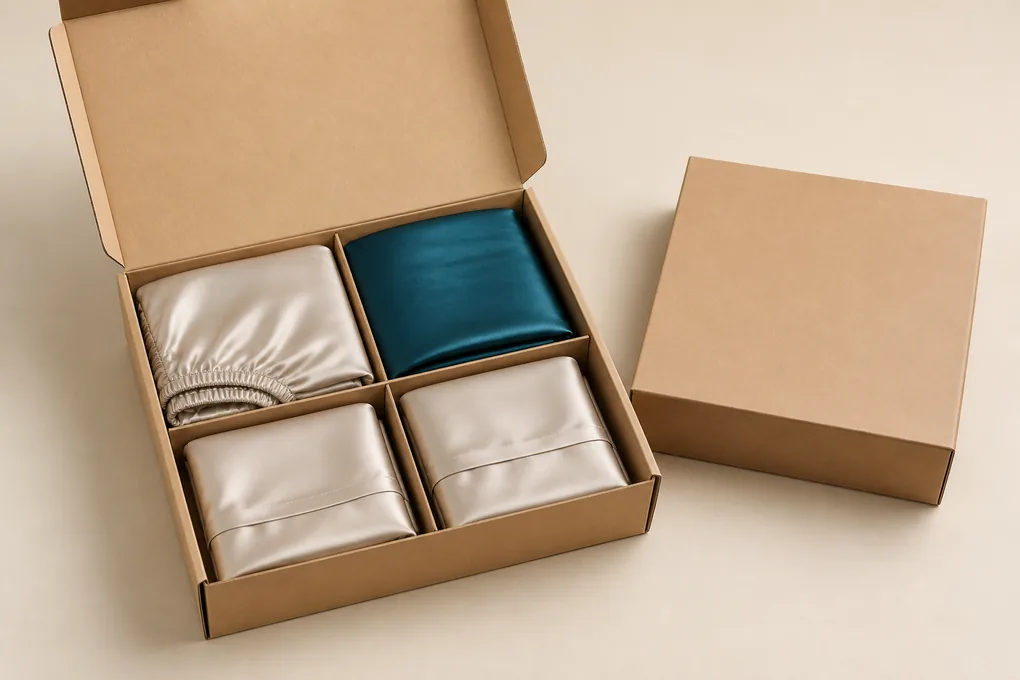
The packaging for a four-piece silk bedding set needs to protect the articles, communicate the selling-unit contents, and support the way your brand intends the customer to encounter the product. Those goals should be designed together. Start with the precise saleable unit: one duvet cover, one nominated sheet, and two identified pillowcases for one size and colourway. Then map the sequence in which those articles are folded, protected, labelled, placed in an inner presentation, and grouped into an outer carton. A package that looks good in a flat mock-up can still create unwanted fold lines, conceal a key component, make count verification difficult, or leave a delicate edge without suitable protection. We ask buyers for the pack format, desired customer-facing opening sequence, any mandatory label or insert fields, the market destination, and the way cartons will be handled after receipt. Do not assume that a fabric bag, sleeve, tissue, hanger, or photo card is included unless it is a named line in the brief. Each adds a material and assembly decision and may change the carton basis. For a bedding set, the component count should be intelligible without opening the product; that is particularly important where several sizes or pillowcase configurations share similar artwork. A pack drawing or marked reference can show which article sits on top, where the label is read, and how the set is returned to its display configuration. We also recommend examining a complete sample in the proposed pack after it has been folded and handled. This is where a border, printed surface, or pillowcase pair may reveal a practical issue not visible in an unfolded review. By defining the selling unit and outer-carton relationship early, a buyer avoids receiving a quote that covers the textile articles but leaves presentation, protection, or logistics assumptions unresolved.
Define the customer-facing selling unit before the carton
Contents statement, fold order, and label read point
The pack must make four pieces legible
Write the exact contents in the order the customer will see them, then state how each article is folded or protected. Identify the primary read point for the label and whether a component count needs a visual cue. This enables your merchandising and fulfilment teams to assess the unit from the same drawing. It also reduces the chance that unlike pillowcase or sheet variants are packed under one generic front label.
Protect silk surfaces without hiding the product decision
Folds, tissue, sleeve, bag, and insert are distinct choices
Presentation materials should be quoted explicitly
If your brand uses tissue, a sleeve, a bag, or an insert, list each as a separate requirement with its role. Consider where a folded edge lands across a visible panel and whether the buyer needs a particular unboxing sequence. Review the proposed pack with the full set inside; a protective choice can change bulk and appearance even when every bedding article is correct.
Link inner-unit design to outer-carton handling
Quantity per carton, destination, and storage condition
Logistics inputs cannot be guessed from a lifestyle image
Give the intended destination, distribution route, and any outer-carton information your team already knows. State the number of selling units expected per carton only when it has been decided, and separate it from an estimate. We can then discuss the presentation and handling questions connected to your actual programme rather than applying an unsuitable default. Review both a customer-facing pack and a transit-ready carton concept before sign-off, because a correct inner presentation still needs to reach its destination in the intended condition.
Write Care and Fiber Statements That Match the Assembly
Care, fibre, and product statements are part of a silk bedding set’s commercial integrity. They should be written from the final component record, not copied from a broad category description or assumed from the visible face alone. A duvet cover, sheet, pillowcase pair, closure, label, trim, and pack may have different material roles; your customer-facing language should accurately reflect what the finished selling unit contains. Start with the claims your brand needs to make and identify the product information that supports each one. If the silk scope is limited to named surfaces, make sure the wording does not extend beyond those surfaces. If the set contains a non-silk closure, elasticated corner, decorative trim, or packaging accessory, include the relevant information where your legal, compliance, or market process requires it. We do not manufacture product statements from a marketing adjective. We use the confirmed bill of materials, label plan, and approved product version as the starting point for copy review. Care language also deserves a configuration-specific check. It should be consistent with the final material and construction and should go through your own approval process before it is printed or published. Do not treat a suggested instruction from another bedding product as a released statement for this one. For a multi-piece set, decide whether care information is shared across the selling unit or whether article-specific information is necessary; make that choice visible to label and packaging owners. We can help structure the information you need to collect, but the final claim, care method, and legal wording must remain within the buyer’s approved documentation. This approach is less dramatic than a generic “easy care” promise, but it protects the brand by giving each statement a real product basis. It also keeps the set ready for a commercial review where product, pack, and message can be evaluated together.
Build fibre language from the assembled components
Visible silk surfaces and supporting materials need clear scope
A broad category claim is not a component record
Use the material list developed for the finished duvet cover, sheet, and pillowcase pair as the source for any fibre wording. If a component is not part of the same material scope, do not let a headline silently include it. Give your compliance reviewer the exact set version, material lines, and label location so that customer-facing information follows the product rather than an assumed template.
Treat care copy as a review item, not a decoration
Care statements must suit the finished configuration
Print only after the appropriate approval
Write the care question in the buyer brief and identify who will approve the final wording. Check whether all four articles share a consistent instruction or whether a specific feature creates an exception. A label, insert, or pack panel should not use unreviewed promises from a prior collection. This protects both the customer experience and the credibility of your programme.
Coordinate product, label, and pack information
One approved version should guide all customer touchpoints
Consistency is easier when fields are connected
Make a small sign-off table connecting set SKU, component scope, size, colourway, care copy, fibre language, and pack location. This does not replace market-specific legal review; it stops a correct statement from being attached to the wrong variant. It also allows a buyer to trace a product-page phrase back to the exact physical assembly it describes. Keep final customer language in the buyer approval route; this page can organise accurate inputs, but it must not substitute for a completed legal or market-specific review.
Send an RFQ That Keeps the Set Comparable
A productive RFQ for a four-piece silk bedding set gives a supplier enough information to respond to the right programme without inventing missing commercial facts. The request need not portray every decision as finished. It needs to distinguish the fixed elements from the alternatives and questions still under review. Begin with the saleable configuration: the four named articles, intended market, size family, colour or artwork status, and the specific quantity allocation you want considered. Add the material scope by component, the key construction details, and the pack format you have approved or want to compare. Attach the most useful evidence—measurement table, marked reference, artwork version, sample photographs, packaging layout, or a clear written instruction—and identify which one controls when information conflicts. Then state the outcome you need. You may need a development discussion, an evaluation sample, a quotation basis, a pack review, or help resolving an interface between bedding components. A direct request gives us a better chance to address the actual procurement obstacle than a broad email asking for a “best price.” Do not put a target or timing into the request unless it is a real buyer input you want evaluated. If a detail has not been decided, label it as open and describe the decision owner or milestone. We can then keep an alternative separate from the base configuration rather than allowing it to contaminate the quotation. Include your destination and any known distribution constraints, because these may affect the packaging or delivery conversation; do not assume a generic route fits your order. Finally, give your contact team enough context to manage the next review: business role, company, decision date, and the most urgent unresolved point. The result is an RFQ that lets product, purchasing, and quality speak from one coherent set record while retaining a clear path for informed change.
Send the physical configuration before the commercial question
Components, sizes, material scope, and construction
A quote can only compare what has been defined
List the four pieces and their quantities, then include size, colourway, and the component-level material and construction decisions that govern the set. Attach the current revision of any measurement or artwork record. If you want two alternatives, separate them clearly. This permits a meaningful comparison instead of forcing purchasing to interpret which version of a duvet cover or sheet was assumed.
Make open decisions visible rather than silently filling them
Options, decision owner, and required sample question
Transparency creates a stronger buying brief
A product manager may still be deciding between a fitted and flat sheet, a pillowcase opening, or a pack route. Name the alternative and the question it must answer. Do not relabel an open point as an approved standard merely to complete an RFQ form. A clear open item gives your team a more useful response than a fabricated certainty.
Tell us what needs to happen next
Sample, technical discussion, or configuration-specific quote
The call to action should solve a buyer problem
End the request with the decision you need to make and the material available for review. If a sample is required, say what it must demonstrate; if a quotation is needed, state the version to which it should apply. Include your role, destination, and review date where available. This keeps the follow-up focused on moving your actual set programme forward. The strongest first inquiry identifies the decision owner and the current reference version, allowing the response to address the real buying question instead of a generic silk category.
Buyer questions about defining a four-piece silk bedding set
Does four-piece mean the same components in every market?
No. The page requires the buyer to name the exact four articles and their quantities.
Can a room image approve a bedding set?
No. A complete-set review needs a named component and pack count check.