
P012
Silk Fitted-Sheet Fit Development
A fitted silk sheet has to work around a real sleeping surface, not an abstract mattress label. We help bedding buyers describe the mattress width, length, height, topper or protector condition, pocket concept, elastic route, fabric direction, and selling-unit plan that turn a silk sheet into a definable B2B product. The useful question is usually specific: a pocket that keeps releasing, an elastic route that needs a better review, a size name that hides different regional dimensions, a large panel layout, or a set that needs coordinated pack information. Send the product detail that is blocking your next decision and we will begin the discussion there.
Published by China EverBen Silks Reviewed by Mark Liu
Prevent a fitted-sheet request from losing the mattress reference
Bring the mattress dimensions, pocket condition, elastic route, corner behavior, and pack question together.

Turn Mattress Names Into Numeric Silk Fitted-Sheet SKUs
A familiar bedding size name is useful to a shopper, but it is not enough information for pattern development or a comparable wholesale quotation. Twin, Queen, King, Super King, and other retail labels change across markets; even within one market, a product may be sold for a standard mattress, a deeper mattress, or a mattress used with a protector and topper. We work with buyers to translate the retail assortment into numeric rows. Each row should name the target market, mattress width and length, maximum dressed height, intended fit style, selected sheet construction, and pack identity. That lets the team keep a customer-friendly size name while giving sourcing and quality teams a real product definition.
Record width, length, and dressed height for every saleable size
Mattress geometry instead of a borrowed size label
A size name becomes useful only when linked to numbers
Begin with the actual mattress dimensions the product is meant to fit. State width and length in a consistent unit, then record the mattress height under the conditions that matter to the customer. If a protector, topper, or pad is normally used, name it as part of the fit context rather than assuming the bare mattress describes the finished bed. A fitted sheet pattern is built around a three-dimensional object. A nominal Queen or King name does not reveal the corner drop, the surface area, or the amount of fabric that has to travel below the mattress edge.
For each size, add the intended selling-unit identity and any related bedding components. This is valuable when a fitted sheet is offered alone in some channels and inside a coordinated set in others. The buyer can compare costs and quantities at the true product-row level, while merchandising retains the names customers expect. It also prevents a supplier from quoting one geometric assumption while the retailer plans to sell a different mattress interface under the same label.
Separate destination-market conventions before you combine an assortment
Regional dimensions, merchandising names, and product data
One global name should not hide multiple patterns
A bedding brand selling into North America, Europe, the United Kingdom, or other markets should map retail names to the local dimensional reality before a sample is requested. A shared collection name may be sensible, but a pattern should not be inferred from that name. List each destination row, the actual mattress reference, the desired sheet dimensions or pocket route, and the companion pillowcase or duvet-cover relationship if one exists. This gives buying teams a concrete way to decide whether one construction can serve several regions or whether separate size development is warranted.
The map is also useful for e-commerce and customer service. Product pages, pack artwork, and catalog feeds need to distinguish a US King from a UK King or a deep-pocket variant without asking the customer to decode an internal factory reference. When the numeric row is the source for every channel, the finished product is less likely to be photographed, packed, or replenished against the wrong size standard. That clarity starts before any price or order decision is discussed.
Describe the desired fit as well as the mattress measurements
Relaxed drape, secure pocket, and visible side drop
The customer experience needs a stated visual goal
Two sheets with the same basic dimensions can create different experiences because the buyer may want a relaxed fall around the sides, a close mattress-hugging look, or extra reach for a topper configuration. State what the customer should see when the sheet is installed: whether the pocket should cover the mattress sides fully, where the top edge is intended to sit, and how much of the product remains visible below the sleep surface. These are product questions that help a pattern team understand the purpose of the numeric inputs.
A concise fit statement also improves the sample review. Instead of saying that a sheet is too loose or too tight, a buyer can compare the installed sample with the intended result on the named mattress condition. That makes the next action more precise: revise pocket depth, change elastic coverage, reconsider a size row, or retain the existing route. It gives a silk fitted-sheet discussion the engineering clarity that a large, soft bedding article requires.
Measure the Full Sleep System Before You Choose Pocket Depth
Pocket depth is not simply the height printed on a mattress label. The fitted sheet has to travel over the upper corners, down the side, and under the mattress while accommodating the protection and comfort layers the customer actually uses. A protector can add thickness and a slippery interface; a topper changes the surface height and corner profile; a mattress with rounded edges behaves differently from one with sharp corners. We help buyers capture this installed condition before pattern and elastic decisions are made. That prevents a common failure: a sheet that technically fits the bare mattress in a sample room but releases or looks undersized on the dressed bed a customer uses at home or in a hospitality setting.
Measure the dressed bed, not the mattress in isolation
Mattress, protector, topper, and selected bedding condition
The fitted pocket must meet the object it will cover
Ask the product team or customer to provide the mattress width, length, and height after the intended protector and topper are in place. Include whether the layers are always part of the sale or whether the sheet must accommodate a stated range of common use. The corner shape matters as well: a rigid square profile and a pillowy rounded profile create different fabric paths. A photograph can help illustrate the bed, but the measurement record should name the points and condition so a supplier can understand what the numbers represent.
This measurement step is valuable for premium silk bedding because a smooth surface makes a poorly fitted edge easy to notice. The goal is not to promise that one pattern fits every bed. Its purpose is to state the buyer’s intended use before a sample is judged. If the brief includes several mattress profiles, keep them in separate rows and decide which one controls the initial development sample. That gives the review team a real reference instead of a moving target.
Calculate the route around corners and under the mattress
Top panel, side descent, under-mattress return, and allowance
Pocket geometry is a path, not a single vertical number
A fitted sheet’s pocket has to cover more than the visible mattress height. The fabric moves from the top panel around the corner, down the side, and beneath the mattress where elastic or another retention route takes hold. Buyers do not need to solve the pattern mathematics themselves, but they should explain the desired bed condition and the amount of tuck or return they expect. A deep-pocket request without a mattress context can produce very different assumptions from different suppliers. A clear pathway lets the development conversation focus on the correct geometry.
During sampling, inspect where the sheet returns under the mattress and whether the elastic is working at the point the product design intends. A pocket may appear adequate from the top while the lower return is too shallow for movement or a topper. Conversely, excessive fabric can bunch and compromise the clean bed presentation that a silk surface is meant to create. Use the observed condition to guide a revision rather than adding an arbitrary depth number without a reason.
Keep fit-range decisions visible in the buyer brief
Single nominated mattress or defined usable range
A range needs a deliberate approval plan
Some buyers sell a fitted sheet for one nominated mattress profile; others need a stated range because customers use different protectors or mattress heights. These are different product promises. If a range is required, identify its lower and upper conditions, the customer-facing language under consideration, and the physical setups that should be used during review. Do not present a broad range as confirmed just because one sample fits one bed. The buyer and supplier need to decide the product boundary together for the selected construction.
The fit-range record should travel into package information and digital product data only after it has been agreed. It is also useful when a line contains shallow, standard, and deep configurations, since those variants may look similar when folded but have different pocket patterns. A clear line between the approved fit condition and an untested use case helps buying teams protect both the product experience and the integrity of their customer communication.
Build Pocket Geometry From the Mattress Corners Your Customers Actually Use
The corner is where a fitted sheet proves whether its geometry has been chosen intelligently. Fabric has to turn from the deck to the side without producing a tight diagonal pull, loose pocket, exposed mattress edge, or distorted surface. Silk’s smooth drape makes those problems visible because the material reflects light across the bed rather than hiding uneven tension. We help buyers define the corner configuration in terms of real mattress shape, selected pocket route, seam position, and retention method. That produces a better starting point for a sample than the category phrase “deep fitted sheet,” which says little about how the pattern should behave around four loaded corners.
Make the corner shape part of the product drawing
Corner seam path, side panel, and selected pocket form
A usable pocket starts with a visible geometry choice
A fitted-sheet drawing should identify the top deck, the side descent, the corner seam or shaping route, and the position of any elastic channel. It does not need to expose proprietary pattern detail, but it should show the buyer what the sewn product is expected to do. A square corner, curved transition, or shaped pocket can produce a different installed appearance. The chosen geometry should relate to the named mattress condition, not a generic bedding photo. This lets the product team review the physical concept before color, packaging, or size names distract from the fit issue.
If the program includes multiple mattress heights, decide whether each needs a separate pattern or whether a defined adjustment route is being considered. Avoid assuming that simply lengthening every side produces the same corner behavior. The merchandising and product teams need a clear view of the sampled configuration and the geometry still under discussion. That protects the range when a deep-pocket addition is developed after a standard-depth SKU has already been approved.
Review tension points with the sheet installed and under load
Top corners, side panels, elastic pull, and mattress movement
A flat sample cannot show a corner’s real behavior
Install the sample on the nominated bed and observe each corner after the sheet is pulled into place. Look at the top surface, the vertical side, the lower return, and the point where elastic begins to pull. Check again after normal bedding movement or after the bed is made in the intended sequence. The aim is not to promise a universal no-slip result; it is to reveal how the selected sheet interacts with the stated mattress and to identify the conditions that need refinement before an assortment is launched.
Record the location of any issue. A diagonal pull near one seam, an exposed lower corner, or excess fabric at the side each suggests a different development question. A direct note gives the next sample a purpose: alter the pocket shape, revisit the tuck route, adjust elastic placement, or confirm that the observed condition is acceptable for the selected product. A targeted note beats a generic demand for tighter fit, which can create a new problem while solving only one corner.
Coordinate corner geometry with the visible bed aesthetic
Smooth deck, controlled side drop, and consistent four-corner view
Fit and styling are part of the same customer experience
A silk fitted sheet often belongs in a visual bedding range where customers care about the smoothness of the deck and the way the fabric falls at the sides. The corner pattern should support that aesthetic. Some collections need a crisp tailored look; others prefer a softer drape. State the intended presentation and review all four corners, not just the easiest one. Differences in mattress construction, seams, or elastic orientation can make a sheet appear balanced from one view and uneven from another.
Photograph or note the approved installed condition from enough angles to help the next team recognize the goal. This is useful for e-commerce photography, retailer line reviews, and internal quality checks. The record should not be used to make unsupported performance promises; it is a product reference for the chosen mattress configuration. When the fit, corner geometry, and visual standard are linked, a buyer has a stronger foundation for adding other sizes without losing the character of the original fitted-sheet design.
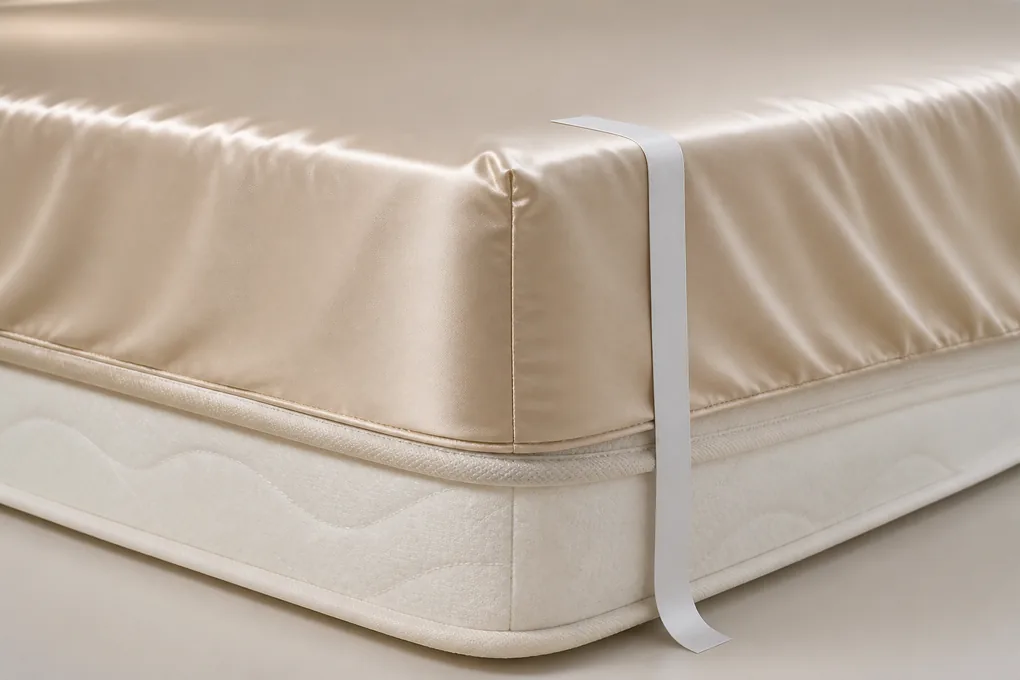
Select Silk Fabric Direction for a Large Fitted-Sheet Article
A fitted sheet uses a large expanse of fabric, which makes silk selection a design and planning decision rather than a simple category label. The chosen face, weave, weight direction, color, luster, and panel arrangement influence the made-bed appearance, the way the article folds, the behavior of the pocket, and the relationship to pillowcases or duvet covers. Catalog references such as 16, 19, or 22 momme silk can help begin a conversation, but a buyer still needs to choose the selected material route for the product being sampled. We work from the desired use and visual outcome so teams can ask specific questions about body, surface, color, panel planning, and care support instead of treating every silk sheet as equivalent.
Tie the selected silk route to the bed appearance you want
Surface, luster, hand, and coordinated bedding components
Large silk panels amplify both beauty and inconsistency
A smooth silk surface can make a bed look striking, but it also makes color variation, panel joins, and uneven tension more noticeable. Buyers should describe the intended visual result: a fluid glossy surface, a more restrained sheen, a particular color depth, or a close relationship with a matching pillowcase or duvet cover. When a momme or weave direction is specified, attach it to the exact product component and selected colorway rather than using a general category phrase. The sample should be judged as a large article on a bed, because a small swatch cannot show every part of the eventual presentation.
This conversation also helps the buyer identify which details need separate confirmation. A fabric route that looks appropriate for a pillowcase may create a different handling or panel question at fitted-sheet scale. Rather than making a blanket claim about feel or durability, we can help the buyer define what the bed sample must show: visual continuity, a chosen hand, fold behavior, color relationship, or the integration of the pocket construction with the selected surface.
Plan panel width and joins before you approve product imagery
Fabric width, size row, seam location, and visual priority
A large bed cannot be designed from a close-up swatch
Depending on the selected fabric width and mattress size, a fitted sheet may require a panel plan. The buyer should decide whether a join is acceptable, where it may sit, and its relationship to the sleeping surface and visible sides. Do not assume that a polished listing photograph confirms an uninterrupted panel for every size. A written plan distinguishes what the brand needs from what remains open to a technical proposal. This is particularly important for large or regional mattress sizes, where one physical article may demand a different layout from another.
The review should include the installed product and the fold used for retail presentation. A join that is unobtrusive on a made bed may be prominent when the sheet is folded into a pouch or box. Conversely, a location chosen for packaging may not be suitable near the customer’s sleep surface. By naming the visual priority—smooth top deck, clean side, hidden join, or coordinated set appearance—the buyer gives the development team a practical criterion rather than a vague request for a premium sheet.
Keep material and color choices aligned across the bedding range
Fitted sheet, pillowcase, duvet cover, and set relationship
Coordination requires selected references, not assumptions
A fitted sheet may be sold alone, paired with pillowcases, or included in a larger bedding set. If coordination matters, identify the selected color reference and the components that must be reviewed together. Silk can look different on the taut mattress base, plumped pillowcases, and a softly falling duvet, particularly under retail and bedroom lighting. The buyer should decide whether exact color continuity is required, whether tonal variation is part of the collection, and what physical reference governs the approval.
Keep each product’s construction distinct even when the color is shared. A matching pillowcase does not remove the fitted sheet’s pocket, elastic, or panel questions. The product map should show which attributes are common across the set and which belong only to the fitted sheet. This makes the purchasing conversation clearer and prevents a shared color name from being mistaken for a shared material or measurement specification.
Set Grain Direction and Panel Layout Before Cutting a Silk Fitted Sheet
The way fabric is oriented and joined across a fitted sheet affects the visual flow of silk, the position of any color or print effect, the corner construction, and the fold customers receive in the pack. Large articles invite shortcuts when the layout is not defined; a buyer may approve a beautiful swatch or a mock-up without asking how the pattern, surface direction, and panel seams will work across the actual size. We help teams move from a textile concept to a cut-and-sew question that can be reviewed. This is not a demand for one universal layout. It is a way to name the selected surface direction, any directional artwork, acceptable join locations, and the features that must remain consistent across size rows.
Decide which visual direction controls the top deck
Warp, weft, print direction, and made-bed view
The largest visible surface needs an intentional plan
For a solid silk fitted sheet, surface direction can still affect the way light moves across the bed. For a stripe, border, engineered print, or logo-like motif, direction becomes even more important. Buyers should state which way the design should read across the mattress and how it should relate to the head of the bed, pillowcases, or a paired duvet cover. A generic image often hides these choices because it shows only a carefully arranged section of the sheet. A marked reference or simple bed-top diagram gives cutting, sewing, and marketing teams one view of the intended article.
Do not make direction an assumption when different size rows are involved. A print that reads well across a single or Queen bed may require a different panel plan on a larger size. Record what is fixed—such as a motif centered at the head—and what variation is acceptable. That lets a sample review focus on the correct feature and avoids the late discovery that a pattern shifts, reverses, or breaks at a join in the retail size that matters most.
Place joins where they support rather than distract from the product
Top surface, side panels, pocket areas, and fold line
A seam location should be chosen, not discovered
If the selected fabric width or finished size requires joins, decide early which areas can carry them. A buyer may prioritize a continuous sleep surface, a smooth visible side, or a seam placed where it is less prominent under a duvet. The answer depends on the mattress size, product photography, channel, and overall bedding design. We recommend stating the visual priority rather than prescribing a pattern method without the full fabric and construction context. A supplier can then discuss an appropriate layout for the selected configuration.
Review any proposed joins on the made bed and in the packaged fold. Check whether the line disrupts color, print, or surface continuity and whether it creates a visual imbalance at the corners. For a private-label product, keep the layout reference with the product row so a future reorder does not silently move a visible join. The goal is a controlled article that meets the buyer’s intended bed presentation, not a hidden assumption that becomes obvious only after units are unpacked.
Test the layout on the sizes that create the greatest risk
Largest bed, directional print, and coordinated-set sample
The hardest SKU often reveals the real development need
A useful development plan identifies the size row most likely to expose a layout question. That may be the largest mattress, a deep-pocket version, a directional-print colorway, or the sheet that must coordinate with several other bedding components. Sampling that configuration can provide better information than approving only the smallest or simplest size. The buyer should state why the sample is being chosen and what it needs to prove: panel continuity, orientation, pocket behavior, fold, or set appearance. That gives each physical sample a purposeful role in the product program.
Once the selected layout is accepted, document the relationship among size row, fabric direction, face, join location, print placement, and pack fold. This helps design, sourcing, and retail teams talk about the same product. It also creates a cleaner foundation for extending the line later, because the buyer can see which elements are essential to the original concept and which can change when a new market or mattress profile is added.
Choose Elastic Coverage and Casing Construction for the Selected Mattress Interface
Elastic is the retention system that turns a flat silk sheet into a fitted article. Its coverage, placement, channel construction, and relationship to the pocket determine how the sheet is installed and how it sits under the mattress. A buyer should not select “elasticated” as a broad feature and assume the rest will follow. Four-corner elastic, perimeter elastic, and other selected routes create different product experiences and different sewing questions. We help B2B teams compare them against the nominated mattress profile, desired side appearance, pack format, and customer dressing sequence. The preferred route should serve the chosen sheet design and be reviewed on the actual bed, rather than merely sounding comprehensive in a short listing.
Compare elastic routes through the customer’s installation sequence
Four corners, partial coverage, perimeter route, and selected fit aim
The right retention route is a product decision
Ask how the customer is expected to put the sheet on the bed. A sheet fitted around four corners may suit a particular pocket geometry and pack goal; perimeter coverage may create a different feel and installed appearance. The buyer should name the selected route or make the question explicit in the brief. Include the mattress condition, desired edge position, and whether the sheet is intended for frequent changeover, a coordinated luxury set, retail home use, or another stated context. These details help the supplier respond to a real product need rather than guessing from an image.
A sample review should observe how the route behaves on all four corners, not just whether the sheet initially goes on. Look at the lower return, side tension, top-deck smoothness, and the ease with which a customer can remove or reinstall the item. Do not convert one observation into a universal performance promise. Use it to decide whether the selected elastic coverage and pocket construction work for the named product and whether another configuration needs its own review.
Specify the elastic channel as a visible construction feature
Casing, attachment line, seam exposure, and corner transition
Silk and elastic need an intentional meeting point
The elastic route is supported by a channel or attachment construction that can change the look and feel of the fitted sheet. Buyers should consider whether the casing is visible from the outside, how it reaches the corner seams, and how it sits against the selected silk surface. A clean channel can support a refined bed appearance, but the exact construction must be selected and examined on a sewn sample. State the components and visual expectations in the product brief rather than relying on a generic word such as finished or premium.
This attention is especially useful for a silk product because light can reveal an uneven edge or bulky seam. Inspect the channel around the intended mattress, including the transitions where the pocket turns. If a buyer needs a particular measurement, recovery characteristic, or test method, that requirement should be agreed in writing for the exact product. Until then, focus the inquiry on the observed installed behavior and the construction question that needs technical review.
Separate an elastic choice from an unsupported fit guarantee
Sample observation, product scope, and customer communication
Clear language is better than a broad promise
Fitted-sheet marketing often uses broad promises about staying in place or fitting every mattress. A B2B buyer is better served by defining the mattress condition and sample check than by copying a claim into early product copy. The selected elastic route may be appropriate for the chosen bed profile, but its outcome depends on pocket geometry, fabric, mattress edge, topper use, and the way the product is installed. Describe what the sample will be asked to demonstrate and what information must be confirmed before any retail performance statement is finalized.
This distinction supports honest product development and more useful supplier comparison. A buyer can ask for an elastic proposal, identify the desired installation experience, and request a physical review without pretending that a universal result has already been established. Once a configuration and evidence route are agreed, the product, packaging, and customer communication can stay aligned with the selected article rather than with an exaggerated category phrase.
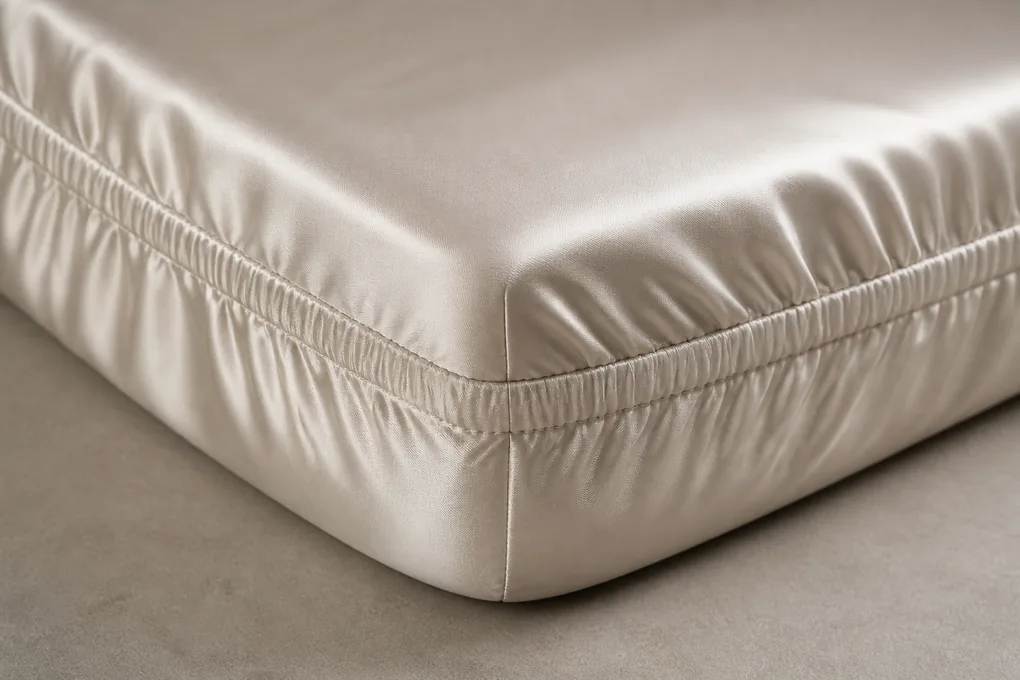
Resolve Corner Seams and Pocket Finishes Before a Silk Sheet Reaches Bulk Review
Corner seams and pocket finishes are where the sheet’s large fabric panels, geometry, and elastic system meet. They influence visible neatness, the way silk turns around the mattress, the amount of bulk at a loaded corner, and the consistency of the product when it is made up for photography or retail display. Buyers do not need to dictate every sewing operation, but they do need to identify the product features that matter: a clean outside corner, a controlled inside finish, a specific edge line, or a pocket that does not twist when installed. We help teams turn those priorities into sample-review questions that are grounded in the chosen mattress and silk route.
Identify the corner features customers will see and handle
Outside appearance, inside finish, elastic transition, and lower return
Visible product details deserve direct review
A fitted sheet corner is normally hidden under a mattress after installation, but it is visible during packing, customer setup, product photography, and many retail demonstrations. The outside seam, the internal finish, the elastic transition, and the lower return all contribute to whether the item feels deliberate when handled. Buyers should decide which of these features are essential for their channel and list them in the development brief. This lets the sample review distinguish a minor aesthetic preference from a feature that affects fit, brand presentation, or customer instructions.
Examine the corner both empty and installed. A seam that looks tidy flat may pull or bunch once the pocket is under tension. A corner that works on one mattress profile may behave differently on a deeper or rounded bed. Note the exact condition when giving feedback. That precision keeps the product discussion focused on a recognizable construction relationship instead of an abstract demand for better workmanship.
Check consistency across all four pocket corners
Matched seam path, elastic behavior, and visual balance
One good corner is not a complete fit review
A fitted sheet should be reviewed around the full mattress. Different corners can reveal different conditions because the installer pulls the fabric in sequence, the mattress may have handles or a slightly different profile, and the cut pieces meet from different directions. We recommend a four-corner checklist that records the sample version, bed condition, lower return, elastic position, visible tension, and any seam or fabric concern. The aim is not to force cosmetic sameness where the design does not require it; it is to identify whether the selected construction is behaving consistently enough for the buyer’s chosen product standard.
When a difference appears, make the feedback location-specific. A note about an uneven lower return at the foot corner is more useful than a broad comment about loose fit. It gives the development team a real question to address: pattern geometry, elastic attachment, fabric direction, or the installation condition. This approach supports a calmer, more efficient revision process and helps purchasing see whether a concern is tied to one size, one mattress profile, or the overall construction.
Relate pocket finish to packing and retailer handling
Fold line, exposed corner, label placement, and display sample
The product is handled before it is placed on a bed
Before a fitted sheet is installed, customers and retail staff see it folded, labeled, and often partially opened. A bulky or awkward pocket finish can affect the pack shape, make a size cue hard to read, or create an unattractive first impression when the item is displayed. Include the selected fold and package components in the corner review. This is especially helpful for silk because the product may be sold in a premium box, pouch, or coordinated bedding set where neat presentation carries real commercial weight.
The buyer should map labels or size identifiers so they do not compete with the corner finish or become hidden in a way that frustrates fulfillment. If the pack uses a transparent window or a folded reveal, check which part of the sheet is visible. A well-considered pocket finish supports both the installed bed and the selling unit. Treating these as one product conversation avoids a late packaging change that creates a new fold or presentation problem.
Coordinate a Silk Fitted Sheet With Pillowcases, Duvet Covers, and Bedding Sets
A fitted sheet is often the quiet foundation of a broader bedding offer. It may be sold as a single replenishment item, paired with pillowcases, included in a duvet-cover set, or assembled into a gift or hospitality program. Coordination needs more than a shared color name. Each component has its own dimensions, construction, labeling, and pack requirements, while the customer needs the set to look and feel like one considered purchase. We help buyers define what the fitted sheet shares with the range—color reference, silk direction, artwork, visual mood, or retail naming—and what remains unique to the mattress interface. This prevents a set concept from erasing the critical pocket and fit information that makes the fitted sheet a viable product.
Map every included component and its customer role
Fitted sheet, pillowcases, duvet cover, flat sheet, and accessories
A set becomes clear when each item has a place
Start with the selling-unit count. List whether the fitted sheet is sold alone or with pillowcases, a duvet cover, a flat sheet, or other textiles. For each component, name the size family, colorway, selected material route, and retail role. This stops a common set-development issue: teams approve a coordinated bedroom image without deciding which exact items are inside the pack. The fitted sheet should retain its own mattress size and pocket definition even when it shares a color story with other pieces.
The component map helps both purchasing and the customer. Procurement can request quantities by real item row instead of a vague “set,” and the retail team can explain what the customer receives without inferring details from photography. If a component is optional or varies by market, make that visible. A shared silk bedding concept can still accommodate regional assortment differences when the pack and product data clearly show the selected configuration.
Approve color and surface relationships on a made bed
Fitted base, filled pillows, draped duvet, and selected lighting
Coordination should be reviewed at real scale
Silk reflects light differently across a taut fitted sheet, a filled pillowcase, and a draped duvet cover. A color match that looks simple on small swatches may read differently once the bed is made. We recommend reviewing the selected components together in the approximate presentation customers will see. Decide whether the range needs exact color continuity, a tonal relationship, or an intentional contrast. Record the physical reference and sample versions so a later reorder or new size does not lose the original creative direction.
Keep the discussion product-specific. The fitted sheet may use a smooth solid while a pillowcase adds a printed face or contrasting edge. Those choices can work beautifully when they are intentional. The buyer’s map should show the relationship rather than assuming every part of a named collection is identical. That gives designers room to create variety while providing suppliers and quality reviewers a clear record of which component belongs to which visual role.
Plan set packaging around the fitted sheet’s actual bulk and fold
Component order, protective layers, size cue, and opening experience
An approved sheet is not automatically an approved bundle
A bedding set should be packed as a complete product for review. The fitted sheet’s fold, pocket bulk, and size label interact with the pillowcases and any other included item. Decide what the customer sees first, how pieces are protected from each other, where the count is stated, and how staff distinguish size rows during fulfillment. A generic set box may not accommodate a large fitted sheet and a separate duvet cover without creating a messy or overly compressed opening experience. The only reliable way to evaluate that is with the selected components in the intended pack concept.
This review should include the retailer or channel context. A direct-to-consumer parcel, a department-store shelf, and a hospitality replenishment order may need different identification and internal grouping. Keep the product count and size identity visible in the source files and package artwork. The result is a set that reads clearly to buyers, fulfillment teams, and end customers without requiring a long explanation at the point of sale.
Run a Mattress-Specific Silk Fitted-Sheet Sample Review Before Bulk Decisions
A fitted-sheet sample answers its most important questions only when it is installed on the mattress profile named in the brief. We encourage buyers to plan the review around a real sequence: confirm the size row and materials, install the sheet over the nominated mattress and layers, inspect the top deck and all four corners, observe the elastic and lower return, make the bed, fold and pack the item, then document the decisions. This is more useful than judging a sheet from a flat table measurement or a single studio image. The sample is not a universal performance guarantee. It provides configuration-specific evidence and gives the buyer a staged route to the next commercial decision.
Define the exact mattress condition used for the review
Size row, bed layers, installation sequence, and reviewer questions
A repeatable condition makes feedback meaningful
Before the sample arrives, name the mattress dimensions, dressed height, protector or topper condition, and the size row being reviewed. Identify who will install it and what each reviewer needs to decide. Product managers may focus on fit and appearance; quality teams may focus on corners, seams, and measurement condition; merchandisers may need to see how the color or surface supports the range; packaging teams may need the fold. One shared review plan prevents people from approving unrelated features from different samples and assuming they belong to one finished SKU.
Use the same condition for later revisions whenever possible. If the bed setup changes, record the change so results are not compared as if they came from the same scenario. This is especially important for deep-pocket development, where a new topper or different mattress edge can change the apparent outcome. Clear conditions turn a sample from a subjective impression into a useful product-development reference.
Inspect fit, surface, and retention across the whole bed
Top deck, side drop, corners, lower return, and elastic route
The review should look beyond the first installed corner
After installation, walk around the mattress and inspect the top surface, visible sides, four corners, and the point where the sheet returns beneath the bed. Look for diagonal tension, loose fabric, exposed mattress edge, uneven corner behavior, or a seam that becomes too prominent on the selected silk surface. Make the bed in the intended customer sequence and observe the final appearance with pillows or duvet where relevant. This gives a buyer practical information about the selected construction without turning a short trial into a broad marketplace claim.
Record findings in direct product language. State the sample version, size row, bed condition, location, observation, and decision. For example, retain the chosen deck dimensions but revise the foot-corner pocket; or confirm the selected elastic route for the nominated mattress while leaving a deeper range under review. A structured note gives the next team an actionable request and lets purchasing understand what exactly is being compared in the next response.
Review the folded and packed sheet after the fit check
Product recovery, pack shape, labels, and size recognition
The selling unit deserves the same attention as the bed
A fitted sheet returns to a folded condition after its bed-fit review. Check how the selected pockets and elastic affect the fold, whether the sheet can be presented neatly, and whether the size or colorway identification stays visible. If it is part of a set, review the assembled pack rather than assuming the fitted sheet’s individual fold will translate directly. This is the point to notice a label placed under a bulky corner, a pouch that compresses the product awkwardly, or a set count that is difficult to understand.
Close the review by listing accepted details, required changes, and decisions still owned by the buyer. Do not allow a visually successful bed sample to imply that all packaging, size rows, or colorways are approved. A precise closeout protects the product as it moves from development toward commercial discussion and gives every stakeholder a shared reference for the silk fitted sheet that was actually reviewed.
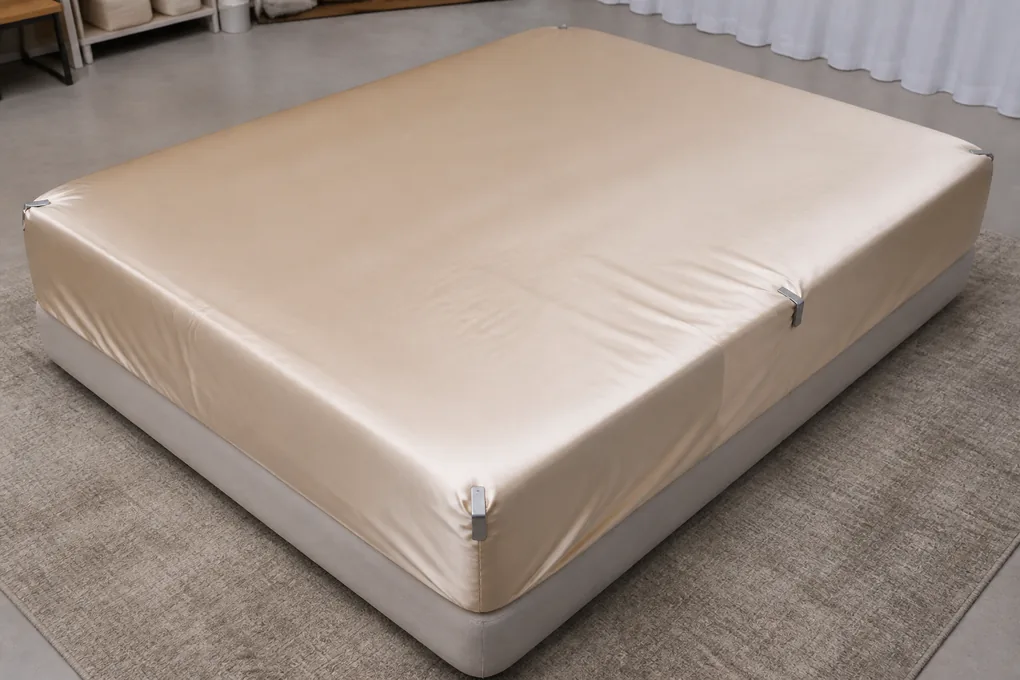
Set Product-Specific Quality Checks for Silk Fitted-Sheet Fit and Appearance
Quality planning is most helpful when it starts with the customer-visible features of the selected fitted sheet. A generic inspection paragraph cannot tell a reviewer whether the correct size row was made, whether the pocket fits the named mattress condition, whether the elastic route is where the buyer specified, whether a colorway is correctly identified, or whether the folded selling unit contains the right components. We help buyers name the physical checks that matter for their product and keep them linked to an approved sample or written specification. Measurement method, acceptance level, test procedure, and commercial commitments should be agreed for the exact product and destination; the purpose of this page is to help buyers ask the right questions before that agreement is made.
Check product identity before judging the finished article
Size row, colorway, material route, and pack configuration
The right sheet must be on the review table
Start with identity. Confirm the product row, mattress-size family, selected silk route, color or artwork reference, pocket construction, elastic coverage, label version, and pack configuration. A well-sewn sheet cannot be accepted against the wrong SKU definition. This matters when an assortment includes standard and deep versions, multiple regional sizes, or sets with similar-looking components. A clear identity record lets the buyer compare the sample with the correct brief and prevents a positive review from being attached to an adjacent variation.
Keep the identity information visible at practical points: on the sample record, in the packaging proof, and in the internal SKU map. The customer-facing name can stay simple, but sourcing and quality need enough detail to know which version is being measured and handled. This is how a buyer avoids a common B2B failure where an approved color or construction is later applied to the wrong mattress size or sales channel.
Measure and inspect under a stated product condition
Finished dimensions, pocket points, corner appearance, and installed fit
A number needs its endpoint and use context
If dimensions matter, define where and how they are measured. A fitted sheet has a top deck, pocket sides, corner shaping, elastic locations, and a folded or installed condition that can affect the observation. The buyer should identify the measuring points relevant to the selected design and agree a method with the supplier when formal tolerances are required. During sample review, compare the installed product with the nominated mattress rather than treating an empty flat measurement as the whole fit story.
Visual inspection should also be linked to the product context. Look at seams, corner behavior, surface continuity, color or print orientation, labels, and the pack. State what is observed and what action is needed. A buyer does not need to promise that every unit will look identical in every setting. The useful step is to define the selected reference and the visible conditions that must be discussed before a bulk quality plan is finalized.
Keep corrective feedback specific to the fit problem
Location, sample version, observation, and next action
Actionable notes are better than general quality language
When a review identifies an issue, note the exact location and condition. “Foot-left pocket releases on the nominated deep mattress” or “size label is hidden by the selected fold” gives a development team a real question. “Improve quality” does not. Specific feedback can be linked to a pattern change, elastic decision, packaging adjustment, or clarification request. It also helps the buyer see whether the issue belongs to one size row, one material route, or the whole construction.
Use the review record to separate an accepted feature from an unresolved one. A smooth top deck may be approved while an elastic channel still requires a revised sample. A colorway may be acceptable while the associated pack needs clearer size identification. This protects the buying team from treating a partially successful sample as a complete release. It keeps quality discussion grounded in the customer-visible article and allows commercial decisions to be made with an honest understanding of what has and has not been confirmed.
Create Fitted-Sheet Packaging and Labeling That Helps Buyers, Retailers, and Customers
A silk fitted sheet is a large, flexible product that must become a clear selling unit. The fold has to accommodate pocket bulk and elastic; the pack has to identify size and colorway; and the label or insert needs to describe the selected configuration without drowning the customer in technical language. We help buyers plan these decisions around the actual folded article. A premium pouch, sleeve, carton, or set box can all work when the product count, first-open view, protective materials, retail information, and fulfillment identity are considered together. The right pack supports the fitted sheet’s bed-level value while making the size row easy to recognize before a warehouse or customer opens it.
Prototype the fold with the selected pocket and elastic construction
Fold lines, bulky corners, protective layers, and pack dimensions
A large soft article should not be packed from an empty mock-up
Pack planning should start with a real or representative folded sheet. The pocket corners and elastic can create bulk that changes the shape of a pouch or carton, particularly for larger sizes. Decide where the fold begins, which surface should be visible first, and whether tissue, a band, an insert, or another protective layer helps maintain an orderly opening experience. The goal is not to claim transport performance without a test; it is to make sure the product and package are reviewed as one physical selling unit before artwork is finalized.
A buyer should also consider the retail channel. A folded sheet in a premium box may need a different visual hierarchy from a direct-to-consumer pouch or a hospitality replenishment package. Inspect the selected pack with the exact size row, not only the smallest sheet. This reveals whether labels, color swatches, or barcode areas remain legible and whether the largest configuration still presents the silk fabric in a considered way.
Make size and variant information easy to find
Retail name, numeric identity, colorway, barcode, and internal SKU
The pack must distinguish similar folded sheets
When fitted sheets are folded, several size rows can look nearly identical. The package should help retail staff and customers recognize the selected size, depth or fit category if applicable, colorway, and component count. Keep the customer-facing description clear and the internal identification traceable. A size name may appear prominently, while the precise regional row and barcode sit in a practical operations area. Review multiple variants side by side so the team can see whether the cues are strong enough to prevent a deep version from being picked or shipped as a standard version.
The same identity should be used across purchase records, pack artwork, e-commerce data, and sample reviews. This protects the customer experience and reduces rework when a buyer expands the range. Do not rely on a silk color alone to distinguish products; lighting and folded surfaces can make shades appear similar. A deliberate size and SKU system gives every stakeholder a stable way to refer to the complete fitted-sheet configuration.
Align label and care information with the selected construction
Component wording, care direction, and pack insert route
Product information must match the article inside
Labels and inserts should be reviewed against the selected silk route, pocket construction, elastic components, and market requirements. Avoid carrying a generic care statement from another silk product without checking whether it applies to this fitted sheet’s exact construction. Decide what information must appear on the sewn label, what belongs on the exterior pack, and what may sit on an insert or digital product page. The customer should be able to locate the practical information without the package making broader material or performance claims than the product supports.
Before release, cross-check the sample, labels, packaging copy, and retail listing. Confirm that the size, colorway, component count, and selected product wording agree. This review is especially important for sets, where a fitted-sheet label can be confused with a related pillowcase or duvet-cover claim. Accurate, simple information gives the customer confidence and gives the buyer a dependable record for future orders or channel updates.
Send a Quote-Ready Silk Fitted-Sheet RFQ That Makes Fit, Pack, and Quality Questions Comparable
A strong fitted-sheet RFQ gives a supplier enough information to understand the actual mattress interface and enough honesty to see what remains unresolved. The buyer should bring together the destination and size rows, dressed mattress measurements, intended fit, chosen pocket and elastic system, approved silk direction, color or artwork references, panel priorities, labels, pack configuration, quantity context, and the sample or commercial question that needs an answer. That detail allows us to start a focused B2B product discussion. We do not invent MOQ, cost, lead time, capacity, testing results, certification scope, or delivery commitments from a website. Those values belong to the exact product, destination, order context, and written commercial conversation.
Build one clear row for every requested fitted-sheet configuration
Market, mattress geometry, construction, materials, pack, and quantity
Comparable answers begin with comparable inputs
For each size or variant, list the destination market, retail size name, numeric mattress width, length, and dressed height, intended fit, selected pocket or elastic route, fabric direction, color or artwork, labels, packaging, and quantity. Add the sample question that remains open. A row-by-row description gives a supplier more usable fit context than a general silk-sheet price request because it identifies the variables that change the physical article. It also lets a buyer compare supplier responses without losing track of which answer belongs to which mattress profile.
If some information is still being decided, label it as an open question rather than hiding it. A brand may know the mattress size and color but still need a recommendation on pocket geometry or packaging. That is a normal stage of product development. A direct question invites a relevant response and prevents a preliminary conversation from being mistaken for a confirmed production promise. Attach reference images or diagrams with a short note about what feature they are intended to illustrate.
Name the proof your sample must provide
Fit condition, visual check, corner review, and selling-unit approval
The next sample should answer a real buying decision
Ask the sample to prove a selected decision: fit on a nominated mattress, compatibility with a named topper, the appearance of a panel layout, the behavior of a corner and elastic route, a color relationship within a bedding set, or the fold in a retail package. Keep the requested review tied to a version and a physical condition. This gives a supplier a practical target and gives the buyer a clear way to decide whether the next stage can proceed. It is more effective than asking a sample to prove an undefined claim about universal deep-pocket performance or general luxury quality.
The brief can also identify formal requirements that need written agreement later, such as a measurement method, documentation, market-specific labeling, inspection plan, or testing question. State the priority and destination, then keep the requirement distinct from a statement already confirmed by a sample. That distinction protects the buyer and helps all parties see what needs to be agreed before retail copy or bulk release is considered.
Use the RFQ to open a focused product-development conversation
Known requirements, unresolved decisions, and commercial next step
A clear brief keeps the first supplier response useful
Finish by naming the product issue that is blocking progress. It may be a mattress profile, a pocket-depth decision, elastic coverage, panel layout, corner finish, fit-range wording, a bedding-set pack, or the evidence required for a market. Add the responsible buyer contact, the target decision date if known, and the commercial context that can be shared. This gives us a place to begin without forcing the team to pretend every production detail is final. The quality of the first conversation improves when the real obstacle is visible.
We will use the information you provide to discuss the selected silk fitted-sheet configuration in B2B terms. We will not make unsupported claims about factory capacity, pricing, lead time, customer results, certification, or performance. The goal is a disciplined, buyer-led product conversation that lets your team move into sample planning, supplier comparison, and the next written decision with clear priorities.

Silk Fitted-Sheet Buying Questions
Why is mattress depth alone not enough for a fitted-sheet brief?
The selected fit also depends on width, length, dressed height, topper or protector condition, corner shape, under-mattress return, and the chosen elastic route.
What should a B2B buyer include in a silk fitted-sheet RFQ?
Include destination and size rows, numeric mattress dimensions, the dressed-bed condition, agreed pocket style, elastic route, and silk construction, colors or artwork, packaging, quantity context, and the sample decision still open.
What should a fitted-sheet sample review check?
Review the selected sheet on the nominated mattress condition for top-deck appearance, all four corners, lower return, elastic position, size identity, labels, fold, and the relevant bedding-set or pack presentation.